
The Lost Art of Watching Someone Watch Something
Confession: I once worked as a “social media consultant.” I was indirectly fired for laughing at clients who thought that was a real job. In truth, I only landed it because, as the company’s business analyst, I was the best writer in a 12-person shop. When the actual consultant quit, they threw me in the chair.
So for six glorious months, I ghostwrote a blog about underground utility detection. Yes, riveting essays on “Call Before You Dig!” and “The Sexy World of Underground … Cables?” All in the name of proving that a company charging for their use of metal detectors was somehow an industry thought leader. Once a month, I cranked out a report “proving” how much web traffic we’d earned, thereby justifying my paycheck. Laugh all you want, but I now know more about GPR (that’s Ground-Penetrating Radar, for you uneducated) than is healthy, and I can tell you in nauseating detail why construction at 96th and Allisonville was three months late in 2014.
Outside that glamorous gig, I’ve spent 15 years running a basement indie radio station that only plays local musicians you’ve never heard of. And despite my best efforts to avoid mainstream attention, my listenership occasionally edges out actual terrestrial stations (usually the business channel and a few of the 60 low-power stations that play God’s greatest hits). I’ve hosted charity events, been nominated for “best radio station” and “best radio personality,” and even won a Cultural Visionary Award — a lovely crystal hockey puck that hangs on my wall. Not exactly “big time,” but I’m proud of my weird little niche. Still, I sometimes think that if I’d just uploaded videos of a technician in a low-cut blouse reacting to radar scans, maybe we’d have been billionaires by now.
I don’t get it. Our generation gave Millennials and Gen Z the most powerful publishing platform in history. They have the ability to broadcast their art, message, or manifesto to the world without gatekeepers, agents, or the studio system, and for little to no cost. Shakespeare would’ve killed for YouTube; Hendrix would’ve killed on YouTube, but what do they do with this awesome power? Record themselves watching other people’s art. Some people create art. Some people consume it. Some people try to create art out of consuming art. Meta, sure. But could you imagine if Shakespeare’s greatest contribution had been a playlist of him fake-laughing at Marlowe’s plays?
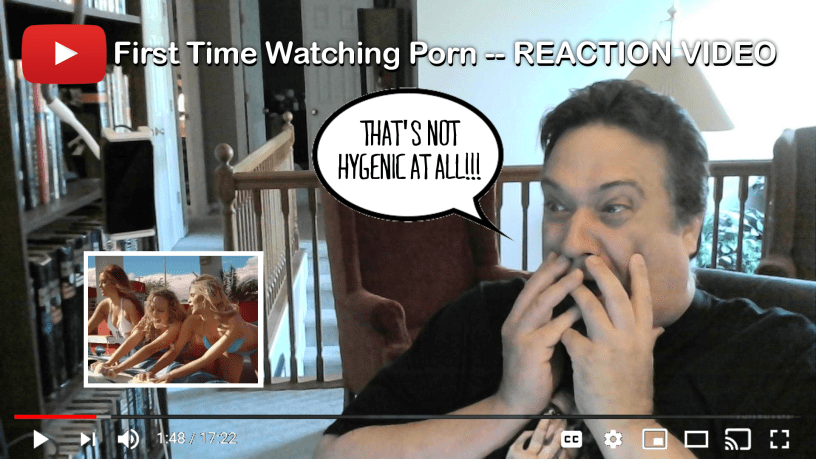
I first stumbled onto reaction videos a few months ago. (They’ve been around for years, but I’m terminally unhip.) I don’t know what I asked for, or what I expected when I clicked on it, but I got some 20-something girl with far too much cleavage and gigantic eyelashes and lips staring into her webcam as if she just discovered humans invented light. This was followed by, what I can only assume was, two hours of the unfiltered majesty of watching another mammal blink, nod, and occasionally shout “Oh, no he didn’t!” while a cinematic classic played at one-quarter volume in a little postage stamp square in the corner. It’s like MST3K, but if the robots were lobotomized and the jokes replaced with melancholy sighs.
This raised several questions:
- Who films themselves watching a movie?
- Who spends two hours watching someone else watch a movie?
- What cave do you live in where you’ve reached adulthood without seeing Star Wars and you call yourself a geek?
- And how can you go outside after you just gave the worst acting performance ever? “OMG, guys, I had no idea Vader was Luke’s dad!!”
Sorry, your geek card is revoked. Also, your internet privileges. Oh, and you’re not as hot as you think you are. Might want to rethink that channel name.
To make matters worse, her channel included “first time” viewings of the other Star Wars films, Lord of the Rings, and The Matrix trilogy. Meanwhile, 20 other self-described “hot geek girls” were doing the exact same thing. Is there some secret convent of amnesiac girls with ill-fitting t-shirts who’ve avoided pop culture for 25 years?
Sadly, because I watched 90 seconds of one of these videos, YouTube immediately decided this was how I like to get my freak on. Now my feed has become:
- “First time hearing Dark Side of the Moon.”
- “First time hearing In the Air Tonight.”
- “First time playing Call of Duty.”
- “First time eating Lou Malnati’s Pizza.”
- “First time watching another YouTuber’s reaction video because I ran out of ideas.”
- And my personal favorite: “Reacting to my old reaction videos.” (Dead serious. This exists!)
Most of these masterpieces are 30–60 minutes long. Sometimes it’s the whole movie, unedited. Then comes the “expert” review of films that were already dissected decades ago by people who didn’t confuse plot twists with oxygen. Thanks, oh great Roger Ebert of the ring light, your nuanced insights on why Empire Strikes Back was a good movie are about as relevant as your memoirs on Hobbes and Locke’s “Social Contract Theory.”
And the kicker? The first ten minutes are always the same: “Don’t forget to smash that like button, subscribe, ring the bell, tell your grandma, tattoo my channel name on your cat. Shoutout to my Patreon, shoutout to my dog’s Instagram, link in the description for this custom T-shirt of me staring at the void.” This is all the YouTube equivalent of voicemail greetings that remind you to leave a message after the beep, as though “beep → talk” is beyond human comprehension. Look, I’m not mad at the reactors. It’s just selfies with extra steps. We’ve all been guilty of self-absorbed narcissism. The real culprits are the millions of viewers who fuel this madness.
Apparently, people find endless entertainment in watching a (possibly underage) girl with improbable cleavage fake-laugh and shriek at things we can’t even see. And yes, these “reaction actors” make thousands a month from ads and merch celebrating their uncanny ability to overreact on cue. So no, don’t explain it to me. I get how it works: supply, demand, and cleavage. I just mourn for talent and content.
