

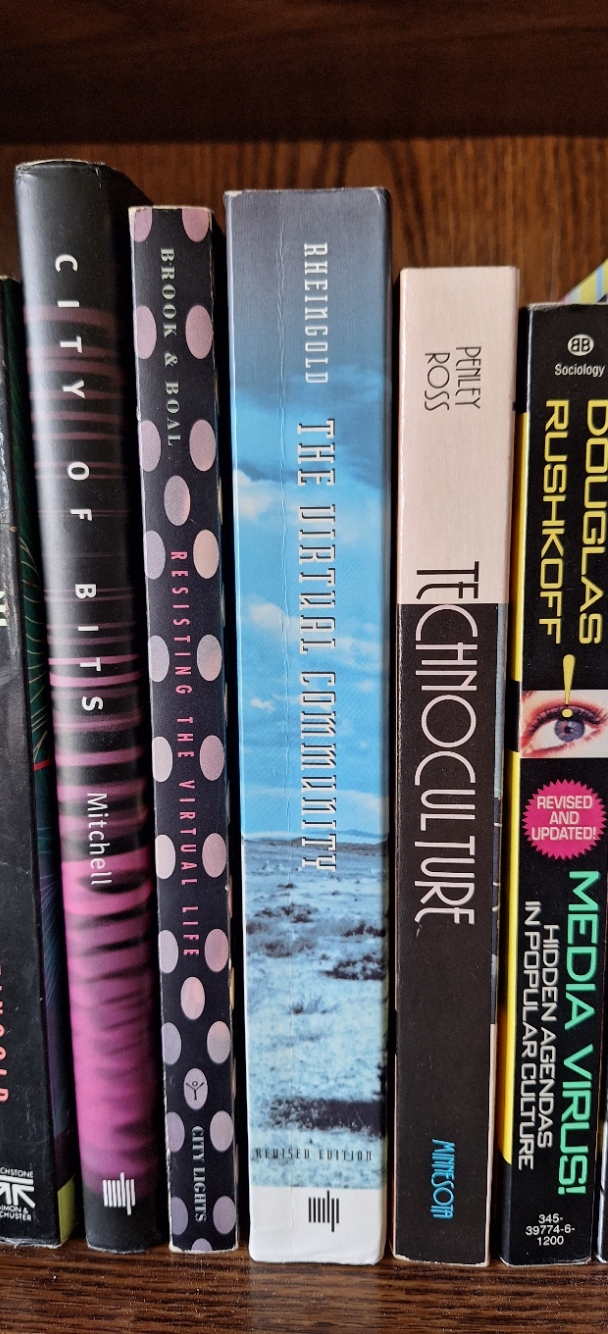
 Lately, I’ve been ping-ponging between “earnest amateur writing blog” and “cyberculture/technoethics doomscroll.” This one will be the latter. Let’s talk about one of my heroes, Howard Rheingold, who got left out of my prior post because his book was on the wrong shelf and, like an infant, I have object permanence issues. (Sorry, sir, I’ve returned you to your rightful place in the pantheon.) He’s particularly appropriate here because he conveniently stitches together two of my recent obsessions: a) missing my small, Dunbar-aligned tribe of like-minded misfits while the lowest-common-denominator crowds set everything on fire, and b) the increasingly plausible reality of the Dead Internet.
Flash back to the Mosaic era, when CD-ROMs were the futuristic tech you wished you could afford. Rheingold wrote “The Virtual Community: Homesteading on the Electronic Frontier.” In it, he somewhat optimistically describes how a “small distributed peer group” of geeks basically reinvented civilization on what was, functionally, a fancy BBS. Think “Lord of the Flies” meets “Tron,” adapted by Louis L’Amour, with a Whole Earth Catalog centerfold. He believed people would build digital frontier towns. These were quirky, self-governing spaces where free thinking, long-form conversation, and civic virtue would tame the wilds of cyberspace. How adorable. Cue the fiddle music and a drone shot over prairie skies.
To be fair, that wasn’t a ridiculous take at the time. I bought in. My professors bought in. In Rheingold’s telling, The WELL was a saloon of intellectuals, activists, artists, and futurists trading essays and expertise at a deliberate, civilized pace. You know, just like Twitter or modern social media, except it’d done in semi-witty one-liners, rage bait, and “wait ’til the end pleas on dubiously staged 3-camera videos proporting to be candid cell phone footage.” It’s not that communities vanished; it’s that everyone’s now a religio-political polymath with “inside info” and an irrefutable take (Yeah, none of us took Turkel seriously). The frontier towns exist, but they’re mostly toxic fandoms, parasocial influencer cults, and rage-optimized word salad designed to energize the comments and bump up somebody’s “social clout” so they can score a more lucrative sponsorship for their TicTac channel.
Rheingold hoped isolated virtual communities would rekindle democratic participation, let people route around Rushkoff’s Media Virus and Debord’s simulation and build grassroot movements free of corporate puppeteering. Okay, we did get that … if by “that” you mean how, in between crypto ads and thirst-trap pop-ups, Grandpa got radicalized by a QAnon video on YouTube and now refuses to order from Papa John’s up the street because he’s convinced it’s a secret Democrat child-trafficking hub where the mayor drinks the blood of babies. Turns out democracy dies not in darkness, but in autoplay.
Where Rheingold imagined online spaces that nurtured activism and meaningful change, we got “Like” and “Share” as the modern sit-in and hunger strike, with hashtags substituting for rallying cries on signboards. No, online activism rarely topples corrupt regimes or ends injustice, but it can get your favorite show canceled for trying to make a cultural point, and it did successfully preserve the Cracker Barrel logo in its original, divinely-ordained font. The revolution may yet be televised … er … live-streamed … but rest assured the platform will monetize it.
Okay, enough “Old Man Yells at Clouds from the Cloud.” If the Internet’s mostly dead, but most of us creative types still need a cheap and effective way to promote our art, and yes, the charlatan “Internet Marketers” still need a way to suck money from the corporate teat because they don’t have any actual creativity and should be on Adams’s B-Ark, then maybe there’s an opportunity to bring back something of Rheingold’s frontier town, only this time, make it bot-free, hype-resistant, and weird in just the right way. Because the metaphor is fun, let’s go full Western mode and not register a shiny new domain and spin up a pristine, untouched virtual server. Let’s reclaim a ghost town. That’s right, I’m saying we should resurrect our MySpace pages or GeoCities sites and declare ourselves the new “Mayor of Deadsite, USA.” Throw out the glitcy Flash widgets, tear down the old ad banners, and just move on in. Forget “responsive design” and JavaScript frameworks. We’re old school! Repurpose GIFs into load-bearing lumber. Fire up those MIDI files to ward off Gen-Z influencers with your one true vision of “good music.” Turn the old Guestbook into your front porch and hand out metaphorical lemonade to passersby.
Of course, pioneers faced bandits, coyotes, and carpetbaggers. You’ll face spambots, AI infiltrators, and TicTac experts promising to “grow your brand” with a series of clickbait camgirl pictures and a coupon code. You could deploy CAPTCHA, but who wants to click on nine pictures of stoplights across three screens, just leave a note that says, “hi.” Instead, be the Marshal Dillon for Deadsite as well as the mayor. Make the well-being of the townsfolk your personal mission, never to be automated. Keep that 12-gauge loaded with rock salt handy and don’t be afraid to use it on troublemakers … that is to say, liberally use the “Ban Button.” If Gunsmoke taught us anything, it’s that swift justice beats three weeks of “constructive dialog” with an obvious troublemaker who gets the townfolk riled up, and it’s a lot more exciting to watch at 6PM.
On the frontier, you grew crops. In Deadsite, you grow original human content, which is rarer than Texas tea and twice as flammable. Yes, the soil is poisoned with AI slop, so the first few harvests will be rough. Plant essays. Fertilize with wit. Water with sarcasm. It makes them tastier. Rotate crops between long-form rants, bizarre personal anecdotes, and reviews of obscure music only you know about and nobody requested (or whatever your personal jam is, that’s just my example). Toss in the occasional meme to keep the soil from crusting. Don’t fret over the TL;DR crowd. They aren’t your kin. They’re tourists who complain the saloon doesn’t serve decent cappuccino.
If one of them does take up residence, smile and let them. The WELL thrived because it embraced eccentrics. Your ghost-town-turned-hamlet will too. On today’s Internet, your neighbors won’t be thoughtful poets and philosopher-kings. Heck, you’re more likely to get two conspiracy hobbyists, a crypto evangelist, and one guy role-playing a transgendered self-aware toaster. That’s fine. Community isn’t agreement. Community is arguing in the comments until you accidentally become friends. That’s the frontier spirit we forgot about in the 21st century.
Rheingold dreamed of digital town halls. You’ll probably host something more like a digital HOA meeting where people debate whether a “TRON: Ares” reference belongs in the MCU thread on the grounds that they’re both Disney properties. Doesn’t matter, delude yourself and your group with the idea that it’s all working to plan. Sure, the Internet is still a shambling zombie wearing a “HotGeekGirl Reacts!” merch t-shirt and testing your electric fences, but pioneers survived on delusion at least as much as grit. Pretend your three regular commenters are the sparks of a renaissance, because one decent human interaction amid the bot zombies and algorithms is a win worth a yeee-hah.
Rheingold wanted homesteads. We let the wildlife take over and blight the cities. Maybe the next phase isn’t carving farms from new, untouched wilderness. Maybe it’s chiseling meaning out of ruins. You don’t build on virgin land anymore; you build on the bones of your ancestors and your past lives. It won’t perfectly match Rheingold’s vision, but then frontier life was never meant to be comfortable. It was meant to be real.
