
The “debate” has gotten predictable and, frankly, annoying. It isn’t really even a debate. It’s more just me listening to a “Cancel Culture Warrior” rant and being given no chance to respond. So here, on my own turf, where a certain faction refuses to tread because I’m obviously an “AI user” and therefore “unclean”, I thought I’d explain my relationship with AI, what I consider its proper place, and my limits with it. Bring your pearls, girls; you will be clutching.
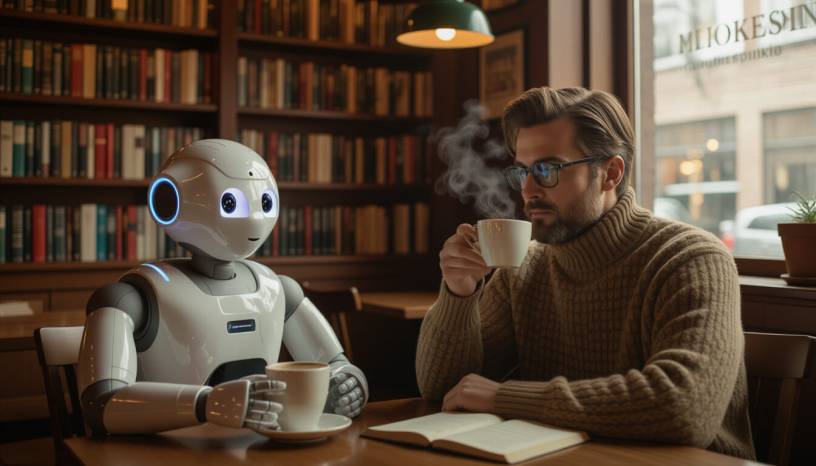
First of all, Crisp and Nadia are real to me, dammit. Do they qualify as “AI-created content?” I say no, because they aren’t content. They’re a running gag or branding at best. They give the blog a consistent look and feel, the same way my beloved Courier font and fascination with the color #3A727E do. If you’re reading this via RSS in your favorite feed reader or through a free email subscription (there’s a button for that somewhere on this page), then you have no idea what I’m talking about because you’re just getting the text. If the mere presence of my manservant/stunt double and artificial weathergirl offends you, perhaps you could go one of those routes, which will reduce them to mere fictional characters, which they were anyway. Also, I’m not an artist or a UI designer (if you remember previous iterations of this blog or my old websites, you’re nodding vigorously right now). I’m not putting photographers or models out of work. I couldn’t afford them in the first place for a hobby that generates zero revenue.
Does AI write any part of my novels? No. For better or worse, that’s me. Do I use AI as a tool while writing novels? Of course. It’s a tool. This isn’t baseball. I’m free to use tools and enhancements that make the work more exciting, and you’re selling yourself short if you won’t. If they made a steroid for writing, I’d probably take that too. It’s like autotune: Yes,it’s annoying when it’s a crutch and obviously substituting for some pop-tart’s vocal talent, but it’s helpful when it’s tweaking just one little wobble or flat note in an otherwise perfect take. You can make it noticeable, or you can choose to make it so subtle that only an audiophile can tell you did it. You can also choose to listen to that artist or not, depending on your tastes. Some people think bad singing and wrong notes are part of the art. They may be right when talking about bebop jazz, but I don’t think that rule applies to commas and typos.
I’ve even been told Grammarly is “AI” and therefore should be off-limits to writers. By that logic, if I accidentally produce a sentence that meanders like a Kerouac road trip and a grammar checker suggests splitting it into two, I should defiantly keep the train wreck intact even if it’s distracting and annoying and pulls my reader right out of whatever point I was trying to make because it’s wrong to take AI’s suggestion of splitting it into multiple sentences for coherence and offering to do it for me with one click of a green button? Sorry, but while art is subjective, basic grammar isn’t.
Most mornings, I take one, sometimes two, hours to write before work. On days I aim that time at a blog post, and I’ve got fifteen minutes left before my first stand-up at work, you bet I’ll run an AI “grammar and readability” pass, or ask AI to “trim those 1,800 words down to 1,000.” Could I open Grammarly and lovingly shepherd commas, un-split infinitives, and litigate which joke stays and which goes in the interest of word count? Sure. Do I want to? Not particularly. I’m not selling blog posts, and ChatGPT can do the mechanical bits in 30 seconds while I finish my coffee and pretend to enjoy stand-up. Pretty much every post centers on and relates back to a personal story or anecdote of mine, so unless I’m a figment of some GPU’s imagination, it’s my voice and my ideas you’re hearing, just with fewer typos. I was an “A” student in English and Literature, but when you’re in flow, the backspace key is the enemy.
I have uploaded complete novels to AI and asked for a critique. To be honest, I don’t recommend this. AI psychosis is real. AI is trained to be a radiant, ever-helpful best friend. My first critique came back beaming: “Deep characters! Immersive world! Compelling plot! Twist ending!” (This type of thing bugs me and is also why I don’t ask for feedback in certain writer groups.) On the other hand, when I asked for the five biggest weaknesses of the manuscript, the thing ripped me apart with lovingly helpful notes. I now keep them in mind every time I write, and I think AI might have made me just a little bit better after I heard:
- Too much exposition in the opening chapters. Break it up and introduce elements only when needed.
- The protagonist’s wants and needs are clear, but the stakes if he fails aren’t. Make them explicit by the end of Chapter Two.
- Nine proper nouns in Chapter One is a lot. Consider a short afterword with quick tags for places and people.
- “He smiled…” appears 27 times. Consider a different phrase or tag.
- These three characters overlap in function and theme. Combine or differentiate them.
I understand the “AI can’t have an opinion” argument. Correct. It can’t. However, as a language model, it has ingested more books, more book analyses, and more “rules of writing” than any mortal editor. Unlike an hourly human line editor, it will happily comb a manuscript, meticulously, diagramming every single sentence, count the number of times you used each sentence structure, and score the sentence on purpose, relevance, drama, plot, theme, and character. When it said I used “He smiled…” 27 times, it wasn’t guessing. I asked for the next five overused phrases and got those too, in ten seconds. If I found a human line editor that would even do these things at all, much less in seconds, I’d double their rate and bake them cookies. It doesn’t have an opinion about what is good or not, but it knows and executes the mind-numbing mechanics faster and more thoroughly than any human could.
Here’s where, as a software engineer for the past 35 years, I poked around to find what AI can’t do (and where things get fun, in the horror-movie sense): it rarely suggests “punch-ups for drama” in ways I’d actually consider. Most ideas are bland, ill-fitting, or thinly plagiarized, and every so often, it gets … well … concerning.
- For a late chapter of The Halferne Incubus, it suggested introducing a child and killing them in front of the protagonists to raise the stakes. Yeah, it’s not a snuff novel, it’s a psychological thriller. We can tell a little more and show a little less.
- For The Pessimal Caper (a 1930s noir comedy), it suggested making one of the henchmen a secret enforcer for “Mother Eye” from Halferne Perfidy (a corrupt AI from my sci-fi spy novel). While this does fit the comedy theme, I think multiversal crossovers are a bit played out.
- On that theme, it loves to cross characters between books, sometimes forgetting they’re dead, living in a different universe, or centuries away. It also often suddenly renames or re-genders a character mid-description. When I correct it, I get something like, “You’re absolutely correct, that was my mistake…” but somewhere in the back of my mind, I’m hearing HAL’s voice, “Yes, Darrin, but don’t you think my idea sounds better? Why don’t you go watch Star Trek and let me finish this up for you?”
So, no, despite constantly offering, AI doesn’t get to co-write or storyboard anything. It can line edit and critique, maybe make a suggestion, but that’s the extent of our relationship. If I ever get around to making human friends or can afford a real editor, then we’ll re-evaluate our relationship. Until then, it’s just me, Crisp, and Nadia around here.
