
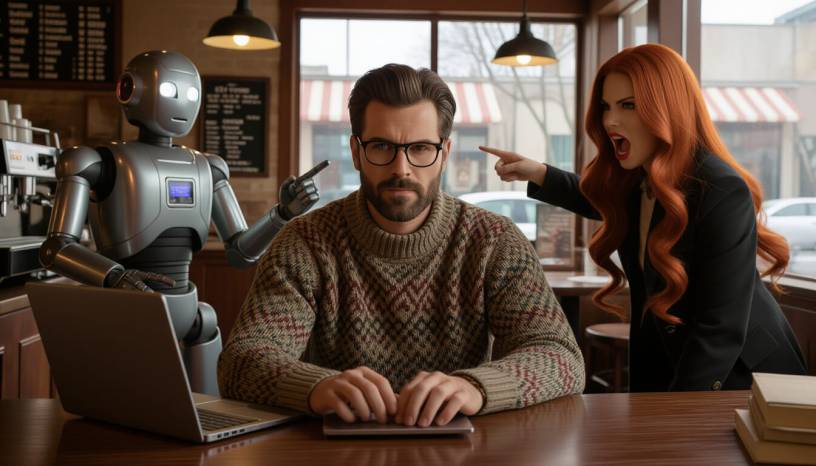
Lately, I’ve been getting editing notes from an algorithm, not a person, an algorithm. I’ve been playing around with ProWritingAid.com. Since they’re supporting my bad habits by sponsoring Novel November, I thought I’d be nice and support them back. I’m starting to see a pattern here, though. Apparently, everything I write needs to be trimmed by 10-15%. Fair, I do tend to over-describe, which comes from thirteen years of gathering software requirements. The one that really points out my argument that AI will never make a good editor is its insistence that I delete a big chunk of Chapter One because “it doesn’t advance the plot.”
My opening scene follows the Save the Cat beat of showing my protagonist in his element, establishing his skills, and demonstrating the core of his humanity. Unfortunately, however, it fails to meet some algorithm’s sacred formula that “every sentence must move the story forward” and “there must be dramatic tension and one action beat within 700 words” or whatever it said. It was right about the stacked adverbs and the awkward sentence, but I know it’s dead wrong on this, so I quit reading.
Okay, not entirely fair, the machine isn’t “technically” wrong, exactly. Nothing explodes. No one betrays anyone. There’s just atmosphere and introspection. The point, though, is to show how this character acts and feels when he’s still safe in his element, and right before I yank that rug out from under him and start dismantling everything he believes about himself in Chapter Two. Of course, the AI can’t see the rug coming; it can’t see that I’m writing a scene that will be mirrored at the beginning of each act, and is crucial to the denouement. AI only knows the rules. It doesn’t understand that sometimes the setup is the story.
Which brings me to my ongoing feud with writing advice in general, whether from humans or AI. There’s a special place in hell for people who tell other people how to write. It’s not that it’s all wrong. It’s that it’s smugly right yet completely unhelpful. It exists to make you feel like your natural creative instincts are mistakes waiting for correction.
The worst part? The same people dispensing these rules will turn around and worship at the altar of an author who gleefully violates every single one of them. Apparently, rules apply only to us mere mortals, and they don’t count if your book that ignores them sells ten thousand copies.
Case in point: I’m currently reading an Eric Van Lustbader spy thriller. Chapter One: Two guys sit around talking about music, wine, and newspapers. That’s it. No explosions, no car chases, no assassinations, not even a glimmer of plot, unless the theme of the novel is being tediously civilized in your discussion of wine tannins. I don’t know who these guys are. I don’t know why they matter. I don’t know what country I’m in, but one guy has a vaguely Russian name. That’s what makes this all fascinating to me. The dialogue has that dry tension and smug superiority that suggests these guys are probably the villain and henchman of the story, at least they seem like the type to have multiple expensive pens and a basement full of secrets.
If I, a guy who has not sold a best seller yet, turned in this same scene to a YouTube “writing coach,” I’d be told to burn it immediately. “Where’s your hook?” “Introduce your theme beat by the third page!” “Establish conflict and stakes by paragraph two!” “Your protagonist’s flaw should be clear by the end of the chapter!” Meanwhile, Lustbader’s out here opening with two mysterious men agreeing that printed newspapers are better than online newspapers because of the placement of the images (dead serious, that’s what I’ve gotten from this book so far). I still don’t even know who the main character is, and I don’t care, because I trust ol’ Eric Van to make it good later.
All of this writing advice does is autotune personal nuance into a formula. “Save the Cat” has you diagramming your plot structure like a tax return, but the creative process isn’t paint-by-numbers. It’s jazz. Sometimes it starts with a long suspended cord and a cymbal swell, and melody doesn’t show up until bar twelve. Sometimes the point is the atmosphere, not the plot.
Moby-Dick is my go-to example. Look, not a huge fan of it, I’m more of an “Old Man and the Sea” guy, but it seems to me, if Herman Melville were workshopping Moby Dick today, he’d be bullied into deleting those 300 pages of whale taxonomy for “pacing.” Thirty percent of that book is world-building so granular it borders on academic torture, and it takes place on Earth! The rules say “stick to your protagonist.” Melville says, “Sure, but first let me classify every creature in the ocean while I dismantle Western theology.” The part your writing coach would call “slow” is where the soul of that book actually lives.
A particular favorite of mine is Martin Eden. Jack London wrote the ultimate anti-arc. The story begins with an uneducated sailor clawing his way toward intellectual greatness and ends with him realizing the ladder was leaning against the wrong wall the entire time. There’s no redemptive ending, no lesson learned, no triumphant third-act reversal. Just exhaustion and suicide. It’s the story of ambition as slow-acting poison that London plays out in agonizing real time. Every “how-to” guide would demand you “Cut the philosophy,” “Make Ruth more proactive,” “Give readers closure.” That’s why the book works. Martin Eden doesn’t teach; it dismantles.
Finally, Kerouac’s The Dharma Bums subverts the rules of a good book in the opposite direction. Seriously, this book has no plot, no central conflict, and no climax. Half of it is people drinking cheap wine and talking about enlightenment. Every editor alive would scribble “nothing happens here” in the margins of just about every page, but that’s the idea. The book moves like the mountain hikes it describes — breathing in, breathing out, wandering nowhere in particular. It doesn’t build; it drifts, like Ray Smith. It’s not his journey, it’s his heartbeat.
Writing advice should be teaching you craft, but the stuff I’m seeing on social media feels like some semi-pro writer trying to gaslight new writers by instilling fear and awe in exchange for likes and subscribes. The result is you stop experimenting because who wants to get tagged as a newbie? You cut the scene you love because someone on Reddit said it’s “too indulgent.” You sand down everything edgy until your story is safe, transparent, and lines up with the algorithm perfectly. Then you wonder why it feels hollow.
So yes, I will listen to some YouTuber’s condescending writing advice, I will endure ProWritingTools throwing up little red warning boxes and telling me this scene “doesn’t serve the plot” when it hasn’t seen what I’m planning to do with that scene. I reserve the right to tell you you’re full of it, though, especially when I can cite some of my favorite books that do exactly what you tell me not to. It’s not because I think you’re wrong, but because you’re patronizing, homogenizing, and above all, boring. If I wanted to be told how to do my job by someone with less imagination than me, I’d go back to being a business analyst. (At least there, I get a paycheck to go with the abuse.)
