
Sorry, angry rant from me today.
A good friend of mine lost his job yesterday. Not because he was bad at it, but in my opinion, because he was too good at it. He was a business analyst, and he swears he will never return to BA work. He was flat-out told, “Well, we have an AI solution that can do your job better.” This is the first time I’ve had first-hand experience with this, but we all saw it coming years ago. I just thought programmers would be the first with their backs against the wall.
I feel his pain. I did that job for 13 years, and after getting laid off 5 times in 4 years, I also swore I’d never go back. Sadly, I’ve been a software engineer, a network admin, a project manager, a business owner, and a few other things in my life, and, tragically, business analyst was really my favorite job.
I didn’t love the glass ceiling of subpar pay at the top of the position, and I certainly didn’t appreciate being the first one let go during a downsizing because the bean counters didn’t understand what I did. I loved controlling the big-picture view of projects, using decades of experience to predict when and where things would go off the rails and plan around it, and proving to a boardroom full of rich guys that “this colorful graph shows you aren’t as clever as you think you are.” Mind you, it was also lovely to get a pat on the back from an architect or CIO saying the project would never have been successful if I hadn’t pulled the technical requirements out of people’s [heads] and explained the data in [boardroom-readable] terms.
Think about it. It was the perfect job for me: brain of a software engineer, heart of a fiction writer (back in the dot-com days, half of what I wrote about never got built, so I count it as words on my sci-fi resume), and carte blanche to communicate findings in any means possible, including more than once, sarcasm. I’m shocked, but not surprised, bean counters think AI can do the BA job better. Heck, we now have declarative programming languages where anyone can simply describe what they want, and the computer spits it out perfectly the very first time. (That last bit was a joke.)
If that works for you, great. In my opinion, it’s just data without a story, however. It’s pointless at best and dangerous at worst. I see the appeal. Questions make people uncomfortable. Questions take time, and time costs money. Management doesn’t have time or money for questions, and the AI analyst doesn’t ask why. The AI prints a graph and creates a dashboard in 30 seconds instead of three hours, which is apparently cost justification. People want instant gratification and numbers where they should be, not a strategy or vision that takes effort.
Business analysts were a rare breed even back in “my day.” I moved from engineer to business analyst because we couldn’t find someone who knew what he was talking about or who he was talking to, so I took on the role myself. BA’s are a different mindset. They’re translators between the living and the spreadsheets. They take a data set and dig up the story behind it. They connect a column of numbers to the humans who made it happen. They make data make sense, but they can’t actually change the data … so they’re expendable.
A good BA can translate your chaos into “actionable insights,” however. They see every metric as a cry for help from a human or mechanical component. They know every dip and spike is a story to be told, and they will find that story if asked. Then management will condense it into a bullet point on someone’s slide deck, which will be shown at an “all-hands” meeting next week. It hurts. A good BA knows numbers have souls, while management believes souls can be replaced by algorithms and numbers can be moved by changing the scale of the graph and not worrying about the small problems.
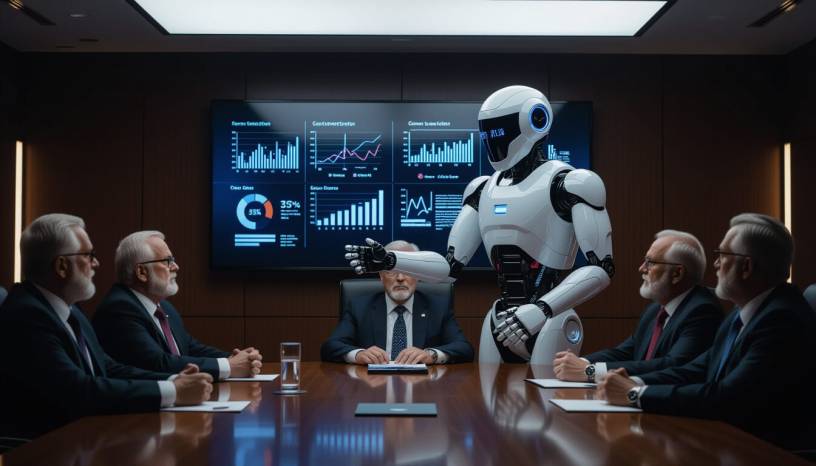
Because of this, yesterday morning, when the VP of Optimization (formerly, “Human Resources,” but that term’s really “old school/sentimental”) declared, “We’re going with an AI analyst! It does everything you do, only faster, cheaper, and without all that sarcasm,” my friend packed up his desk quietly and left. He knows exactly how that particular pivot table works, so he’s not going to argue with the spreadsheet.
Now, machines are going to do his job. They won’t interpret, they’ll optimize. They won’t care why the data exists; they’ll change the measurements to make the numbers look better. They aren’t trained to solve problems. They’re trained to make a graph appear more optimistic. We’re in an era of aesthetic analytics — the numbers look great, so everything must be OK.
There is an expression: “It’s not the coffee, it’s the culture.” Now, there’s a dashboard that tracks both, but as long as coffee satisfaction is up 8%, then… mission accomplished. Management is praised. It isn’t so much that people at the top have stopped listening; it’s that they’re convinced data is listening to them. If you hear someone say, “The data supports this decision,” then you should have warning bells ringing in your ears, because that’s corporate code for, “We’ve already made up our minds, and here’s a manipulated chart to prove it … data not shown to scale.”
Data makes a great alibi for any decision because it’s objective, impersonal, and unquestionable. If AI says business is trending upward, then it must be true. Never mind empty desks, grumbles in private Teams chats, and general lack of engagement from the minions, we can just get better coffee and nudge those “job satisfaction” numbers back up. What matters is the dashboard is green.
“Green” is rather binary, though. If you think about it, “green” just says “above what we said was our low bar.” It does’t necessarily mean “good.” Please don’t focus on solutions; focus on the root of the problem, and let the solutions present themselves.
Next week, after my friend has hit the unemployment line, I’m sure nothing at his former employer will change, at least not in ways anyone will notice. Dashboards will continue to update. Reports will continue to generate. Middle management will continue to congratulate themselves on their “data-driven efficiency.” I’ll be AI will be spitting out insights, forecasts, and executive summaries faster than ever.
Let’s just hope nobody asks where the numbers came from. Let’s hope no one asks, “Does this actually make sense?” or “Is this the story we want to tell about ourselves?” The numbers speak for themselves — and they’re fluent in corporate delusion.
AI is never going to be better than a human BA. It’s just going to be cheaper, but to management, cheaper beats better. That’s because management doesn’t wasnt to solve problems. Management wants to get stuff out with minimal expense. We don’t ask why anymore. We ask, ‘How quickly can you fix it?‘ This applies to both the product and the product stats, which are easier to fix and/or manipulate. The machines can do that in seconds. Humans take too long, and worse, they care about the numbers.
So congratulations. Your system is efficient. Your graphs are gorgeous, and your story is gone. Good luck.
