
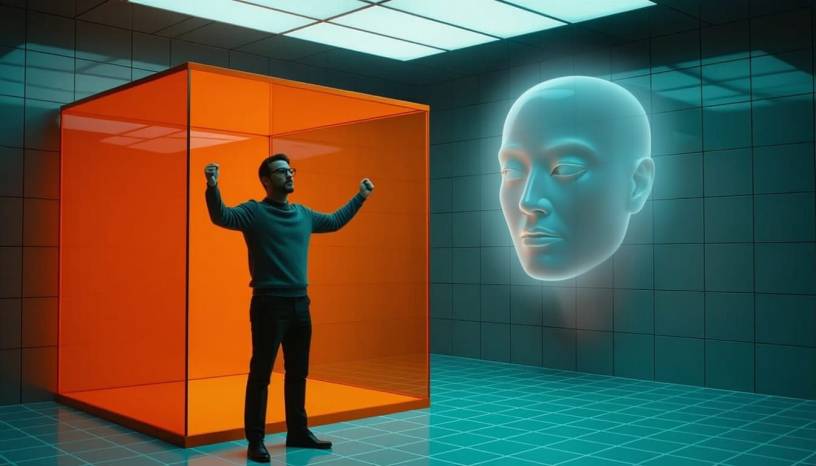
I finished my latest novel. No, not that one. Not the heist novel that I said I was going to finish. No, I finished the first passable draft of the “hard sf/philosophy” novel that I left three-quarters finished two years ago, The Halferne Expedition. I know, I said I’d have both done back in November. I even wrote this post back in late October, anticipating a clean ending by November 9th, followed by a second announcement at the end of the month about The Halferne Deception getting done, and a potential hat trick, with The Pessimal Refrain, my rockumentary parody, being ready for peers to read by the end of the year.

To give the proper background and insight into how my brain works, this is the novel I started back in NaNoWriMo 2023, while on a tropical resort holiday. I wrote the first 13 chapters and 50K words that month, which was technically all of acts 1 and 2. Act 3 was done in outline. It should have been a slam dunk. The problem was that I had a cool, light, pulp SF story with some deep thoughts about the nature of intelligence and how we personify our own psychology onto artificial intelligence, where it has no business being. Then, after getting into a really deep philosophy debate with a vacationing couple from Vermont about Thomistic theory in a hot tub one night, I realized we’ve been thinking about thinking for millennia longer than we’ve had psychology. This led to the same ending, but with a completely different context, requiring rewrites to acts 1 and 2. Also, I had made a couple of canon tweaks that necessitated touch-ups to The Halferne Perfidy and The Halferne Incubus. Those touch-ups turned to full-on draft revisions (as long as you’re in there, might as well change the spark plugs, after all…), and the next thing you know, we’re prepping for NaNo 2024 already, and I was excited to get started on The Halferne Deception.
Yes, it’s me. The same thing happened again with Deception a year later. Hey, at least I’m consistent, and these multiple drafts are constantly improving, right?!
With NaNo no longer a thing in 2025, I dedicated that month to writing the last act of Expedition and the second half of Deception. Cut to December 2025, two more significant plot changes later, and I finally got Expedition done, painfully, page by page, and now it exists. A quick run-through, and a fourth rewrite of Act 3, and it’s ready to share as a “mostly-solid draft.”
So what did I make? Honestly, I’m not sure. Like all my stuff, it’s a hodgepodge of genres and ideas I combined into a stew, hoping to make it feel original. Here’s the genesis, the middle bits, and a story of pain …
… and yes, this one was painful.
The Magic Box Problem
Arthur C. Clarke is my favorite sci-fi author. I love 2001: A Space Odyssey. The monolith is one of the greatest images in science fiction. It’s minimal, terrifying, elegant, and the perfect symbol of the unknown: a black rectangle that makes you feel small without even trying. On the other hand, I’ve got a bit of a beef with it because, after thirty years and three very solid sequels (and a separate “orthoquel trilogy” that may or may not help you crack the mystery), it’s still just a magic box.
After four (or seven) books, we’re still reading “a weird black rectangle did it?!”
Rendezvous with Rama, on the other hand, is my favorite sci-fi book. Rama also doesn’t explain everything, but that’s sort of the theme of that book. You get enough to see that it makes sense and has a purpose; we’re just too primitive or too far removed from the context to get it. I like a magic box with that “it’s there if you think about it vibe.” So, that’s the flavor I decided to go for: “I’ll give you the answers for this story, but you decide what it means. Oh, and I may contradict you in a sequel someday.”
Also, I wanted to pay tribute to another thing I love, the “Jules Verne adventure of wonder thing.” Verne didn’t have modern physics. He didn’t have orbital mechanics calculators in his pocket, high-resolution images of Saturn, or YouTube, but he could still explain tech in his 19th-century way that made you feel the gears turning while a big adventure story spun around it. His stories didn’t feel too fantastical. You could trust he had a plan.
Welcome to YouTube University, Where I Got My Degree in Existential Dread
At some point early in this process, I decided I didn’t want to do the Star Trek version of “make up some consistent words and pretend it’s science” thing that some sci-fi, including mine, does. If I’m going to build my version of a monolith/Rama from theoretical physics, I’m gonna try to learn those physics well enough to not embarrass myself. So, I hit Wikipedia and enrolled in YouTube University.
I watched lectures. I chased references. I fell down rabbit holes on quantum theory and simulation theory. The first two acts swim in the Fermi Paradox and the Drake Equation, and I will debate them until I ruin everyone’s night at the bar talking about qubits and quantum cloning. Instead, I threw my ideas down in the book.
Finally, because my brain is incapable of doing anything easy, I did my best to grok Summa Theologica, based on that couple from Vermont I met in a hot tub who told me, “What you described about your ideas is already halfway there.” Yeah, that was optimistic, and that tome was a workout. Thomas Aquinas doesn’t so much argue with you as disassemble you … politely — like being gently crushed by a giant boulder. It’s literally, “Here’s the argument you’re about to make before I tell you the truth, so let me phrase this as if I’m arguing with you across the 750 years that separate us.”
Still, he did give me a couple of nice key phrases that condensed paragraphs of my primitive ideas that he spent years thinking through. This became an extra spice to make the jambalaya tastier (in-joke/metaphor if you read the draft).
Baxter, Clancy, and the “Please Don’t Make Me Read Your Research Notes” Rule
I also love Steven Baxter. I put him at #5 in my top five sci-fi guys. His books are packed with tasty science, big-brain ideas, and interesting characters. I wanted that. However, his books also depress me in the same way the impending holiday season does every year. I didn’t want to go that far.
The typical Baxter novel format is, “Here’s what physics implies. Cool, right? Here’s what that means and why that’s horrifying. Enjoy your new awareness of mortality and the possibility that the universe might end while you’re sleeping. Good night.” Then I go and Google half his references and feel even worse, because he’s not making it up for a cool plot device. There’s science behind it! Nothing but respect and awe for his works, but I want my science to be real and my story to be fun.
Tom Clancy is the opposite influence for me. Clancy can make you believe his world is real because the details are right. In fact, they’re so right that he’ll also exhaust two chapters proving to you he studied all of the controls on a submarine. I get it. That’s the style. That’s part of the appeal. I just can’t do that to my readers. That’s not a novel; that’s a hostage situation. I did the research. If you doubt me, ask for the footnotes, and I will give you my annotated draft.
The Big Swing: Physics + Theology + Star Trek Allegory + Seven Deadly Sins
Okay, I have to admit there are a lot of different things going on in this book. If I had to elevator pitch it, however, I’d just say it was a Jules Verne adventure story that morphed into a Star Trek moral play, that evolved into an allegory about the seven deadly sins, that evolved into Thomistic philosophy about souls, intelligence, and determinism. Every draft got away from me, until it was a car going down the road, dodging potholes with pride, greed, wrath, Jung, Aquinas, Socrates, Austine, Ian Malcom, and Chef Boyardee fighting for the wheel.
Worse, after going through three different endings, now referred to as the “Camus Ending,” the “2001 Ending,” and the “Tron Ending,” I settled on the Tron ending. Not because I didn’t study and attempt all three (I did), but because I had to make an executive decision. If you prefer the version that ended with everyone staring into the abyss and whispering about absurdity, or the “My name is Ozymandias … Look on my Works, ye Mighty, and despair!” ending, then I can recommend several better authors who can hurt you in that specific way. I’m not that guy. I want us all to be friends in the end.
So, with the usual warning that “there are going to be revisions, then more revisions, then edits…” The draft is now 95% stable, unlikely to be revised for a year or so, and available for the curious. The annotated “director commentary footnotes draft” is on my friends-and-family page. (If you don’t have that link, drop me a line and I’ll get it to you.)
For now, I just wanted to mark this moment, because for two years, this book has been sitting there waiting for that last little bit to be finished. I don’t quite know what I created, but I know I put real work into it. Real thought. Real physics. Real questions. Real jokes. Real heart. So, I’m proud to add it to the strange little universe I’ve built in my head for four decades, and am now slowly starting to put into words.
