
Let’s talk rabbit holes. I am obsessed with them, or maybe they’re outlets for my obsessive personality, not sure. I’m not talking about spending two hours reading Wikipedia just to put off doing actual work. I mean the wild tangents, like when you’re writing a scene, and you go to Google Maps to make sure the intersection you’re describing actually exists. Three hours later, you’ve got SoundCloud up, playing the demo from the band that’s headlining the hole-in-the-wall club down that alleyway, and you’re calling that restaurant next door to see if they’re equipped to ship a steak and Guinness pie overseas.
Some people treat this as a flaw. I think it’s my superpower. Give me a few hours in a neighborhood like Chelsea in London or Old Town in Kaunas, and I will happily Google Street View down side streets, plaques, bookstores, odd statues, forgotten alleyways, and tiny museums until I know the place well enough to give a tour.
One bit of graffiti leads to a name. That name has a Facebook page with a story. That story leads to a location. That location leads to an event, or a series of events. Suddenly, I’ve got a crazy mental map that even the people who live there never took the time to put together. It’s hypertextual. It’s hyperreality. It’s what we were originally promised the Internet would be — an ever-expanding, cross-referenced sum of knowledge we could traverse in four different dimensions.
Instead, we got funnels. We got algorithms that push everyone toward the same content in order to make us a predictable revenue stream for ads. Platforms are built around niches to optimize engagement. Please follow the yellow line. Keep scrolling. Don’t wander. It’s efficient, but also boring.
Does anybody remember the good old days, when people built personal websites and strange blogs for the simple reason that they had something interesting to say, or a weird passion they wanted to share? (Heck, I had a Sela Ward fanpage back in 1998, I’ll admit it.) Web pages weren’t delivery mechanisms for ads back then. They were weird, quirky back-alleys of random ideas. It was a mark of pride to link to as many weird sites as you could through guestbooks, webrings, and link pages, most of which pointed to something completely unrelated to your own page, but all of them fascinating in their own quirky way. I know, I’ve fawned over Howard Rheingold and Kenneth Gergen a few times now, but that’s what we thought we were building.
I suppose that philosophy is still hanging around. You just need to break the algorithm and shatter your delusions of having thousands of followers at your command, bringing you a five-figure salary from ad revenue every month. Honestly, though, I find blogs, pages, and channels with only a dozen followers to be the most interesting.
Years ago, when I was actively running Indy In-Tune, tens of people tuned in on Saturdays for our live broadcasts. We broke 100 maybe three times in 20 years. However, we had one metric that blew away my friends who worked in “serious radio” and completely changed the way I think about audiences: a 20% engagment rate. Easily one out of every five people who were listening would write messages, make requests, call in, or show up to events. From a traditional media perspective, that’s absurdly high. My radio station buddies were proud if they hit 3% on a call-in or sign-up contest, and they had thousands of listeners. Both stats are impressive, but only one of them feels like a real Rheingold virtual community.
Rabbit-hole blogs work the same way. They’re don’t try to build a massive fanbase. They’re trying to explore an idea and put out a signal for like minds who want to follow along. The readers who stay tend to appreciate the intellectual wandering. They don’t care if a post about jazz suddenly detours into 1960’s French literature, or an “amateur writer’s blog” turns into a technoculture lecture for a few posts. The weird tangents are the reasons those blogs work.
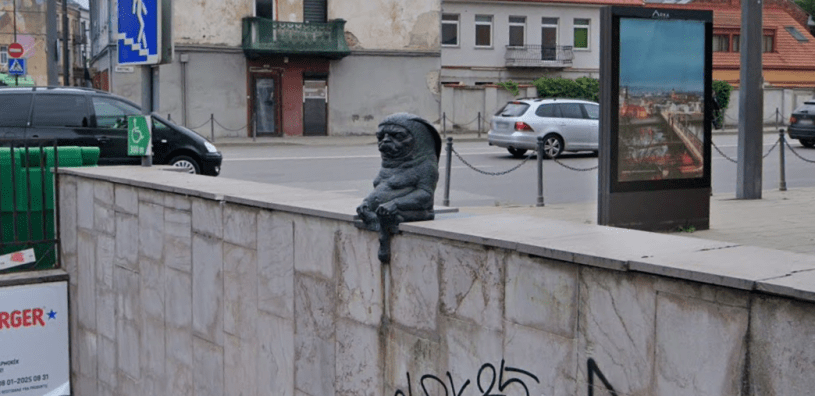
Side streets are usually more interesting than main streets. An obscure historical plaque often tells a better story than Wikipedia. My favorite example was using Google Earth Street View to map out the locations my protagonist visits in The Halferne Bodhi. In the middle of serious research, I spot a curious sculpture sitting on a wall. Oops, that’s like crack to an addict. What is that? A frog? Just sitting there watching pedestrians? Do people even notice it? Does it have a purpose?
Three hours later, I’ve tracked down the artist, Lukas Šiupšinskas, and I am emailing him to ask what’s up with that Zen Triušis (Zen Rabbit) sculpture, because it’s definitely going in my book.
Ironically, I later learned that the sculpture itself was intended to represent the calm, contemplative figure watching the world go by, waiting for someone to stop and notice it. A reminder to be curious about your surroundings. You know, get off the obvious path and check out a few rabbit holes.
This is also how I approach writing about music. The goal of Indy In-Tune was never to be some kind of authority on the local music scene. I wasn’t trying to crown winners, rank artists, or declare what was “good” or “bad.” I just wanted to point to the scene, the musicians, the shows, the venues that were already there. It was going on whether I wrote about it or not, but I wanted my rabbit hole to point to all of the other rabbit holes and say, “Hey, this is happening.”
Some weeks the music was brilliant; some weeks it appealed to a more selective audience. That was the point. If this band isn’t your thing, hang on, we’ve got four coming in this afternoon, maybe you’ll like one of the others. It’s a pretty big scene.
It only changed later, when it stopped being an advocate for the scene and became a point of influence. Bands constantly asked for reviews because they knew they’d get a “safe critique.” They knew I’d never say anything bad about anybody’s art. I wanted to be Wolfman Jack, not Roger Ebert, and that’s when it stopped being fun.
I’m not cut out to be a critic, but I’m a pretty good guide to finding weird rabbit holes. I will always be the one to point out an interesting thing, explain why you might want to explore it, and let you decide whether it’s your thing. I think that’s the much more interesting role. Scenes evolve, personal tastes evolve, and the context around the thing may evolve, but it’s always going to be deeper than it looks with just a cursory glance.
