
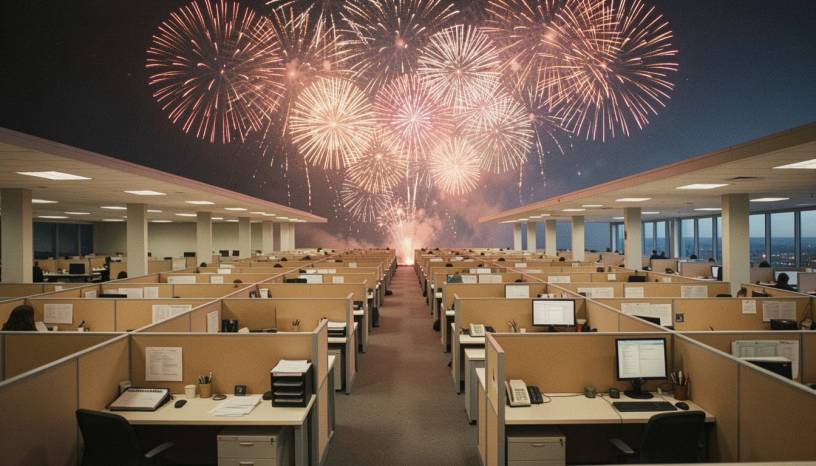
Last week I did something unusual. I went to the office. This may not sound like a noteworthy event to anyone who has spent the last century working in buildings designed for exactly that purpose, but in the modern hybrid-work world, it feels a bit like visiting a historical reenactment village. “Ah, yes… open seating plan. Very turn-of-the-century.” For six years now, my entire professional life has pretty much been on a screen. There are chat windows, mailboxes, calendars, conference calls, and a steady stream of polite beeps from notifications that aggressively demand my attention. My teammates are really just initials inside a circle inside a Brady Bunch Teams window. I’ve only met two of them in person; the rest could be AI bots or very animated house plants, I have no idea. I couldn’t tell you what any of them look like. I know their names. I know their job roles. I know their typing speed. That’s about it.
So, I actually got up, bought coffee and a breakfast biscuit at the gas station, and braved rush-hour traffic and a fairly theatrical/severe thunderstorm to go to work. From a productivity standpoint, the day was not especially impressive. Half the schedule was consumed by a mandatory safety seminar (the real reason I went in). The rest of the time was fragmented into short conversations, quick check-ins, and spontaneous discussions that wouldn’t normally exist in a remote work environment.
In other words, from the perspective of a time-management spreadsheet, it was probably inefficient, but on the other hand, I found it strangely energizing.
Walking down the hallway, I ran into people I hadn’t seen since before Covid sent us all home, permanently. We exchanged quick greetings, two-minute conversations, small jokes, a quick “So, what are you working on now?” “Oh, wow, I’ve been on those calls for three weeks; one of them felt like an entire month. I had no idea you were on that project too.” Nothing profound happened. These weren’t major social events or strategically valuable conversations, but each of those tiny interactions carried a small emotional charge. Hey, there are still flesh-and-blood people at this company, and they are aware of me!
Apparently, my brain had missed that more than I realized. At one point, I even got to something I hadn’t done in months: I tapped my boss’s boss on the shoulder and simply said hello. Not to ask for anything. Not to escalate a problem. Not to present a slide deck. Just to say “Hey.” The entire interaction lasted maybe five seconds, but it made me feel more connected than a dozen of those “perfectly efficient” online meetings where everyone politely waits their turn to speak while staring into the void.
So of course, when I got home, I had to start diving into the strange psychological economy of remote work. When we work from home, communication becomes transactional. Messages are sent when there is a reason to send them. Meetings happen when there is an agenda. Conversations exist to solve problems or make decisions. Physical workplaces are full of interactions that have no explicit purpose.
You might make a quick comment or get a “thanks for helping me with that” when you walk past someone’s desk. Someone might overhear you talking about your project at the coffee machine and give you the name of that one contact you needed to keep it from stalling. Or you might just complain to someone about the coffee’s quality or how lousy the weather is.
As far as business goes, those moments are inefficient. As far as people go, they might be the entire point. There’s actually been quite a bit of research on how technology is reshaping how we see ourselves and connect with others. I’ve blogged before about Sherry Turkle’s concept of the “Second Self.” She argued that, when interactions move into digital spaces, communication becomes more deliberate, curated, and efficient. Removing the small, accidental interactions also removes our sense of belonging. Also, she said this in 1984, the days when, if you had an email address, you were pretty much a spaceman.
So, I was reminded me how powerful those little moments can be. Individually, they don’t accomplish anything, they don’t produce anything, they don’t move a metric, they aren’t even important enough to justify a Teams call — and believe me, everything at my job justifies a Teams call … apparently.
Anyway, about four months ago, I found out I am ADHD. Looking back, this shouldn’t have been a revelation. I’ve always been the type of person with a constant stream of ideas and an attention span that bounces between ten different projects like a ping-pong ball in a clothes dryer until something shiny unexpectedly locks me in and consumes my focus for weeks. In my twenties, during the dot-com days, that mindset was a superpower. We were all sprinting, fixing the last thing while building the next thing, and adding features to the thing two things back. We wrote the front end, the back end, the middle tier, the database, and the UI; assembled PCs from spare parts; ran cables to build a network; made sales calls; and answered help desk calls. Meanwhile, new technologies came out every six months, making everything obsolete and starting the race to be the first to rebuild with the new stuff, if nothing else, so you could put another mysterious acronym on your resume. Systems had to be built, rebuilt, and rebuilt again. Fluid focus and curiosity were competitive advantages.
These days it’s different. The environment is quiet. The meetings are regular and recurring. Co-workers are all icons with the same font and two-second audio delay. We can’t even change our desktop wallpaper for a bit of variety, which I think is just cruel. Work still gets done, but the brain that thrives on novelty and micro bursts of stimulation can start to feel strangely underfed. So naturally, walking down the main hall at the office was a neurological firework show. Every conversation was a small spark. Every unexpected interaction was a tiny dopamine hit.
Sure, you can deal with ADHD by suppressing it. Medication can be enormously helpful for many people, and I won’t argue against something that improves someone’s quality of life. On the other hand, the same brain that quietly screams in parentheses during a stand-up meeting that goes on way too long — full of people reciting task lists that have absolutely nothing to do with my work — has also somehow managed to write four novels, record two music albums, and build the software to automate and run a streaming pirate radio station in its spare time. At some point, you have to ask yourself whether the chaos is the bug or the feature.
Either way, mental note to self: Go work in the office more often to recharge. I never thought I’d hear myself say that sentence. Next thing you know, I’ll be defending open office floor plans and praising the office coffee. Let’s not get carried away.
