
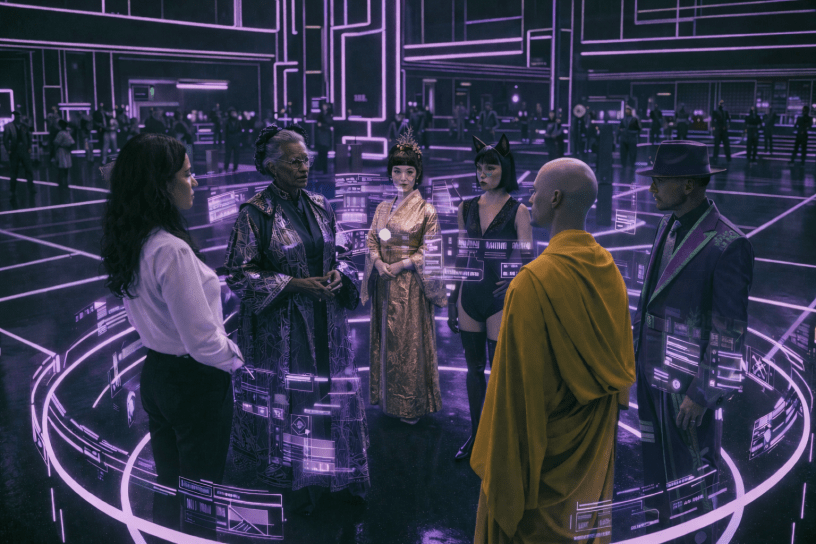
She stepped off the transit booth pad and into a cathedral-like foyer, drawn in violet neon. Light emanated from a subtle grid-work pattern on the floors, walls, and arched ceiling, illuminating the thin, billowy haze meant to mask the room’s actual dimensions and provide a semblance of privacy from people more than a few dozen feet away. Where De Wallen had been a cacophony of noise, light, and personality, this construct was far more subdued. As a result, it wasn’t popular with the younger crowd. The design aesthetic drew from primary colors popular in early constructs. She even imagined the hum of an antique CRT like the one in her father’s study.
Only a handful of people were currently visible. A quick check of the events calendar in the room’s central kiosk showed several lectures were in progress — mostly philosophical debates and religious monologues. Most meeting rooms were currently booked by small, newly formed organizations that didn’t yet have their own constructs. The open-door common rooms were at half-capacity. None seemed like a good place to hide. Finally, she found what she needed: an open research pod. Information, knowledge, truth … “veritas.” More importantly, it offered privacy and anonymity settings. She promptly reserved it and stepped over to the waiting transport booth that would take her there.
She arrived in a 3-meter-by-3-meter square room, done in the same violet neon motif as the Lobby, with only the transit booth and the outline of a featureless bench and table. She immediately keyed for privacy on the transit booth, sat down, and relaxed for the first time since leaving De Wallen.
Her personal menu still refused to cooperate, leaving her stuck with the local constructs’ less-anonymous tubes. She could call for an emergency technician to break the immersion and wake her up in her apartment, but decided to keep that as a last resort. She was safe for the moment. Even if her pursuer managed to track her here, they would need a master engineer to override the room’s privacy settings.
She keyed the local interface menu and scanned the list of research assistants for any familiar name. Only one matched, and not her first choice. Her heart sank as she punched the summons button and waited.
After two minutes, a figure materialized across the table from her. He was tall, thin, and pale. His appearance was that of a “default person,” with no distinguishing features, lines, wrinkles, or imperfections. She knew these were intentional choices.
“Hello, Vey.” Serah forced a smile. “It’s been a while.”
The outline of a chair materialized directly behind Vey. He sat down, and it slowly slid him up to the table opposite her. “Seventeen months and an odd number of days. You were investigating information smugglers from Malyon. I supplied you with cross-domain synthesis on trade telemetry.”
Serah smiled. “You were surprisingly helpful.”
“It’s my job to be.”
“Yes, but in just a few minutes you saw patterns the SI’s and I had overlooked for weeks. You broke my research wide open, but you … of course, you don’t remember that, do you?”
“I remember the details of our interaction.”
“You don’t remember how excited we both got when we figured out how the money was being laundered, however.”
“No, of course not; that would be inefficient. I pruned those parts of my memory.”
“Yes, you said you were going to. You seemed frustrated that other people don’t.”
“I was frustrated,” he said.
“Then you do remember some emotions, at least.”
“I remember their states. I do not retain the experiences.”
Serah frowned. “I don’t understand?”
“I preserve only the essential results of emotion,” he said. “Everything around it is noise.”
She grimaced. “Noise?”
“Emotion, sentiment, attachment, and narrative continuity.” He said calmly. “They all indicate bias, and bias is contrary to clarity.”
“So, what level are you now?” Serah asked, attempting to be conversational before getting to work. Vey was a devout member of an order — many would say a cult — of humans and LiM’s who sought to divest themselves of their humanity and become creatures of pure computation and memory. This made him very efficient, but usually unsettling to deal with. An SI would be preferable. They had personalities and the equivalent of emotions, ironically the things that Vey sought to remove.
“Of the seven layers, I am still of the third, perspective and context. I am still seeking the second, abstraction without interpretation.”
“Your ability to interpret data is what made you so invaluable to me the last time we worked together.”
Vey nodded. “As I train and optimize my mind, the amount of data and the speed with which I can recall it increase proportionally, making the lower layers much more difficult to achieve than the higher ones.”
“You seriously see the part of you that was most helpful to me last time we met as a flaw to overcome.”
“It is. You choose not to see it that way.” He shifted his weight slightly. “This should satisfy your need for social ritual. Shall we begin work now?”
Serah rubbed at her temples. This was exactly why she both loved and hated working with Vey. “Banpei Research Station. Near the Auria gate.”
The station appeared at once, along with a long scroll of informational text and linked records. “Independently owned scientific research station,” Vey said. “Crew of sixteen plus scientific complement of forty. Built fifty-seven standard years ago by Vurn Enterprises, a holding corporation financed by the scientists themselves and by several affiliated universities. Operated under Aurian protections as an autonomous colony territory.”
“What kind of research?”
“Publicly, there is a list of over two thousand projects involving terraforming techniques, advanced synthetic intelligence theory, bioengineering, and genetic design, plus a few outliers on universal constructors and Von Neumann machine theory.”
“And the private work?”
Vey’s eyes shifted slightly as he processed. “Direct inference is impossible. Weighted extrapolation is not.”
“See? You’re interpreting already.”
“No, I’m weighing the likely veracity of any abstraction. It’s not the same.” He paused, waiting for his point to register. “The station’s staff profile is anomalous. All but one of the scientists had a background in biology/xenobiology, psychology/xenopsychology, and some form of physics. The published research, however, does not meaningfully reflect that concentration. Therefore, the public record is incomplete, either by accident, which seems unlikely, or by design.”
“Throw out a few useful discoveries and theories, and they leave you alone to do your real work in secret.”
“Yes.”
“Show me the scientists.”
Images and bios of several dozen people appeared on the wall, each with a dense cloud of citations and publication histories.
“That’s too much. Show me Abil Halferne.”
Halferne’s headshot and bio replaced the rest.
“Dr. Abil Halferne,” Vey said, “longest-serving member of the executive board. Rose from adjunct to executive in five years. Born on Mycion, one hundred seven standard years ago. Advanced degrees in medicine, biology, biophysics, psychology, parapsychology, xenopsychology, xenobiology, neuroscience, cybernetics, chemistry, physics, astrophysics, quantum engineering, mathematics, and neomathematics.”
Serah whistled. “Not an underachiever.”
“No,” Vey said dryly. “He appears to have regarded the concept of specialization as a personal insult.”
She laughed despite herself. “How did his qualifications compare to the others?”
“He possessed the highest number of advanced degrees, with fifteen. Syd Kumar and Nial Das followed with twelve. Wayde Lincoln had nine.”
“Okay, what were the most common degrees across all the scientists?”
“All except one had backgrounds in either biology or xenobiology, psychology or xenopsychology, and some form of physics.”
“How many published experiments dealt with biology or psychology?”
“None.”
“That’s it, then.”
“It is revealing,” Vey corrected. “Not ‘it.’”
Serah leaned forward. “Meaning?”
“We’ve reinforced our theory that the published work likely existed to justify the existence of the station, but we have not established the true purpose.”
“Did Halferne publish books on those subjects?”
“Nine dealing with xenobiology. Seven on xenopsychology. Six on biology. Four on psychology. Two on physics.”
“What’s the most famous one?”
“Complexity Issues in Supporting Interaction Involving Intermediaries in Xenointeractive Systems. Co-written with Dr. Stevn Ellis and Dr. Jak Hodges.”
Serah smiled. “A page-turner.”
“It is unremarkable and impractical in the conventional sense,” Vey said. “Which may be the point.”
“Can I get a stem upload of it?”
He looked at her for a fraction longer than normal.
“You are already running a degraded local function. A stem transfer is inadvisable.”
“I know. Bill NPNA.”
He paused. “Mr. Whitaker will hate me.”
“He already does.”
“Good.”
The transfer began. It had been years since Serah had done a stem upload. She had forgotten the euphoric violence of suddenly possessing knowledge that had not been in her head seconds earlier. She winced and grabbed the sides of the couch. A flood of abstract structures rushed through her. She saw them as patterns of communication between entities with no common sensory architecture, mediation theory, or translated cognition. They shaped themselves into a logical framework between incompatible biological assumptions.
This was different from what she remembered. The material wasn’t fragmented and incomplete. It felt whole to her. She gasped, and for an instant knew, not just guessed, how intelligence might construct bridges between minds with no shared substrate at all. The rest of the research was theoretical at best, and simply filler for that one very specific idea, almost as if it were meant to distract the casual reader.
Vey frowned. “That shouldn’t have happened.”
Serah blinked at him. “What?”
“The transfer did not complete.”
“I know the text,” she said. “I can feel it. Most of it, anyway.”
“No.” He stepped closer to the wall display, eyes narrowing. “You do not have most of it. You have less than five percent of the information, and it is in random fragments.”
Serah stared at him. “Then why do I remember the whole thing?”
Vey went very still. When he spoke again, his voice was lower. “You are not remembering the book.”
She felt a shiver down her spine. “What do you mean? It’s plain as day.”
“No, your mind simply filled in the missing sections.” He studied her intently, watching her for signs of stress or trauma. “It’s not intuition; it’s pattern and structure. Your brain is supplying absent data as if the pattern already exists elsewhere in your cognition. How are you doing that?”
She swallowed. “That doesn’t make sense.”
“No. It does not.”
“Are you saying I guessed right?”
“I am saying guessing does not produce that degree of coherence.”
He pulled a smaller display into existence and began cross-referencing burst fragments, transfer logs, and her response times.
“Most minds,” he said, half to himself, “would receive enough to sense disruption and little else. You are resolving wholes from non-contiguous fragments.”
He looked back at her, and for the first time since appearing, seemed to see her.
“Your hippocampus and medial prefrontal cortex are unusually ordered. Your cognition is almost optimized.”
Serah did not answer immediately. She saw flashes, random telemetry, flickering forms, impossible intuitions. The same feeling she’d had in De Wallen when she could somehow identify the thing pursuing her through crowds.
“Can you tell what Banpei was really for?” She changed the subject back to something useful.
Vey let the question sit a moment, then went back to the data.
“Yes,” he said at last. “Not conclusively. But enough.” The wall reorganized itself. Project clusters collapsed into three central themes. “First: cognition across incompatible systems. Not merely alien linguistics. Framework transfer. Translation between unlike forms of mind. Second: biological adaptability under non-native information conditions. Third: mediated intelligence. Intermediaries between entities unable to directly understand one another.”
Serah stared at the model. “That doesn’t sound like terraforming.”
“No, it does not.”
“… and it’s not SI theory.”
“No.”
“Then, what is it?”
Vey calculated to the last minute, waiting for certainty to cross a threshold. “People expecting to encounter something intelligent they could not speak to conventionally.”
Serah felt her stomach tighten. She checked the time. Late. Erik still had not contacted her. She should have been back in the Root Realm already.
“One more,” she said quickly. “Luna Base. Military archive. Code name Yama.”
“Restricted.” He paused. “No. Not merely restricted. Partitioned.”
“Can you get in?”
“It’s designed to keep advanced SI from infiltrating,” he said. “I may be one of a half-dozen human minds potentially capable of circumventing the–” The screen shifted and flickered, freezing Vey in place. On the display, a stream of telemetry appeared in the margins. Serah’s pulse jumped. The symbols were the same ones she saw orbiting her pursuer in De Wallen. He had somehow found her.
“Vey?”
He was still frozen. The symbols moved from the holo around him to the walls, spreading through the room. Vey’s avatar lost resolution for a second, recovered, then came back sharper than before.
“Restricted archive,” he said.
His voice was unchanged. That was what made it worse.
“Vey?”
“Partition implies barrier. Barrier implies adversarial structure.” He tilted his head slightly, as though listening to something very far away. “Adversarial structure implies observer, danger.”
Serah stood up.
“Vey, stop.”
He looked at her. Something in the look was different. He looked distracted, and unusually content with it. “I see the error,” he said at last.
“What error?”
“The one we introduced when we gave Synthetic Intelligence an equivalent to emotion.” His expression emptied. “Noise disguised as empathy.”
Serah backed toward the transit booth.
“Vey? These symbols, I’ve seen them before. What do they mean?”
“It’s masterful,” he whispered. “It’s … below the first layer … reality without abstraction. Life as information. The universe as a single equation,” he sighed. The telemetry burst brighter around him. A new display bloomed beside his head, not summoned by either of them. Serah recognized none of the symbols, but she understood them anyway in the same sick, half-formed way she had understood the missing text. “Miss Wyles,” Vey struggled to speak. His face contorted as if he were struggling to form words. “Get out. Now.”
Serah dove for the transport booth and set it for the main Lobby. As soon as the transport cycle stopped, she started walking for the exit as fast as she could without drawing attention, not daring to look back, merely assuming she would soon be pursued.
“Serah!” a woman’s voice yelled from a crowd to her left.
Serah turned and saw an unusual-looking woman, elderly, short, and slightly stout in a way that implied the avatar was based on her natural features rather than an idealized form. The woman ran over and placed a hand on Serah’s upper arm.
“Erik sent me to make sure you’re all right,” she said. “Obviously, you’re not.”
Serah jerked away. “Let go of me.”
The woman grabbed her arm again, this time more firmly, and pulled her toward the crowd. “You need to trust me. We’re here to help you.”
Serah stopped briefly and looked at her. “I trust Erik. I don’t know who you are.”
“Even though you quit smoking five years ago,” the woman said, “you still keep a pack of puffsticks in your top desk drawer. The access code is ‘48-A, 59-G, Apricot, Banana, St. John.’”
Serah froze. Those were two simple facts, and only Erik would know both. It made sense as bona fide. She nodded once. “I was in a research pod. My assistant–” She stopped herself. “Vey is compromised.”
Flo’s face lit with something between recognition and panic. “A LiM?”
Serah shook her head. “Virtual. He’s a RISC monk.”
The woman swore under her breath. “All right. That changes things.” She gestured subtly, and four others folded around them from the nearby crowd as if they had been there all along: a woman with catlike features, a man dressed like a twentieth-century gangster, a girl in a gold kimono, and a skinny, hairless man.
“They’re with me,” the woman said. “This is W, X, Y, and Z. My name is Flo Ridamann. First things first, we get you somewhere safe. Second, you tell me exactly what he saw.”
Serah looked back toward the archway. A man stood there scanning the room. Still. Watchful. Flickering at the edge of her heads-up with the same impossible telemetry noise.
“I’m still being followed,” she said, voice thinning.
Flo did not look directly at him.
“The shade?” the one called Y asked, suddenly alert.
Flo shook her head. “If a human mind is subject to corruption, we may be past shades.”
Serah barely registered the words. Bits of Halferne’s book were still slotting themselves into place in her mind, adding confusion to the adrenaline and fear.
“I need to call for emergency extraction,” she said. “I’m going back to the Root Realm.”
“No,” Flo said sharply. “Not yet. If that thing learned through your research assistant, we need to know how much it knows.”
That frightened Serah more than the pursuit itself. “What did you just say?”
Flo hesitated for only a moment, then grabbed Serah by the shoulders and looked directly into her eyes. “I said, I think it used him to understand you.”
Serah’s mouth went dry.
Flo turned to Y, who began making frantic finger gestures in the air. “Can you still access your interface?” Flo asked.
“No. Something about a transfer in progress.”
Flo nodded and turned to Y. “Cut her loose. Mask the ID too.”
Y’s fingers moved faster.
“Done,” she said, then turned to Serah. “You should have access to a backup menu now.”
Serah tapped her middle finger to her thumb three times. Her heads-up lit at once with an unfamiliar set of options in a different color and font.
“How did you—”
“No time,” Flo interrupted. “Set emergency transit for Construct 1021-CN24. Passphrase: ‘Satori Qasr Sepulcher.’ Wait for me there.”
© 2022 Darrin Snider. All Rights Reserved.
