
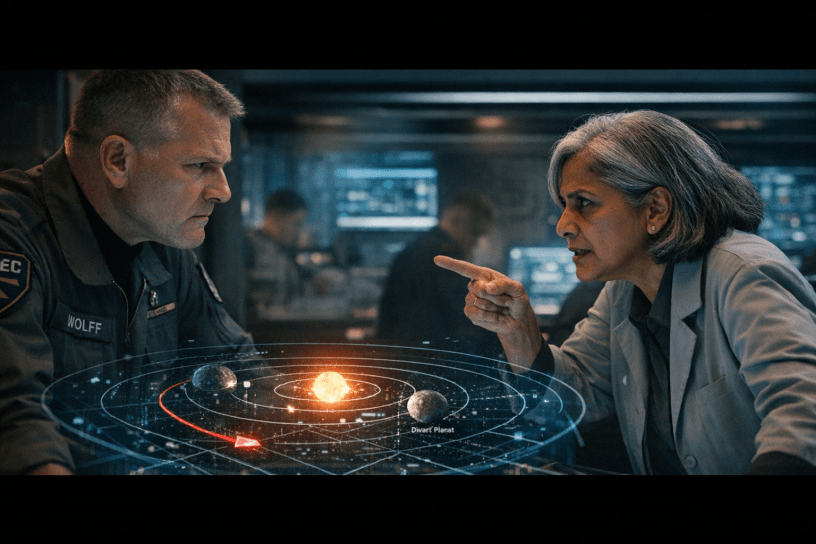
The six expedition members sat around the conference table, quiet enough to hear the air recyclers in the galley module next door. Major Wolff and Captain Conner, the base’s second in command and senior engineer, watched them like handlers. Dr. Tamana entered and immediately called up a view of LT-9A447 on the table’s holodisplay. Its roughly spherical form rotated slowly, and a small gold dot indicated the base’s position on the surface next to a completely underwhelming “mountain,” if one could call it that. In reality, it was little more than a swollen bump in the landscape, Jaysn decided.
“Good evening,” Tamana began. “I appreciate everyone’s patience and willingness to come here on so little information. I was under instructions from Expedition Logistics and the claimholders of this planet to keep a very low profile about … well … about what their engineers found last week.”
Chairs creaked as everyone shifted. This was the moment they’d been waiting for.
Tamana waved her hand, and the holo zoomed in on the base and the nearest section of the mountain. With another gesture, a roughly octagonal chamber appeared within the display, approximately two kilometers away from the base and nearly that same distance under the ‘mountain.’ “When scouting dwarf planets in the area for resource mining, drones came across an anomalous mineral reading here on LT-9A447. After moving into orbit for a closer scan, they detected this chamber, buried underneath the mountain, with no visible points of entry or construction.” The display zoomed in on an area directly beneath the mountain. “It is roughly octagonal, five meters in diameter, with a level floor and dome-like ceiling.”
Dr. Amin, the geologist, was instantly intrigued. “I’d like to see scans of the composition of the mountain. Do we know if it has any history of being volcanic?”
“No,” Conner confirmed. “It has a silicate core and volatile ice mantle, mostly water and methane, typical of most dwarf planets of this size.”
“So, it still could be an eruption of some form.”
Jaysn asked, “How do you explain the oddly octagonal shape?”
Amin thought for a moment. “Something in the substrata of minerals that caused them to break off that way, maybe. Have we done a compositional analysis of the cavern walls yet?”
“We weren’t overly concerned with the walls once we breached the chamber,” Conner said knowingly, gesturing back to Tamana, who was stone-faced, despite the interruption. It was why she picked the team, after all.
“Right,” Amin flushed and gestured for Tamana to continue.
“The original survey scans indicated the concentrated presence of uranium in the chamber. The engineering team landed and began an excavation tunnel using drones. When they reached it, this is what they found.” She gestured again, and a holovid of the drone cam appeared. Its search light traced around the room, then finally settled on a perfect disk, silvery in color, slightly reflective, resembling a large coin, standing on its edge atop a short cylindrical base.
There was a collective gasp from the viewers. Wolff and Conner observed them, expecting a quick and easy explanation for something they had lived with and speculated on for weeks now.
The camera perspective continued moving. The scientists in the room angling their bodies and heads straining to see something just out of frame. The vid now showed the rock drone’s perspective as the tunnel in front suddenly gave way to a large empty chamber. The drone stopped, scanned the perimeter, floor, and ceiling for stability, then finally stopped on the strange disk. Tamana paused the playback. Silence and awe hung in the air. All eyes were fixed. All jaws were agape.
“What are the dimensions?” Dr. Solvig finally asked. Jaysn realized it was the first time he’d heard her speak. Her voice was more childlike than expected but had a no-nonsense tone.
Conner consulted his datapad for accuracy, then projected the data onto the display next to the holo. “Well, it depends on how you want to measure it. If we scan it from this side, it’s 2.05 meters in diameter; 10.34 centimeters in thickness. The base is .94 meters in diameter, and approximately 22.44 centimeters tall. If we measure it from the other side, it’s 2.27 meters in diameter, 9.99 centimeters in thickness, and the base is 1.02 meters in diameter and 21.6 centimeters tall.”
They all shot each other quizzical looks.
“First things, first,” Clarc said. “Dr. Amin, is there any record of uranium appearing naturally in any form like this?”
Amin shook his head. “None that I’ve ever heard. However, it could be a natural phenomenon. The core of the planet is largely composed of uranium and thorium, which, as they decay, will produce considerable heat. I suppose it’s possible a fissure in the mantle could have created a vent of some sort where uranium was allowed to come to the surface. Strata in the rocks could have influenced its shape as it cooled. Uranium is actually quite malleable. It may have occurred early in the planet’s development. We should be able to determine the age of the object by the types and proportions of the isotopes and the amount of radiation it emits. That will give us a big clue as to its origin.”
Wolff and Conner looked at each other and frowned. It was Conner who finally spoke, “The exact proportion of the isotopes fluctuates constantly, Doctor. It seems to be comprised in nearly equal parts of uranium 238, thorium 234, protactinium 234, and uranium 234, but the exact proportions and configuration of the atoms change every time we make a scan. As for radiation … well … it isn’t giving off any, aside from the normal background levels we would expect to see.”
“Well, that’s impossible,” Amin said. “That’s the natural decay chain for uranium 238. You’re describing something like an Oklo reactor, which has occurred naturally on Earth; however, those daughters decay on human timescales—minutes, hours, days. They shouldn’t be sitting there in neat balance unless something is forcing them to. That means that disk is …” Amin paused and cocked his head to one side, studying the vid.
“A closed decay loop. Essentially a neutron capture lattice; secular equilibrium enforced unnaturally with entropy held at bay.” Novik finished the sentence.
Wolff leaned in, rubbing his temples in frustration. “What is that, exactly?”
“Fancy scientist talk for ‘impossible.’” Clarc shot Novik a quizzical look. “That’s a hell of an assessment for five minutes of discussion.”
Wolff was confused. “So, it’s alien tech?”
The six scientists exchanged glances, but no one spoke, fearing commitment. “It’s not that simple,” Solvig offered.
Jaysn cocked his head. “Actually, it is. If it’s manufactured, it is not easily mistaken for natural. Suppose I left my shoe on the surface of this planet, and an alien life form found it. Do you think for a minute they’d wonder how molecules formed that particular synthetic fabric and fused themselves together into that distinctly odd and unnatural shape? No. They’d do what we’re going to do: talk about it for about fifteen minutes, and say, ‘Yep, that’s definitely manufactured.’”
Clarc rolled her eyes. “That’s not a shoe,” she said, pointing at the disk slowly rotating in the view in front of them.
“No, that’s a hunk of heavy metals right where they shouldn’t be, formed into a near-perfect basic geometrical shape, and to top it off, for good measure, freakishly sticking a middle finger up to the second law of thermodynamics!” Jaysn was almost shouting now. “Neither we nor nature could manufacture something like that if we tried, at least not without a fusion reactor’s worth of energy to maintain it. What more evidence do you need to convince you? I’ve still got fourteen minutes.”
Wolff sat up, his hand instinctively going to his sidearm. Jaysn spotted the reaction instantly and smiled.
“Fine,” Clarc said, throwing up her hands, “just as a thought exercise, suppose you’re right.” She sat back in her seat and crossed her arms. “Why? What’s it for?”
“The simplest assumption would be a Bracewell Probe of some sort,” Novik suggested.
Jaysn shook his head. “Buried on an obscure dwarf planet under three kilometers of rock?”
“What’s a Bracewell Probe?” Wolff asked, half-rolling his eyes as he typed a message on the datapad in front of him.
“Sort of a cosmic watchdog,” Jaysn offered. “Theoretically, an advanced civilization, instead of exploring the expanse of the galaxy, would simply deploy a bunch of probes to sit around solar systems where life is likely to evolve and wait for an intelligent species to emerge. Then the probe wakes up and makes first contact.”
“Except that it’s not waking up,” Conner offered, wiping sweaty hands on his shirt and betraying the slightest shake. “So, if it’s waiting, it’s not waiting for us.”
Tamana nodded in agreement. “What if it’s part of a larger structure, a ship or a station, and it just ended up here after the station was destroyed?”
Jaysn sneered. “It’s pretty elaborate for construction material. I suppose it could be a very specific type of shield, though.”
“Could it be a radio receiver of some sort?” Solvig leaned forward, transfixed with the rotating image. “Is it aligned with the rotational or magnetic poles of the planetoid?”
“Negative.” Wolff shrugged.
Two guards walked through the room and into the galley. Jaysn thought it was highly unusual, given that the material was supposed to be classified, even to the point that he, as an expedition member, couldn’t get access to it. He tried to read Wolf’s reaction, but the Major remained stone-faced, watching the scene without recognition or emotion.
She steepled her fingers under her chin. “I suppose it could be art.”
Clarc shook her head. “Sure, but if you made art, would you store it underground in the middle of a planet where no one could see it?”
Jaysn chuckled. “Why not?” Clarc shot him a look.
“What are you thinking?” Solvig asked.
“’My name is Ozymandias, king of kings: Look on my works, ye Mighty, and despair!’ Maybe its creators had a sense of humor. Maybe their art isn’t meant to be exhibited. Perhaps it was intentionally put here to confuse anyone who finds it, or maybe we’re supposed to interpret in our race’s own unique way.”
“Anthropologists find meaning everywhere, and you find humor in everything,” Clarc sneered. “Tell ya what, call me when it metabolizes.”
There was a commotion at the doorway behind Wolff. Jaysn saw guards taking defensive positions on both sides. Trying to stay focused, he turned to Wolff and Conner. “I assume you’ve found no other objects like this or detected anything like it elsewhere in the system? We’re not tunneling into a museum or anything, are we?”
“Nothing,” Conner offered.
“Well, it’s obviously artificial, and it isn’t making any attempt to hide that fact. Yet it’s hidden, so we might assume it’s something that its creator doesn’t want to be found,” Amin said.
“How do you know that?” Clarc asked. “We found it.”
“There’s uranium in the core of the planet, so by itself, it’s not improbable to find it closer to the surface. We only found it because we were scanning for specific concentrations of specific metals. Let’s face it, the odds are extremely slim that a second ship would just wander into this system, at this particular point in the far end of its orbit, and find this particular dwarf planet out of hundreds, maybe thousands orbiting LT-9 unless they were specifically looking for this thing,” Amin said defiantly.
As if in answer, a wall-mounted speaker wailed an attention signal. “Comm to Major Wolff, two minutes to intercept.”
“Intercept?!” Tamana asked.
Wolff scowled. “We detected a ship moving inbound to this base. It showed up almost exactly when you people started talking about alien tech. Not sure how that could be a coincidence.”
Everyone looked at each other. Novik’s drone tilted its head to one side, scanning the room for surveillance devices. “They’ve been listening to us,” he said.
Wolff stood and headed for the door. “I’m afraid I’m going to have to ask all of you to remain in this room for the moment.”
Wolff entered the command module and sealed the door behind him. “Give me a tactical,” he barked at the duty officer who deftly worked a couple of controls until a holo appeared in the center of the room. It showed all the nearby dwarf planets with the LT-9 star and q-gate, located 200 million kilometers above the star, perpendicular to the ecliptic plane, to maintain a consistent distance to all points in the solar system throughout their orbits. Wolff gestured with his hands and zoomed in on the immediate neighborhood. It showed one craft, moving in an orbit parallel to their own, headed straight for them. “Any idea who the hell it is?” Wolff asked.
“Negative,” Matthews said. “We have a sensor drone on intercept to get a visual. Ion propulsion, probably Thurin technology from the energy signature.
“How the hell did it get past the fleet at the gate?”
“Probably a second, off-book gate somewhere.”
“Is it pirates?” It was Tamana’s voice standing in the doorway.
“How the hell did you? Never mind. No civilians in the command center,” Wolff snapped.
“I’m not a civilian, Major. As expedition leader, I’m a fully deputized SDEC officer and the final word on decisions that affect the discovery and my team.”
Wolff stepped in close to Tamana and met her gaze. “And I’m in charge of the safety and well-being of all of you, plus the entire population of the base and several million credits worth of SDEC equipment, not to mention your expedition hasn’t even formally started yet.”
Tamana didn’t budge and stared calmly up at the Major. “I outrank you.”
“Not in this room, and certainly not during a potential combat situation,” Wolff said, then shrugged and shook his head. “This system is still being surveyed. There’s no one out here worth robbing, and there won’t be for years, so I doubt pirates would have a gate out this far. It must be one of the claim holders’ competitors doing intelligence gathering to see what they’ve found.”
“I doubt they’re here simply to observe and report back, Major. That could be done with a quick bribe to someone on the inside, which would be a lot cheaper and simpler than running a q-gate all the way out here.”
“You really think that hunk of metal is worth anything?”
“You don’t understand the implications of that object,” Tamana said. Whoever built that has technology thousands of years more advanced than ours. If someone were to study that thing and figure out how it was constructed, it would advance technology by centuries in just a few years.”
“And make the person who controls that tech extremely rich,” Wolff said, eyes shifting around the room, watching his men.
“Frankly, I can’t imagine anyone in the settled systems who would think twice about wiping us off this rock and taking that artifact for themselves. For a megacorp, it’s a matter of survival to keep its competitors from controlling that much potential power. For a government, it would be crucial to ensure that one system doesn’t suddenly start producing advanced ships and weaponry that outmatches all of their enemies, and allies for that matter.”
“Sensor drone coming into range,” Matthews said, switching the holo to the view from the probe. Instantly, a menacing angular ship materialized in the air in front of them, lit by twin spotlights from the probe as it dropped speed to pass the bigger ship at 2 meters per second. “That’s a Thurinese cutter, alright.”
“You need to take a refresher in silhouette identification, Mister. That’s no cutter.” Wolff waved his hand, and the view zoomed in on the port aft quarter. “Those aren’t collector panels. Those are Star 90 pulse cannons, Earth tech. Somebody modified that thing into a gunship, and very expensively, I might add. Wouldn’t be a match against a real military craft, but those could swat us off the surface of this rock in just a few minutes. Have we tried hailing her?”
“No response to hails.”
“How many aboard?”
The image suddenly jerked and then vanished. “They got our drone before sensors could complete the scan.”
“Well, at least we know they’re not friendly. Saves me some time making decisions.”
“Orders, sir?”
“Confine all civilians and off-duty personnel to quarters. Send out a mayday to the gate fleet. Give them our situation and request assistance. How far out is the enemy at present speed?”
“Just over twelve hours. If they want to bombard us from orbit instead of taking the base, weapons range is just under ten hours. Help won’t get here in time.”
Wolff nodded. “Tell them we believe the enemy to be one of the megacorps with intent to seize our …” he struggled to find the phrasing that could be sent over an open channel, “… mineral claim. We’re preparing to repel boarders, but victory is unlikely. We will transmit the identity of assaulting forces when determined, if able.”
Matthews gestured wildly at the display in front of him for a few seconds. “Message sent,” he confirmed.
“Good. Now, tell the supply chief to break out the weapons and have everyone pick one up when they go on duty. At this point, we don’t know if they’ll try to take us prisoner or blow us up from orbit, but maybe it will make everyone feel a bit safer. Then cut off all comms. Nobody sends a message from the base except under my command codes.”
“Sir? What about those with families or those who want to make final arrangements of some kind?”
Wolff shook his head. “It’s obvious we have mole. I’m not risking anyone getting a message to the enemy.”
“A mole seems unlikely.” Tamana was already thinking ahead of Wolff. “Who else knows about the find?”
“You mean, besides the claim holders and half the SDEC Corps of Engineers and Expedition Logistics?”
“That’s just it. Logistics has kept a tight lid on this. I had the only copy of the briefing material under bioseal. My team knew nothing about the artifact until a few minutes ago.”
“Yes, the same time that ship showed up. I think they were lying low on their side of the gate, avoiding a confrontation until somebody on this base confirmed what we had here. Whether it’s one of those scientists or one of us, I’m not trusting anyone right now. Conner, lock everything down.”
“Aye, sir,” the Captain said, pressing a sequence of commands. Alarms sounded in the distance, a garbled voice gave orders over the tinny speakers, and doors began to slam all over the base.
