
Oh, shit. Oh, shit. Oh, shit. The thought circled in Jaysn’s mind. He tried to inhale out of habit and realized he didn’t need to. There was no air. He had no chest. There wasn’t even discomfort from not breathing. There was just awareness. It felt like … oblivion, though instinctively, by definition, he couldn’t be cursing or panicking were this oblivion.
He thought back through theoretical texts on the afterlife, trying to make sense of his current surroundings. The brain and conscious thought were by-products of external stimulation through the five senses, yet they were also more than that. Coma patients can be cut off from their senses yet still exhibit measurable brain activity that neural scanners can detect. Maybe that was what was happening to him. He’d passed into a narcosis coma on the floor of that cave in LT-9A447. How long before he died at that point? Or at least how long until he was blissfully unaware that he was dying? If it were narcosis, then he shouldn’t be as lucid as he was, so he eliminated that theory. If anything, he was thinking more clearly now than when he first felt the symptoms back in the cave. Something wasn’t right about his situation.
Had he died? Was this the afterlife? Would he spend eternity in emptiness as a disembodied thought machine? Weren’t there supposed to be answers? Reunions with deceased loved ones? At least a chance at redemption or repentance? He’d studied religious traditions of dozens of cultures, and he understood faith’s role in maintaining coherence in large groups of people. He never really had faith, despite seeing startling similarities and traditions between populations that should not share them. He didn’t feel the presence of divinity now that he was, he assumed, dead. He decided this afterlife was going to get old very quickly.
Eventually, the blackness began to abate, turning toward a dull, dark gray. Not exactly a promising change, but he could imagine it was an improvement. Maybe his hearing and sense of touch would return soon as well. Perhaps he wasn’t dead. Maybe he had hit his head during another tremor in the cave.
A point of light appeared at the end of his vision, growing larger and brighter over the course of several minutes. Then more pinpoint lights appeared, distant and consistent. Stars were all he could imagine. The one growing in front of him began to change color as he approached. He then realized this was merely an illusion. It was a second object between him and the star – a planet.
He had no idea how he ended up in this position, or how he could be alive and conscious, free-falling through the vacuum of space, but for the first time, he felt danger.
The “planet” was unlike anything he had ever seen. Only a thin, roughly circular patch in one hemisphere appeared to be natural. The rest was a mass of gray and teal structures, possibly a single megastructure covering most of the planet. He made out tilted spires of amber light, regularly spaced around the surface. He imagined these to be space elevators of a sort, with other orbiting platforms as potential skyhooks.
He saw no sign of movement, life, or any activity. There were no payloads in the elevators, no orbital traffic, not even blinking or changes in the lights on the surface below. Perhaps he was too far out for such things to be visible. His current course indicated that he would soon get a closer view.
He marveled at how “normal” this all felt. He felt no panic. He was only questioning the logic of what he was experiencing. He was possibly in shock. He felt calmer and more lucid than he had in days. He felt safe. If someone had brought him here, it certainly would not be to let him fall to his death on a strange, alien planet. Was that ambiguous ‘someone’ the disk back in the cave? That felt comforting, at least as much as a cold, metallic hunk of metal could give comfort.
The planet continued to grow at a constant rate, which, if he had his math right, meant that his speed must be slowing. He had no reference for scale, but if the planet was Earth-sized, he must be no more than a couple of hundred kilometers above the surface. He felt his angle turn slightly, taking him in a descending arc across the planet toward the “day side,” though the non-reflective dark surface appeared almost the same as the “night side.” He had no sensation of mass, couldn’t feel any wind around him, and therefore felt no heat from atmospheric friction.
Below him, several floating rectangular shapes hovered a few kilometers above the surface. They glimmered, white and translucent, with the consistency of thin cloth or gossamer. He passed between two of these “artificial clouds” and got his first look at the surface below.
His initial impressions seemed correct. It resembled one large city, composed of featureless, smooth buildings, most of which were in basic geometrical shapes. There were hexagonal spires, pyramids, spheres, and interlocking polygons that formed large, multi-leveled complexes. He saw no sign of windows in any of these so-called buildings. If the spaces between the buildings served as roads, then he saw no traffic. Everything was completely inert, as if paused by an unseen hand.
Abruptly, he changed direction once more, this time slowing to a leisurely, gradual glide over the city, where he slowed to a stop, hovering perhaps 50 meters over a five-meter-diameter hole in the roof of a tall, cylindrical building. He hovered for a few seconds, taking in his surroundings – works of architecture that were by no means beyond human capability, yet their sheer ubiquity made them a marvel to behold. He could not imagine the raw materials, energy sources, and time needed to construct hundreds of towers, some of which ascended to low orbit in a city that covered at least 80% of a planet’s surface.
He was in awe and hoped that, if this were the afterlife, the answers to all these questions would be forthcoming.
Suddenly, he felt himself dropping, not through any physical sensation, but more as if the hole below him had reached up and engulfed him in darkness.
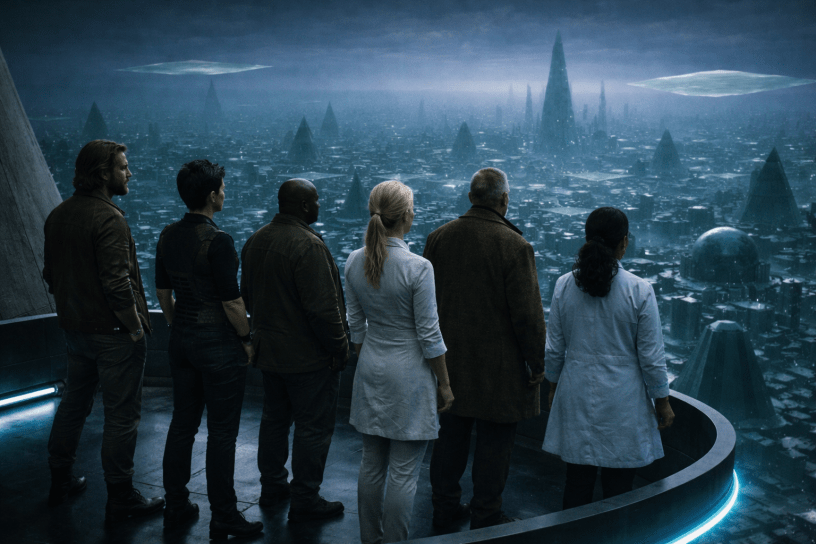
He opened his eyes, which he could now positively identify as eyes, and found himself on a circular platform three meters in diameter, raised one meter off the floor, in the center of a room at least four times that size. Half-walls around the perimeter revealed a 360-degree view of the “city” around him. Six concentric rings on the platform below him emitted a greenish light, mirrored by a duplicate set in the ceiling above. Yet, when he looked at his hands, his own color was somewhat desaturated and did not seem to reflect any of the light.
He took a quick assessment. Gravity felt much more consistent than the oddly placed gravplates in the cave. He estimated it was a bit heavier than earth standard, but not uncomfortably so. The temperature was a bit colder than was comfortable, but warmer than the cave had been. He was still wearing the same jacket, trousers, and shoes as before. There was no wind, and the air had no odor whatsoever. He walked over to the edge of the platform and jumped down, momentarily forgetting the heavier gravity, and received a sharp reminder as soon as he hit the floor. A sharp sting went up his shins: nothing major, but something to be careful of. Pain still worked at least.
He walked to the half-wall and looked out at the city, its buildings uniform in composition. The closest ones were as smooth as plastic, with little or no reflectivity. Each was a shade of teal, some darker than others, all seeming to glow slightly under a dark violet sky. Those further than 100 meters or so were indistinct and shimmered into a mirage of refracted light. He heard no sound coming from the city, but there was a low, omnipresent hum in his ears, resembling a quartet of cellos endlessly holding the same dissonant chord–more of an eerie tone cluster than actual notes. His ever-present tinnitus was absent, as was the sound of his breathing. He snapped his fingers to ensure that he hadn’t gone deaf. The sound was there, the volume was correct, but an eerie reverberation persisted that made no sense.
“Jaysn?” a voice behind him said.
He turned to see a woman in her mid-thirties with dark hair, vaguely Indian in appearance. If it weren’t for the lab coat, he might not have recognized her at all. “Disha?” he asked, amazed.
“Of course. Where are the others?”
“I just got here. Then suddenly you were here. Only–” He pulled himself back up to the platform and approached the woman. “It is you, isn’t it?”
“We were in the cave. There was a tremor of some sort, then … I suppose I was falling …”
“Same here, but how–”
“I’m not sure. Am I hallucinating?”
“No!” He stepped closer, examining her intently. “Do I look the same to you?”
“Of course you do.”
“Then why are you suddenly forty years younger?”
Tamana looked at her hands, then touched her face. “Surely you’re imagining it.”
“Disha, the grey is gone from your hair, your face looks like a woman of 35, possibly 40 at the oldest. You seem to have lost two stone, and even your lab coat seems to fit differently.”
“Well, you don’t look any different to me.” She studied him for a moment. “Well, wait, weren’t your jacket and shoes a bit more worn? They look nearly brand new now.”
Jaysn regarded the jacket. It felt the same, but he did remember some worn patches in the leather that were missing now.
“Some kind of time displacement?” He asked.
From the corner of his eye, he caught movement. He turned and saw a swirling plume of dust, or glittering motes of some sort, rise from the floor. Instinctively, he jumped back. They paid no attention to his action but moved with a purpose. Approximately three seconds later, they formed themselves into the shape of Major Wolff — only, it was not quite Wolff. The man was a couple of centimeters taller and slightly more muscular. Jaysn might not have noticed at all if it hadn’t been for Tamana’s drastic change in appearance.
“Dr. Tamana? What just happened?”
“We don’t really understand ourselves, Major,” Tamana assured him as another dust/mote cloud rose and formed itself into Umar Amin, teetering on the verge of hysterics.
“Umar, it’s okay,” Jaysn said, holding his hands out. “We’re safe. At least, I think we are.”
“What the hell was that? Where are we?”
Jaysn studied the man closely. Unlike Wolff and Tamana, he appeared to have regressed, now appearing a bit shorter and portlier than a few moments ago in the cave. So, Jaysn thought, this process isn’t meant to optimize our physical makeup.
Again, there was a swirl of dust, and Cari Clarc appeared behind Amin. Like Wolff, she was more muscular and even a bit more masculine in appearance than she had before. “What the hell?!” She gasped.
“It seems to be a common reaction. We honestly don’t know,” Jaysn offered as Anita Solvig formed next to him. Hers was the most startling transformation yet. Her worker’s tunic now clung closely to curves that weren’t present in her old form. Her facial structure was much more pronounced with high cheekbones, a smaller nose, and an angular chin. Jaysn tried hard not to let his jaw drop, but instead offered a neutral, calming, “Hello, Dr. Solvig.”
Finally, in the middle of the assembled six, the dust storm appeared again, leaving a late middle-aged man with a thick beard and a knee-length tweed coat. He had a vaguely Slovenian appearance, with a hawkish nose and a cherubic face. His eyes conveyed kindness and recognition.
Jaysn stepped back, unsurprised by anything at this point. “Surely you must be the divine creator of all this?” he asked.
“Me? Don’t be silly, Jaysn. Where are we, by the way? I appear to be missing some memories.”
Jaysn regarded the man, confused. “I assumed you were the one who brought us here.”
“Of course not. The last thing I remember was the cave. There was a tremor, and the atmospheric pressure in the artifact chamber was dropping rapidly. It seemed the inevitable end was only a few moments away. Then, suddenly, you all began to vanish in front of me, one by one.”
“Jaysn, don’t you see?” Tamana interjected. “That’s Syn. Dr. Novik.”
Jaysn shook his head to clear a fog that wasn’t there. “Lev?!”
The man looked confused, then studied his current form. Touching his chest and face to confirm it to himself. “Yes, I suppose I am.”
“Okay, what the hell is going on here?!” Wolff howled impatiently.
Tamana tried to organize the confused looks and murmurs. “Does anybody remember anything after the cave and the tremor?”
Jaysn rubbed the bridge of his nose. “Blackness. Falling. A planet. A hole in a building.”
“Yes,” Solvig said. “What was that? I’ve never seen technology like that.”
Amin gestured at the city around them. “I’m thinking we’re right in the middle of it.”
“Wasn’t it daytime when we were flying above the city?” Clarc asked.
“Do we know if we’re underground or not? That might be a five-kilometer-tall ceiling, and not the sky we’re looking at,” Amin suggested. “The atmospheric distortion doesn’t help much.”
“Where are we, do you think?” Clarc asked.
“The more immediate question might be, ‘What are we?’” Novik said, still touching and studying his physical form. “None of you appear exactly as you did back in the cave.”
“You’re one to talk,” Jaysn laughed.
Tamana began pacing. “So, we were transported? Is the artifact some wormhole generator? Like a miniature q-gate?”
Novik shrugged. “Distinctly possible, assuming I’m correct, and it is an extra-dimensional object, it may be one of several duplicate nodes in a multi-dimensional machine. We’ve already seen it’s capable of controlling and manipulating atoms and subatomic particles, even to the point of controlling entropy itself. It could easily be able to change matter into information, transmit it to a different node, and reconstitute it into matter. In this case, however, we’re merely approximations of our former selves. Me less so.”
Wolff scowled, “It’s better than dying on the floor of that cave, but does anybody have an idea on how to get us back?”
Tamana ignored him and paced around the platform, examining each of the team in turn. “Why the changes? They seem inconsistent.”
Novik looked around the room and out at the city. “The atmosphere here is extremely low in oxygen, containing mostly CO2 and argon. Do any of you believe you’re breathing right now?”
Jaysn held his hand in front of his face. “My lungs seem to be pumping air of some kind, but you’re right, it feels odd.” The others quickly mimicked him and came to the same conclusion.
“If your bodies hadn’t been altered and were breathing this air, you would have fainted by now.”
“So, whatever we are, we’re not human.”
“Guys,” Clarc said, concerned, as she quickly tore her jacket off. “I’m a little more human than I was a few minutes ago.” She pulled up her sleeve and flexed a perfectly normal human arm where a cybernetic prosthesis had been before.
“You still have your tracheal and neural cybernetics, however,” Novik noted.
Clarc studied her new human arm. “So, who decided all this? Don’t I get a vote on what stays, what goes, and what I look like?”
Novik continued, “Whereas I seem to have a human form, but also much more.”
“More?” Jaysn prompted.
“Yes, I’m currently seeing a full-spectrum equivalent to the sensor arrays on that Class 5 drone. My hearing is picking up frequencies far above and below what a human would be able to detect, and I would venture to bet this body, despite its appearance of an advanced age, is on the order of thirty to forty times stronger than any of you, with almost unlimited stamina.”
“How did you get so lucky?” Amin asked. “Why did all of you, except Jaysn and I, get so lucky?!”
“I don’t think I’ve changed,” Solvig offered, making Jaysn roll his eyes.
Novik nodded in understanding. “Unless I miss my guess, the archive recorded all our information, but possibly didn’t completely understand the relationship between biology and psychology, in this case, self-perception. Therefore, in recreating us with bodies and biology tailored to this environment, it also re-created us in our own self-image, the way we subconsciously see ourselves.”
“You have a subconscious?” Clarc asked with just a bit of doubt in her tone.
“Not as such, but I do have a root self-image that informs my personality and interactions with all of you, and I do see myself as something of an elder scholar. The disk, or whoever, may have made use of that in my presentation, essentially making me half SI and half incarnate.”
Jaysn smiled ear to ear. “So, you’re saying Disha sees herself as younger; Wolff as bigger and badder; Anita as–”
“That will be quite enough, Dr. Katsaros,” Tamana interjected. “It’s a viable theory, I must admit.”
“So, it seems, I’m the only one in this group with an in-tune sense of self? I can accept that.” Jaysn crossed his arms and smiled triumphantly.
“So, if we’re here, like this, in these bodies,” Solvig said, “where are our real bodies? Are we really us?”
Clarc snorted. “Is anyone here an existential philosopher?”
“I saw your bodies vanish,” Novik said. “I would guess the disk converted them to information. So, in that sense, your physical bodies are dead and molecularly disassembled, but your information, all that was you, was put into this form, which is adapted to exist here on this world. We can breathe the air; gravity and atmospheric pressure are tolerable to us; we can perceive our surroundings visually; and sounds appear to be pitched correctly to our normal perception and way of thinking. If we had purely human bodies, we shouldn’t be able to see clearly beyond a few meters before light refraction made everything an unrecognizable blur, and sounds like our voices would be pitched much lower than we’re used to. Higher frequencies wouldn’t carry far at all, making our verbal communication sound muffled at best unless we were in very close proximity.”
This made odd sense to Jaysn. He noticed voices did not echo with the strange reverberation that his finger snaps and breathing did. Nor did he and his friends seem to reflect light or cast shadows, and they remained visible even when stepping away from light into relative darkness. “Our senses are somehow tuned and enhanced for the environment. It all feels just a little bit unnatural. I wonder if that’s by design to keep us grounded so we don’t lose our minds.”
Tamana nodded. “Yes, I find it difficult to believe that life would evolve anything like us in an environment such as this. Studies suggest that argon/oxygen breathing lifeforms would have very slow burning metabolisms and would be very slow-moving and deliberate.”
“Which is good. It likely means they likely wouldn’t evolve a fight-or-flight reaction,” Clarc offered. “Not to mention, they at least seem to care something for our comfort and sanity.”
Amin’s face was dour. “I’m with Wolff, however. I’m not entirely sure I want to spend the rest of my life living here, like this, though.”
“You’re assuming we’re even mortal in these bodies,” Clarc added coolly.
Jaysn held up his hands. “Listen, speculation is one thing, but we’ve only been here a few minutes before we get sent to the next destination. On the other hand, we may be here forever. We may be about to die. We may find a way back. The point is, we’re an advanced survey party. Shouldn’t we be exploring rather than making drastic life decisions right now? I mean, look at this place! I don’t think we can deny we’re the first people with concrete evidence of an advanced civilization other than our own.” He smiled at Dr. Clarc. “Or do you want to take fifteen minutes again before you commit?”
Clarc rolled her eyes but couldn’t help smiling.
Tamana nodded. “Quite correct, Dr. Katsaros. In the absence of information and data, perhaps we should attempt to start gathering some.”
“I’m no scientist,” Wolff said, his voice sounding slightly deeper than it had earlier, “but what if we run into the inhabitants of this planet? What if we triggered the disk by accident somehow? What if they’re not exactly thrilled that we’ve trespassed here?”
“I find it highly unlikely that an interstellar species would be inherently hostile to strangers,” Jaysn said. “Theoretically, any race that would develop interstellar travel had previously developed science, which requires them to have curiosity.”
“It doesn’t mean they like strangers.” Wolff grimaced.
“They could be xenophobic,” Solvig offered.
“It’s also possible they wouldn’t even recognize us as lifeforms,” Tamana said, nodding. “Argon breathers are likely completely different from us biologically in almost every way. What if this isn’t even a city, but just some kind of automated factory, and nobody lives here? They may all be up in those floating cloud things?”
“Yes, what were those?” Amin asked, seeming to spring to life for the first time. “I’d love to get another look at them.”
Jaysn smiled, seeing that he was at least engaging the team and getting them back on track. “Personally, I want a better vantage point of this complex to see if there’s some logic to the way it’s laid out. We’re assuming it’s a habitat of some sort, but it doesn’t look like any city I’ve ever seen.”
Clarc smirked. “Well, I’m just a zoologist, and this doesn’t look like any kind of habitat to me. Just a pile of geometric objects. Almost like a child’s building blocks.”
Solvig smiled slyly, obviously enchanted by the idea. “So, it’s settled then? We’re venturing out?”
Tamana regarded Jaysn for a moment. “Dr. Katsaros seems confident there’s little or no danger out there, but I’m not so optimistic.” She thought for a moment. “He is right, however, in that we’re not learning anything standing here. Expedition Logistics sent us to investigate, examine, and assess the artifact to determine its purpose. We should continue to carry out that mission, despite lacking our equipment and tools.”
“Or food, or shelter, or defenses?” Amin added.
“Those things don’t seem to be here.” Tamana gestured around. “Assuming they’re even necessary for these bodies, we’ll likely have better luck finding them out there.”
Jaysn turned to Novik. “Lev, what exactly are your capabilities? I’m sure you’re still not wired into the Phrame or the SDEC network. Does that body have a processor in it that is running your matrix?”
“Through scanning, I can tell you my matrix seems to be stored in a brain-like organ with a processing capability,” he said, tapping his temple, then squinting and thinking for a minute. “I’m wired into … something. I seem to have access to everything that is ‘me,’ but when I try to reach out, I feel someone, or something, is there, and it’s … not really stopping me, the way a logic gate or firewall might … more like it’s gently steering me back to myself. I’m sorry, I’ve never really had to describe my functions in human metaphors before. I suppose to use a human expression, I am sensing a connection out there, but I can’t quite get my head around it.’”
“But, otherwise, you have the capabilities of the drone you were inhabiting?” Tamana asked.
“Yes, Doctor. Obviously, I am at your disposal.”
“Very well.” She nodded. “First things first: where are we going, and how do we get out of here?”
Everyone began to fan out, inspecting various aspects of the room or examining the surrounding cityscape. Jaysn paced methodically around the outer perimeter of the room, feeling his way along the half-wall. Finding nothing of note, he stopped and peered out at the city, placing his arms atop the wall. To his surprise, the wall began to silently sink into the floor, revealing a platform that matched the curvature of the room, jutted approximately a meter and a half out into the open air, outlined in a pale blue strip of light–the first non-aqua light they’d seen so far in the city.
“Hello,” he said to no one in particular.
The others gathered around, inspecting the ledge. “How high up are we?” Solvig asked.
“Hard to say. I can see the tops of buildings, but with no shadows, details, or reflections, it’s tough to determine distance and scale. If I had to guess, we’re several dozen stories up. This building appears to be conical, not cylindrical. It’s the only one like it as near as I can tell.
“So, is this the lift?” Wolff asked.
“That might be a bit presumptive,” Clarc offered. “We’re assuming the residents of this city don’t fly or have some sort of personal transportation means. Not to mention, we’re assuming down is a desirable direction. That might just as easily be a recycling chute for whatever normally arrives on these platforms.”
“I don’t want to be recycled,” Solvig nodded. “However, whatever it is, they haven’t labeled it as dangerous or given any indication as to its purpose. In fact, it has no markings at all. I should think its purpose would be obvious to the inhabitants of this world.”
Novik stroked his chin in a surprisingly human fashion. “I might point out that perhaps the inhabitants of this world may regularly wear a reality augmentation device that provides information and interfaces that we do not currently possess.”
Tamana said, “You believe they would go to the trouble to save us from certain death back in the cave, bring us all the way here, study our biology and psychology enough to construct environmentally appropriate bodies, and not give us a crucial piece of information necessary to survive, Dr. Novik?”
“I am merely stating possibilities. I am inclined to agree with Dr. Solvig’s intuition.” Novik rubbed his chin and began pacing. “We should also consider the possibility that we’re in their equivalent of a zoo, or a lab maze. It’s possible we’re being observed and tested.”
Jaysn threw up his hands in frustration. “The conversation is getting boring, and if it is a test, we’re making idiots of ourselves in front of the zookeepers.” He turned towards the platform and closed his eyes. He’d shot his mouth off again. He thought about how silly he was about to look if he was wrong, and those became his last words. With three quick, mostly-symbolic breaths, he took two steps forward and stood in the center of the platform amid shouts of protests from Dr. Tamana and Wolff.
Nothing happened.
“So, it’s a balcony.” Clarc chuckled.
Jaysn shrugged. “I half expected it to—”
Blue lines at the edge of the platform lit up, and it began to slide slowly down the side of the building with only the faintest hum – not so much machinery, but almost the musical sound of the strange surfaces rubbing against each other.
