
Tamana said nothing as she and the three remaining expedition members stared at each other in confusion.
“We need to go after them!” Jaysn insisted.
“Go after them, how?” Tamana said, summoning her professionalism with a deep breath.
Novik nodded. “She’s right. Even if we managed to board one of those cube-things, we can’t know for sure if it will take us to where they are, or to the other side of the planet.”
“So, we just do nothing? We let them die?” Solvig said, fighting to keep emotion out of her voice.
Tamana took a deep breath. “We don’t know what danger they’re in, if any. Either way, I’m not splitting the team up further.” She stared at the swarm of wisps still pouring into the chamber. The swell was now visibly subsiding, though still too many to risk leaving the relative safety of the wall where they stood. Finally, she spoke again. “We need more information. We need to find out what this chamber is and where those cubes go before we make any decisions. To do that, we need to find a way to communicate, either with these cloud creatures or with whoever is running this city.”
Frustrated, Jaysn threw up his hands and strolled toward the mass of cloud creatures flowing in through the door. “Excuse us,” he mumbled under his breath to calm himself and not startle the wisps. “Could you stop whatever you’re doing and answer a few questions for my friends and me?”
“Dr. Katsaros, stop being foolish and come back here!” Tamana yelled.
In anger and desperation, Jaysn reached out a hand to try to stop one of the creatures. He felt a strange warmth as his hand entered the mist. There was definite resistance, and he felt his hand being gently pushed away. As the mist passed by him, unimpeded by his gesture, he thought he could see the faintest trace of a familiar form in the luminescent swirl of gas. He regarded his hand for a moment, arched an eyebrow, and turned back toward his companions. “That was very odd,” he said, more to himself than them.
“What was?” Novik asked.
“They’re not entirely gaseous. There’s something there, half-formed. It touched me, and I saw it for a moment. It was ghost-like, but I thought I saw a face and upper torso of … something.”
“You need to stop being so reckless! We need to think this through before we go off testing personal theories. What if you had been carried off like Dr. Amin?”
“Then I’d no doubt be closer to understanding what’s going on than you would be standing here doing nothing, Disha,” Jaysn snapped. “You said it yourself: we need more information. I don’t see any textbooks or research terminals here. That means we have to get it the old-fashioned way and start testing hypotheses.”
Novik continued, not acknowledging Jaysn and Tamana’s argument. “What did it look like to you, Jaysn? Was it human in appearance?”
Jaysn shook his head. “Definitely not human, but vaguely humanoid. Elongated head. Eyes on the side of the face. Almost horse-like.”
“Are you sure you weren’t imagining it? Just seeing a face in a random design?”
Tamana was suddenly lost in thought. “Did it look at you or acknowledge you at all?”
“Hard to say with the eyes placed the way they are.”
She nodded. “That might be good news. On Earth, anyway, laterally placed eyes are uncommon among aggressive land species. Even among birds, hunting species like owls, hawks, and eagles have eyes set a bit more toward the center of their heads, giving them greater range and depth perception. On the other hand, many prey creatures do have eyes placed that way for maximum visibility.”
“But ‘prey’ doesn’t mean harmless. Snakes also have lateral vision, but not all are prey, and many can be quite deadly.”
“Based on what we’ve seen so far, they feel more threatened when they’re alone, and they are mostly indifferent to us in the safety of a herd,” Novik noted.
“It doesn’t do anything toward helping us communicate with them. It doesn’t even mean they’re capable of communication, or even intelligent for that matter,” Solvig said.
“Yet they do seem to have some sort of awareness of this room and how this … mechanism? … works.”
“They also seem to be singularly focused on it. Even when attacked by Major Wolff, they didn’t stop what they were doing. To me, it looked like he just got swept up in the whole thing.”
“So, they are vaguely aware of us but not concerned enough to stop and talk to us, or even really acknowledge us. It would help if we knew what this place was and what its purpose is.”
“Which don’t appear to be answers we’re going to get standing around here.” Tamana nodded. “Dr. Novik, with your enhanced perception, do you see any way out of this room that doesn’t involve figuring out how to get scooped up in one of those cubes and whisked off in a random direction through one of the portals in the wall?”
“The chamber runs approximately a kilometer in each direction. The only exits I see are the portals themselves. The lowest ones are still approximately six meters off the ground, making them effectively unreachable with the means currently at our disposal.”
“So, it’s a dead end,” Jaysn said, deflated.
Tamana nodded. “So, let’s head upstream and find out where these wisps came from.” She indicated the doorway where what had been a stampede had now slowed to a relative trickle of one or two wisps per second entering. Jaysn marveled that they still somehow deduced, or instinctively knew exactly where the cube was about to materialize, and always managed to be in position when it happened.
The four started back toward the archway and into the street, with Novik in the lead and Jaysn in the rear. The steady stream of wisp creatures showed no signs of reducing further as they made their way against the flow for nearly two kilometers, sticking close to the walls the entire time. There was no reaction at all on the part of the creatures, nor any indication that the creatures were aware of their presence at all. Jaysn strained, closely watching each one as they passed in an attempt to get a glimpse of the ghostly face again, but they were all moving too fast.
The street eventually ended at a point where it was bisected by a wide canal filled with a rapidly flowing liquid that appeared to be water, except that, much like every other material they had encountered, it emanated its own light in the form of a dull glow, rather than reflecting the light of objects around it. Wisp creatures arrived every fifteen or twenty seconds, riding eight to ten atop perfectly rectangular barges that flowed directly down the middle of the canal until reaching the intersection with the street, at which point the barge diverted slightly to bring them within centimeters of the bank, allowing an easy departure for the passengers.
“The docking is very precise in timing and position. Something is guiding these things,” Tamana observed.
“I don’t see any means of propulsion other than the current of the…” Novik stared at the canal for a few seconds. “My spectral imaging says that it is water, but with almost no impurities. The temperature is slightly warmer than the air temperature, approximately 18.5 degrees.”
“Interesting,” Jaysn said, crouching next to the canal, further upstream from where the barges were landing. “Water, in an argon/CO2 heavy environment? Why?” He cupped his hands and scooped some of the water up to his lips.
Tamana scowled but did not try to stop him. “What exactly are you trying to prove, Dr. Katsaros?”
“Clarc’s point earlier. Do these bodies require us to consume food and water? Are we even capable of doing that in these forms? Lev scanned us and said our biology had been adapted to function within the conditions of this environment – light, gravity, air pressure, and so on. Did they also remove our need to consume food and eliminate waste to provide energy?”
“Provided you didn’t just poison yourself with chemical runoff or microscopic life beyond Dr. Novik’s ability to detect from two meters away.”
Novik studied Jaysn for a moment. “He definitely drank the liquid. It went down his throat to what appears to be his stomach. Whether this body will absorb it or just keep it stored there is yet to be seen. It may simply be for appearances, the way his lungs are processing argon and CO2 as if they were his normal atmospheric mix. I will continue to scan him and let you know if I make any other significant observations.”
“Meanwhile,” Jaysn said, “we need to figure out how to get upstream if we want to find where these wisp creatures are coming from. How deep is the water, Lev?”
“Approximately two and a half meters.”
“So wading is out.” He glanced upstream, noting there were a few more openings where the canal crossed streets. “The current is significant, but we should be able to swim against it. We can take breaks where it intersects the streets.”
“I’d rather not take the risk.” Tamana shook her head. “Even if this new body is in peak condition, it’s been decades since I last swam. I’m not sure I’m up to the challenge.”
“And I am a very weak swimmer,” Solvig said.
“So, what do we do then? Head downstream?”
“That would be going contrary to plan at the first sign of difficulty,” Tamana said. “There must be alternate routes to get where we want to go. I say we go back to the previous intersection on this street and try to find an overland route that parallels the canal.”
“Sounds reasonable,” Novik said.
In the floating cube, miles away, Amin found it difficult to keep from screaming, even though the wisp creatures had released him as soon as the cube began moving. Wolff, now trapped inside the cube with him, dragged Amin to one corner and stood defensively in front of him. To his surprise, the wisps retreated to the opposite corner and had barely moved.
Amin forced himself to open his eyes, seemed to relax a little when he saw the wisps had retreated, but instantly started panicking again when he saw Dr. Clarc lying on the roof of the cube, steadying herself by grabbing the edges of two adjoining faces with her hands. “I’m sorry I got us into this. You didn’t have to come after me. Why did you come after me?”
Wolff rolled his eyes. “You were in trouble. I was the best person to help. You’d rather I let them kidnap you?”
“Statistically speaking, it would have been better if just one of us got kidnapped, not three.”
“Well, to be honest, not being a big brain like you guys, I was feeling a little useless anyway. I guess I decided I would be the brawn of this little group and took it a bit too seriously when the moment came. Don’t beat yourself up about it.”
Amin thought for a moment, then nodded his understanding. “Thank you for trying, anyway. So, why did she come after us?” he said, pointing to Clarc on the roof. “She doesn’t even like us.”
“I suspect because she really is the brawn of the group and seems to know more about those creatures than anyone else.” He mouthed “Are you okay?” up at Clarc and added an exaggerated three-finger okay sign.
It took her several seconds to process, after which she nodded her understanding and gave him a thumbs-up. Then she made a series of gestures and lip movements indicating that they should stand as still as possible, showing their empty hands, placed close to their bodies as a show of non-belligerence.
The cube was traveling in total darkness, with occasional streaks of light that appeared to be kilometers away, above, below, and next to them. The effect was disorienting, but occasionally his mind could briefly interpret them as the edges of a complex structure. Whatever they were passing through was enormous.
Beyond the streaks, the only indication they had that they were moving was the slight breeze that blew Dr. Clarc’s hair, along with the sudden shifting of weight as the cube accelerated, decelerated, or altered course.
Wolff stared at the three wisps in the corner. They had barely moved aside from an occasional shimmy or, in a handful of instances, when two of them would abruptly change places. Without faces, he could not tell whether they were watching their human travel companions or ignoring them completely, staring out at what would be their eventual destination. In any event, he was certain not to make any sudden movements that might startle or provoke the creatures. The last thing he wanted to deal with was the sudden appearance of one of those snake creatures in a confined space such as this.
There was a knock from Clarc atop the cube. She began pointing ahead of them in the direction they were travelling. Both Amin and Wolff gave her a confused look. Frustrated, she pointed to her eyes and then pointed ahead once again. The two men stared into the distance, Wolff even chancing moving a couple of paces around the cube. Through the translucent, amber wall, he could barely make out a square of light that was slowly growing in size.
“I think we’re coming to an exit,” he said, as Amin moved to his side, not taking his eyes off their traveling companions. Amin looked close to panic.
Gradually, the square grew larger until it was larger than one side of the cube. Abruptly, everything around them erupted in sparkling light, and they almost lost their footing with sudden deceleration and eventually a complete stop. Clarc smacked her hand on the top of the cube twice, slid her legs over the side, and let herself drop to solid footing beneath the cube. Seconds later, the top face vanished, and the cube unmade itself into four bars of light that sank into the floor.
They were just inside another huge chamber, similar to the one where they had boarded the cube, except that various orbs of light twinkled in the air above them like stars, or fruit on an invisible tree. The three wisps immediately sped out of the room down a narrow, brightly lit corridor.
“What do you think this place is?” Wolff asked, gesturing toward a wall, where swirls of light slowly spread and contracted like aurorae.
Clarc approached the wall and gently ran her fingers over the surface. There was a low thrum of notes, not quite musical, and the colors slowly moved in response to her touch. “Is that their version of music, do you think?”
Amin was taking slow, methodical breaths to calm himself. “This is an argon atmosphere, and we’ve been adapted to experience it as something closer to our own.”
Clarc nodded. “I’m still not convinced those wisps are indigenous. I’ve been giving some thought to what an argon-breathing life-form might be like. Argon is inert, dense, and chemically lazy. The obvious solution is that their biochemistry would rely on some sort of metal-mediated catalysis, possibly vanadium, nickel, or another exotic chelate. The limited oxygen in the air would be more conducive to resetting reaction states instead of fast oxidative reactions. They’re not going to zip around like those whips.”
Wolff pointed to the wall. “So that slow-moving cloud and low thrum could be like an action-packed vid to them.”
Clarc smiled. “Exactly. If that’s the case, then the low warbling sound we can barely hear would practically be a rock-and-roll concert to them. Given the way light diffuses in argon, I’d venture to guess their entire perception is based on contrast and polarization, not color. There could be tons of information encoded in this one image that we just don’t perceive.
Another cube entered the chamber behind them, disappearing into the ground as soon as it stopped. Two wisp creatures aboard ignored Clarc and the others, proceeding down the passageway on the opposite wall. The three regarded each other until finally Clarc shrugged and gestured for them to follow.
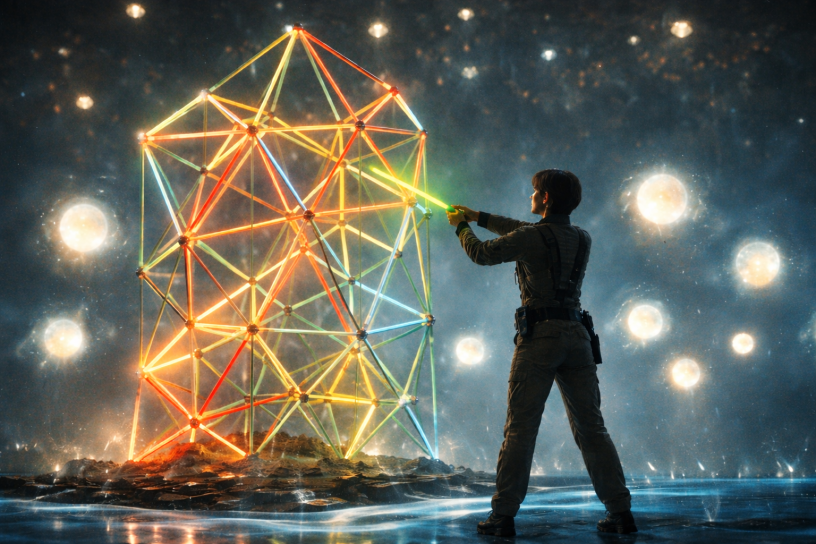
They entered into another colossal, cathedral-like room, the largest they’d encountered so far. The floor of the circular room hummed and breathed with waves of washed indigo and silver light that passed over and through each other. High above them, several stories by Clarc’s estimation, a series of glowing white orbs floated motionlessly and slowly pulsed. In the middle of the room, a gathering of at least three dozen wisps surrounded a multi-colored display of color rods that formed a twisted three-dimensional web of light.
“It’s like being in a holonav display or a planetarium,” Amin said, his eyes transfixed on the ceiling.
Clarc nodded in agreement. “Except that all of the objects, as near as I can tell, are identical. I’d expect to see different colors and sizes of stellar objects, maybe even nebulae.”
“And the light show in the middle?” Wolff asked, gesturing to the wisps.
Clarc shrugged and smiled slightly. “I suppose we should go have a look,” she said and began slowly walking toward the gathering.
“Are you sure that’s wise?” Amin stammered.
“I think we’ve sufficiently established ourselves as being friendly at this point. Those three you rode with seemed more at ease with the situation than the two of you.”
“How can you be so confident?” Wolff asked.
Clarc stopped and turned back to the two men. “I’m a xenozoologist. I’ve been attacked by things ten times as fierce as those puffy clouds or the giant snakes that seem to be protecting them. Trust me, do this for a few years, and you develop an instinct for knowing where you fit on an animal’s food chain and when you’re triggering a fight or flight reflex.”
Slowly and purposefully, she made her way across the room toward the gathering of wisps. As she got closer, she saw that they were surrounding a glowing construct made up of interconnected, multi-colored tubes. Stopping a few meters away, she studied it. It was asymmetrical but still vaguely geometric, composed of regular geometric figures. The glowing tubes were connected to form triangles, squares, pentagons, hexagons, octagons, and so forth, with each tube radiating in a particular color of the spectrum, though proportionally, there seemed to be many more red, orange, and yellow tubes than green, blue, and purple ones. The wisps were able to produce new rods in the air in front of them, which then seemed to snap themselves in place when they were within a few centimeters of a compatible position within the larger structure.
Wolff and Amin fell in behind her. As far as they could tell, none of the wisps took any notice.
“What do you suppose it is?” Wolff asked.
“I’ve seen creatures that build habitats and structures, like webs, hives, and cocoons, but those are usually roughly symmetrical in structure or made up of one recurring shape that is stacked in a pattern of some sort. If Dr. Novik were here, he might be able to identify a pattern to this construction, but somehow, I think it’s as random as the appearance and direction of the cubes.” Clarc started forward once again, moving slightly slower than she had when she approached. Still, none of the wisp creatures seemed to take any notice of her.
“Be careful, doctor,” Wolff warned.
Clarc held up a hand in annoyance but didn’t take her eyes off the structure or the wisps. As she came within a couple of meters, she slowed her pace again and crouched down to their height, or what she estimated would be eye-level if they had eyes. When she was only a couple of paces out, all of the wisp creatures immediately stopped working on the structure and froze in place. Clarc did the same, looking from one to the next, expectantly. She felt sure they were not about to attack her en masse, but prepared herself for anything, including a hasty retreat to the corner of the room with a dozen giant snakes behind her.
Instead, one of the wisps moved from the opposite side of the structure, around the others, and placed itself directly in front of her, hovering just a few centimeters in front of her face.
“Well, hello there,” she said in a soothing voice, grinning, but not showing teeth.
There was a shift in the light within the cloud, and for an instant, she thought she could see the profile of a humanoid head with one large eye on the side, regarding her intently.
Clarc nodded. “So, you do have a face. You’re a very handsome species, but unlike anything I’ve ever seen or heard of.”
Wolff looked at Amin, who seemed to have relaxed a bit. He was more concerned that Clarc was being too relaxed at this point.
Suddenly, a glowing green rod materialized in the air between the creature and Clarc. She regarded it for a moment, attempting to decipher its meaning. “Is that for me?” she asked, then slowly reached out her hand and grabbed it.
Contrary to expectation, the rod was cold to the touch and feather-light. She tapped it lightly with a fingernail. It appeared to be solid, though, judging by the acoustics. As soon as she took it, the wisp moved backwards a meter or so. None of the others had moved since she approached.
“They’re waiting for you,” Amin observed.
Clarc slowly nodded. “I think you’re right.” She studied the rod in her hand.
“What is that?” Amin asked.
“I don’t recognize the material, but it must be a crystal or some kind of precipitate. I would have to believe, given the environment, the local technology is based on pressure engineering, resonance manipulation, or slow nuclear chemistry, not fire or rapid oxidation like ours.”
Slowly, she turned toward the larger construction and held out the glowing tube. Sensing nothing, she moved it over various points in the structure. As the end of the tube approached the end of another tube, she felt a slight pull, as if some powerful magnetism was at work. She continued exploring several points before spotting a placement where the tube in her hand could be joined to two other endpoints to complete a square protruding from the edge of the object. It immediately snapped into place and changed from green to something closer to cyan.
Instantly, the other wisps began whirling to new positions and manifesting new rods, which they added to the construction. Clarc slowly stepped back, apparently unnoticed, and rejoined Wolff and Amin.
“Well, that was interesting,” she sighed.
Wolff cocked his head, confused. “What did you just do?”
“I have no idea, but I’m pretty convinced now that they have at least rudimentary intelligence. They were aware of me, shared what I can only describe as a social interaction with me, and the existence of that thing implies a basic mathematical understanding. Only, this isn’t a hive of hexagons or a concentric web. This looks like spontaneous constructive geometry. We’ve never seen that in any species other than man.”
“What about dolphins? Gorillas? Octopi?” Amin asked.
“They’re social creatures, yes, but most of their behavior is mimicry or the result of years of training. Every component of that thing is a perfect geometric shape. None of them are irregular. So, unless someone else around here is teaching them about hexagons and octagons, they have developed a sense of symmetric aesthetic on their own.”
“And that indicates intelligence?” Wolff asked.
Clarc shrugged. “I can’t say for certain. Maybe they’re just imitating the shapes of the buildings they see around the city, but I’ve never seen anything like this in hundreds of species on dozens of worlds. This may very well be our first encounter with another intelligent species.”
“I’ll admit,” Clarc offered, “I’d always hoped we would discover intelligent life out there. I never dreamt it would be me, and I had nightmares about something like this being the way we eventually found it.”
“Why nightmares?” Amin asked.
“There was a thought exercise going back to the earliest days when we were looking for signs of life with radio receivers. A scientist named Frank Drake tried to develop a formula for the number of intelligent species that must exist in the galaxy. His original equation has been modified over the past couple of centuries, the more we learn, but it still boils down to a handful of things that all have to happen.” She began ticking items off on her fingers. “You need a star that forms a planetary system. You need a planet in the habitable zone where liquid water can exist on it,” she continued, “Stable star. Basic life evolves. No extinction-level disasters. Basic life becomes complex. A bunch of other statistically relevant things, and finally, if all of them happen, then you get intelligent life. On top of that, in the nearly fourteen-billion-year history of the universe, life needs to emerge at the same time we did, so we can meet it, instead of ten million years ago or ten million years from now. Are you with me so far?”
Wolff nodded gingerly.
“Now, assume that’s about ten or fifteen things that need to happen, some of them we can estimate the probability, others we still have no idea how probable they are. For example, it’s not entirely uncommon for a planet to form in the habitable zone of a star, that seems to happen in about a quarter of the systems we’ve observed, however, we don’t know how rare it is for a star to be as stable as Sol has been for 300 million years without frying the inner planets with a gamma burst or massive solar flare. But let’s oversimplify it and say all of the variables are die rolls, and all you need to do is roll fifteen sixes in a row to get intelligence. What do you think the odds are?”
“Extremely small,” Wolff admitted.
Clarc nodded. “About one in 400 billion. That’s about the number of stars in the galaxy, by some estimates. Certainly more than the number of stars with planets in the habitable zone.”
“Yet here we are. So we’re the only ones out of 400 billion stars in the galaxy?”
“Well, as I said, it’s an oversimplification. I could have said ten coin flips coming up heads instead of ten die rolls, in which case the 1 in 400 billion becomes more like 1 in a thousand, and there could be as many as three or four hundred million alien civilizations out there waiting to meet us.”
“So, reality is somewhere in between?”
“Reality is that some variables may be coin flips, others may be one in a million.” Clarc raised one eyebrow and gestured to the room around them. “On the other hand, reality is where we’re standing. Somebody built that disk, probably the same people who built this place, and now we meet these guys, who, unless I miss my guess, are a completely different intelligent species.”
“And that’s terrifying?” Wolff said, growing annoyed with the conversation.
“Yes. What if reality is closer to the one in 400 billion number, and the only way intelligent life ever develops is if somebody cheats the Drake equation and incubates safely in another race’s city like this, either by accident or by design?”
“Yeah, but we’re here. That means at least one species can beat the odds.”
“That’s the problem. Did we really beat the odds? Or were we helped as well, and we just don’t know it?” Clarc asked. “I’m a card-carrying agnostic. I have no problem accepting there’s a higher power out there watching and guiding us, but we’re getting dangerously close to proving it now, aren’t we?”
“You don’t find that comforting, I take it.”
“I don’t like it when a question answered brings up a few dozen bigger ones, no. Are we being manipulated? Or have we been left to our own devices? Can the race that created, or at least shepherded us, suddenly change their minds and come wipe us out on a whim if we become too much trouble or fail to live up to expectations we didn’t even know were set?”
“It sounds like one for the philosophers, not the scientists, to me.” Wolff shrugged.
“If we find a way to get back, and word of this gets out, it will be one for everyone, and it will change everything.”
