
Serah did not breathe easily until the freighter was well away from Lille, at which point she gave a grateful sigh and began studying the controls in front of her. Most were completely non-functional. A display console indicated the uplink to the command center was unavailable and local control was limited. Serah understood that this was the likely intent of whoever had used the freighter’s loading arm to smash the comm array, but she would have felt better if she could at least access a satellite uplink to determine if she was being followed. As it was, it seemed the only things working were the launch button she pressed to get the craft airborne and a navigational map of France with four destinations still illuminated.
If she could at least turn on her pad, she could do more thorough research on those four map locations, tell Henry she was still alive, see if Parrino was okay or had been arrested in the hangar, read a novel, anything to pass the time. She knew instinctively that would be a bad idea, however. At present, both the good guys and the bad guys were pursuing her. For that matter, she still didn’t know if she was currently being rescued or captured. All she knew was she was alone and following someone else’s design, as usual. Someone was always one step ahead, waiting for her, whether in-Phrame, the Root Realm, or in her dreams.
The navigational chart indicated her heading was the city of Avignon. Apparently, an automated route the craft took several times a day and could easily make on its own without an uplink to the control center. She felt herself picking up speed, and the ETA indicator showed just over 800 km, with a flight time of slightly less than three hours. She watched the French countryside scroll beneath her hypnotically – the sun was almost at high noon as it made its arc overhead. She tried to remember if NPNA had any affiliates in Avignon. Maybe they could get a message to Henry, tell him about poor Erik, warn him he might be in danger, and admit he was right, and she was out of her depth on this story.
Everything seemed so helpless. Trees and hills bounced below her like waves in the ocean as the craft floated dreamily over them. Slowly, she felt her body disassociating as her adrenaline levels returned to normal. She became dizzy as her mind slowly drifted with the landscape patterns below. It was not entirely unpleasant; she actually found it relaxing, and after a few minutes, she let exhaustion overtake her.
“All it needs is a waterfall,” she heard Halferne’s voice. She suddenly turned her head and found him sitting in the co-pilot’s seat beside her. Not in the least surprised, she didn’t let it phase her and continued to drift in and out of euphoric exhaustion.
“About time you showed up,” she said.
“You don’t seem surprised.”
“Nope, I knew you’d show up eventually. Even though you’re not here.”
“Oh, but I am. You’re the one who’s not here?”
“Where am I then?”
“Hopefully, you’re right where you should be.”
Serah rolled her eyes. “Again, with the riddles. Why can’t you speak plainly?”
Halferne frowned slightly. “I’m sorry, that’s not how this works.”
“How what works? Why are you doing this to me?”
“I’m not doing anything to you. I’m trying to help you.”
“By driving me insane?”
“Who’s driving you insane? Serah, listen to me. We’ve got to get you out of here.”
“Who’s we?!”
“I have a friend outside, watching the hanger entrance.”
“What hangar? She gestured at the rolling hills out the cockpit window. Dr. Halferne, as usual, you’re not making any sense.”
“Who’s Dr. Halferne?” a new voice answered. “My name is Xev. I’m here to help you, but we’ve got to get you out of here.”
“Fine, there’s a café right over there,” he gestured to a busy sidewalk café with vantage points of the hangar’s front and side entrances. “That’s got two sides of the building covered. Yvet can slip around back and watch the other two.”
Serah stopped suddenly. “No! Listen, you want to get as far away from me as possible because so far, everyone that’s gotten involved with this has ended up dead, wounded, or certifiably insane.”
Xev and Yvet exchanged worried looks. “Erik?”
Serah frowned, tears welling up in her eyes. “I’m sorry.”
“Doesn’t matter,” Xev protested. “I’ve got a feeling we’re already over our heads.” He nodded to Yvet, who darted back down the alley toward the rear of the building and gently grabbed Serah’s arm, urging her toward the café. After an exchange of glances, she relented and followed him.
They took seats at a table on the sidewalk next to the main entrance, giving them some visual cover behind the other patrons and a potential escape route through the café interior if necessary. Serah immediately set the menu upright on the table to obscure her face.
“Okay, we’ve only got minutes,” she said, panic creeping into her voice. “Spill it.”
“Erik gave us the telemetry from your dreamspinner. It showed that, somehow, someone was using your dreamspinner to dump an enormous amount of data into your mind while you were sleeping. It’s only a partial dump and extremely fragmented, so we can’t determine what it is, but we can tell you it’s huge and complex.”
Serah nodded, “Right. Erik told me about it. Let’s assume the transfer is complete, and I have everything now. Apparently, multiple petabytes of it.”
Xev regarded her for a moment. “What’s that like? Having that much raw data in your head? Are there any side effects?”
Serah chuckled, “You have NO idea. Now, how do we get this out and use it?”
“We don’t. I mean, not without a way to distinguish your own neural pathways from the ones created by the data upload.”
Serah thought about this momentarily and was interrupted by Yvet’s voice over Xev’s wrist comm. “The roof is retracting. I hear the Division 4 transport approaching.”
Serah shook her head, trying not to get distracted. “So, why would somebody put data in my head that I can’t retrieve?”
“Whoever did it probably have some way to identify and remove it.”
“The person who did it was murdered three days ago. This is hopeless.” Suddenly, a thought struck her, and she pulled up her datapad.
“Don’t use the Phrame! We’re pretty sure Division 4 is tracking you there.”
“They are. This pad is isolated.” She pulled up the scan she took of the map console with four points highlighted. “I have a feeling I was brought here intentionally; maybe we have an ally we didn’t know about. This was on the navigation console when I boarded the transport.” She turned the map toward Xev, who immediately scanned the image and overlaid it on a more detailed map of the region projected from his arm terminal into the space between them.
“Okay, here we are,” he indicated a spot on the map almost directly in the middle of the four points. He then zoomed in on each point in turn. “These points correspond to the Alysome camps, the National Cimetière of Boulouris, the Abbaye of Saint-Roman, and le Jardin de la Foi in Bouc Bel Air. Mean anything to you?”
“Yes,” Serah said, trying to remember what Parrino had said. An assassin named Sonorus was hired to kill the person who gave me this data. Right before he was captured, he was desperately searching religious sites all over France for something. I’m guessing our unseen friend has narrowed it down to one of these.”
“Xev, something’s wrong. The transport pilot just jumped out and is now screaming to himself, running all over the terminal.”
“I’ve seen that before!” Serah said, panicked.
“Where?” Xev asked.
“The assassin I was just telling you about, then the Division 4 agent who caught him, then another Division 4 agent who tried to kill me at the Calais train station.”
Xev keyed up a new display on his wrist. “I knew it! The shade is back! Yvet, the shade is in the hangar’s mainframe! Can we find it?”
“From a portable terminal? No way. I’m not that fast.”
Serah was confused. “I thought shades were supposed to be unintelligent?”
Xev shook his head, “We can’t explain it either. We’ve been studying it, though. It’s some sort of corrupted rogue construct using the Phrame to tear through various networks. We tracked it from the Plezierkoepel mainframe to the Lyceum network, to Chelsea, to the Calais train station, and then to the DeGaulle Transport hub in Lille before we lost it. Now, it’s reappeared in Avignon. See a pattern?”
Serah’s mind was filled with an image of the dark, shadowy figure. “I’ve seen it. It’s been following me everywhere. It must be after the data. Is it some kind of SI?”
“It shows as something like that, but it doesn’t strictly behave like one, and the code structure is unlike anything I’ve seen, even in synthetic intelligence. It definitely wasn’t written by a human, but our SI friends are almost certain it wasn’t written by one of them either. The bits of the code they’ve been able to scan and interpret don’t account for the size and sophistication needed for the level of intelligence and awareness this thing exhibits. It’s as if only part of its code is here, in the Phrame. The rest of it lives somewhere else. It can adapt and move through security protocols as if they weren’t there, and it can transfer itself into disparate systems and environments the way we walk through a doorway, and far faster than it should be able to perform that type of transfer. The catch is that it corrupts almost everything it touches, making it easy to trace where it’s been, just not where it is at any moment. I’ve never seen an SI or a conventional program construct that can do that before. But what does it want with you? The data you’re carrying?”
Serah thought momentarily, “Well, we’ll have to ask Dr. Halferne or the people hiding at one of those four locations next time we see them.”
“Halferne?” Xev asked.
“It’s his data. It comes with some sort of simulation of him that appears in my dreams to give me worthless cryptic messages that don’t make any sense. It would be much easier if I could just straight-up talk to him without all this subconscious bullshit.”
Xev smiled, then tapped his comm. “Yvet, meet us at Club Toussaint. Tell no one.”
#
Club Toussaint was a nondescript basement-level dinner club beneath a small office building near the Rhone on the city’s western side. Most of the décor and about half of the clientele were holographic and no doubt changed styles and periods nightly. Currently, the central area of the room had been made up to appear as a mid-20th century art gallery, where approximately two dozen real and simulated attendees, many anachronistically dressed, were fixated upon a small, bespectacled man in one corner who was performing a poetic litany of sorts, his words seemingly an incantation that transfixed his audience as he breathlessly spouted an unended series of wailing verses. Though she was not overly familiar with 20th-century American poetry, she did recognize several audience members, including a blushing William Shakespeare, a transfixed Oscar Wilde, and several of the most prominent musicians and songwriters of the past fifty years.
“I wasn’t aware that any necropolaunts still existed.” Serah was familiar with the concept, though at least in London, “virtual companions and augmented realities” had fallen out of favor in the last several decades as the Phrame had taken over.
“Avignon is a bit traditional as far as adoption of the Phrame is concerned, and we have a rich culinary tradition, so they still make for a popular restaurant concept here.”
“Welcome to San Francisco,” a distinct voice said from behind a podium next to them. He wore a trenchcoat and crooked fedora and smiled slyly at the three of them. “Names’ Spade. Are you here for the reading, or would you like a private room?” He nodded toward the crowd, who had now begun chanting “Go!” every time the reader finished one of his long stanzas and took a breath.
Serah looked at Xev, who shrugged. “The main room will be fine,” she said at last, rationalizing that being in the eye of several witnesses might be safer than hiding.
“And how many in your party, physical and virtual?”
“Just four,” she said. “Three physical; one virtual.”
Spade nodded and pulled up a menu display. “And your virtual order? Historical, fictional, or personal?” he asked.
“Historical.”
“Name and time period for the simulated companion?”
“Dr. Abil Halferne. Complete life simulation, including knowledge of world events from his time of death to the present day,” Serah said. This would allow the SI to build a simulation based on everything on record about Halferne and enable him to access and discuss current events. It would still be limited to what information the SI running the simulation could access and retrieve. Still, it would be as close as she could get to talking to the real Halferne as if he had not died twenty years or three days earlier, depending on one’s point of view.
“Halferne …” Spade looked at the list of results. “Physicist, mathematician, biologist? Born Malcyon colony 107 years ago. Died Auria research station twenty-three years ago?”
“That’s him.”
“458 books authored or co-authored, 16 interviews, 2700 hours of lectures, and various correspondence and journals to source from. Simulation accuracy is approximately 83%, though Syn Halferne obviously will not have knowledge of personal information that you may know first-hand as a properly replicated Halferne would. Do you understand and accept these limitations?” Spade asked, pointing to the confirmation and payment section of the form.
“Yes,” Serah said hurriedly. She was about to tap the confirmation when Xev caught her hand.
“Better let me,” he said as he confirmed the transaction. Serah exhaled sharply. Excitedly, she had almost used her personal account to pay for the simulation, which would have instantly flagged her location.
Spade did not notice this and motioned to a large, bearded waiter in a multi-colored shirt and dark glasses. “Jerry! Show these people to table 27.”
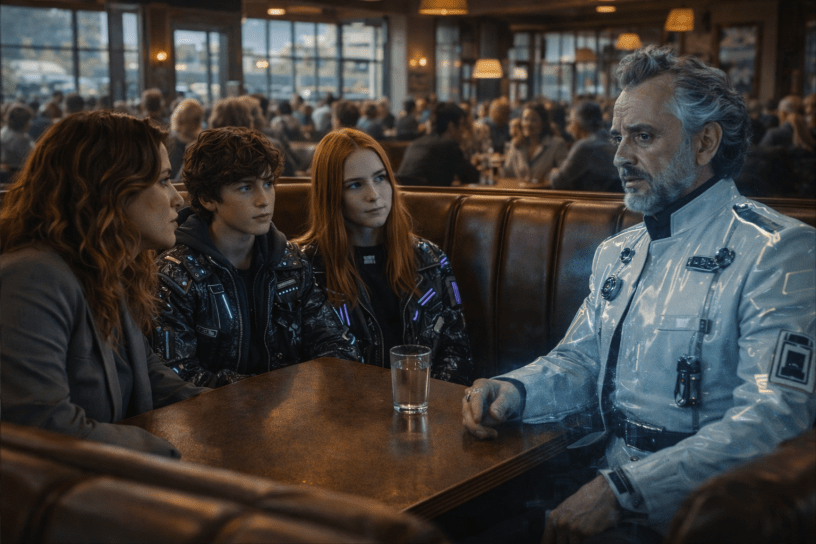
Jerry smiled amicably and motioned the three to follow him through the crowd to a corner table near the back of the room. Already seated at the table was the projected holo of Abil Halferne. Serah wasn’t sure what she expected to feel upon seeing him — recognition, familiarity, satisfaction — as she gazed into the eyes of the man for the first time, she felt absolutely nothing. His appearance was somewhat thinner and younger than she expected, obviously patterned on his age when he was killed, at least according to the official record. His face was expressionless, and he showed no sign of recognition when the group sat down at the table with him.
“Hello, Dr. Halferne. My name is Serah Wyles. I’m a reporter with Neward and Provident. These are my friends, Xev and Yvet.”
“Please, it’s ‘Professor,’ he smiled slightly. “Doctor always sounds so formal and stuffy.”
“Of course,” Serah said. She realized she should have known this. The Halferne in the dreams also corrected her use of that honorific.
Yvet’s wrist terminal chimed. She quickly checked the display, her face turning ghostly white. “The shade. It’s active again. Probably looking for you. You don’t have much time. You better get what you need to know quickly.”
Serah nodded and turned back to Halferne. “Professor, you’re aware of the circumstances regarding your death, right?”
Halferne furrowed an eyebrow. “Yes, it’s a bit disturbing to know that. Even as an artificial construct, I’m not sure how to process it.” He smiled impishly.
“Suppose, hypothetically, that your death was somehow staged.”
“Okay,” he nodded. “Interesting idea. Why would that be?”
“You tell me. What were you working on at the time of the accident?”
He thought briefly and then said, “I don’t recall specifically.” Serah knew this was the SI’s way of representing the missing, or possibly classified, information. “The station itself was running a number of, shall we say, thought experiments. Everything from advanced propulsion to mass/energy transference to genetic engineering and extraterrestrial communication.”
“You were performing genetic engineering experiments?”
“No, no. We were a think tank. Almost everything was purely conjecture and debate. We had laboratories, but I’m afraid the only thing we really produced were publications.”
This train of thought was getting nowhere, Serah decided. Yvet shot her an urgent glance. “Professor, I don’t have much time, so I need to throw a lot of information at you. I’m pretty sure you, or someone you worked for, did fake your death. You’ve been in hiding for the past twenty-three years until suddenly this week, you came to Earth, where you were murdered by a person or persons unknown, but not before you dumped petabytes of information into my head with no real explanation of why or what I’m supposed to do with it. Our best information is that you had some sort of connection with a religious site somewhere in France. I have reason to believe it’s somewhere in southern France.” She rattled off the four names Xev had traced on the map. “I think the intention is that I get the information there before the people who killed you catch up to me. Maybe to someone who knows this trigger. Can you tell me if I’m correct and which one I need to get to?”
Halferne seemed almost horrified at the story. “My dear, I’m so sorry. I can’t imagine why I would involve an innocent,” he choked briefly and recovered, “innocent outsider. I’ve always maintained the highest ethical standards.” He appeared deep in thought.
“Serah, the shade,” Yvet prompted urgently.
“Shade?” asked Halferne.
“A malicious construct. SI like we’ve never seen before. It’s hopping between systems with almost impossible speed, corrupting everything in its path. It seems to be following Serah. We think it’s a tool being used by the people who killed you.”
Halferne froze in thought. Serah noted that the poet at the front of the room had changed tone and was now leading the audience in a chant of sorts. “Moloch! Moloch!” it kept repeating as the first word of a series of more aggressive stanzas than before.
Halferne was suddenly alert. His eyes widened. “How did I transfer this information to you?”
“While I was asleep. Through my dreamspinner via skullcap.”
Halferne nodded, speaking quickly and excitedly now. “Memory implant. Neural fiber simulation. Makes sense.”
“It does?”
“Yes, that amount of data can’t be sent in sequence; it needs to be broadcast, corrected, and reassembled later. Sequential, error-free transference would require correcting and assembling sections of information. Even tucked in a corner of your mind that you don’t use, that many synapses being connected and disconnected would drive you insane.”
“What I have is a jumbled-up bunch of data in the wrong order that’s probably at least partially corrupted, so it’s only of use to someone who can extract it. Which would explain why I can’t get anything useful out of the version of you that appears in my dreams.”
Halferne nodded. “It makes sense, too. I was working on that back in the wild 40s. Had to abandon it. Technology wasn’t adept enough at mapping the human mind to store it efficiently without driving the person mad. Unless, of course, that person had—”
“—a particularly well-organized brain,” Serah nodded. “Okay, you wouldn’t just store this. You’d want the person to access it or do something with it. You’re encoding something subconsciously, so my rational mind can’t make sense of it.”
“I imagine it couldn’t,” Halferne said offhandedly, deep in thought. “I suppose I would encode some kind of trigger. Like a post-hypnotic suggestion. Something that would access your subconscious mind while you’re still conscious.”
“Like what?”
“Oh, it could be anything: A word, an image, a song. Anything the brain can register would work, really. Again, I’m so sorry. I’m sure I was only trying to help.”
Serah laughed a little at this. “Help?! You’re the one who dragged me into this. You’ve gotten my friends either in over their heads, injured, or killed. Now, I’m being chased by interstellar assassins, psychopathic killers, Division 4, and the London Police to the far corners of Europe. To make matters worse, I’m not sure how much longer I have before I’m lobotomized by this stuff you’ve filled my head with and not provided an explanation on how to get it out. You call this helping?!”
“Maybe not,” Halferne frowned. But I wouldn’t have done it if it wasn’t absolutely necessary, and I would have had a plan. Let’s figure out this question of religious sites.”
“Is there anything the SI part of you can access and correlate with your historical information?”
Halferne sat motionless for a moment, then his eyes suddenly lit up.
“The Abbaye of Saint-Roman was purchased by a historical preservation corporation fifteen years ago. The corporation restored most of the standing structure, making it the surface cap of a massive underground data center. The company that bought the abbey is run by Dr. Stevn Ellis, who coincidentally–”
“Complexity Issues in Supporting Interaction Involving Intermediaries in Xenointeractive Systems! I’ve read it!”
Xev looked at her, confused. “I haven’t. What’s that got to do with anything?”
Serah shot him a frustrated look, “A long time ago, the dead guy who put a bunch of crap in my head wrote a book about talking to aliens with a guy who has built a high-tech lab under an ancient abbey up the street!”
“Aliens?!” His eyes grew wide. “So, you think the shade is—”
Instantly, Yvet extended an arm and grabbed Serah by the throat, pulling her backward from her chair and onto the floor.
“Yvet, what are you doing?!” Xev screamed and leaped up, trying to pull Yvet off of Serah. As a light projection, Halferne remained seated, though apparently horrified. With Xev providing a distraction, Serah was able to get one foot up and between her and her attacker. Kicking forward with all her might, she managed to push Yvet off of her and into Xev’s arms, where he quickly subdued her in a full nelson. Then suddenly, Yvet’s eyes rolled back in her head, and she went limp. Xev lowered her to the floor, where she quickly woke up again and began screaming, her fingers clawing at her scalp and face.
“Moloch,” the poet at the front of the room yelled, then went silent.
“What the hell’s going on?!” Xev yelled in frustration,
“Your so-called ‘shade,’“ Halferne frowned and nodded toward Yvet. “It’s not just computer systems it’s moving through.”
Serah’s jaw dropped. “It can take over people too?!”
“Through hardwires, yes. If I’m right, it probably doesn’t even know the difference between a human mind and a computer system. It’s just another construct to inhabit. Remember what I said about error-free transmissions through the central nervous system?”
Soranus, Ducard, the Division 4 agent at Calais. Serah connected several of the pieces in an instant.
“Moloch,” chanted the poet again. One by one, the computer-generated forms in the room began to disappear, starting at the far end of the room and advancing toward them. Serah estimated they had only seconds before Halferne disappeared.
“If I’m right, what I put in your head can stop it, but you’ve got to get to Ellis. He’ll know what to do.” He started to say something else, but suddenly vanished.
“Moloch.”
All computer-generated projections vanished, leaving approximately two dozen disgruntled human patrons sitting alone in a plain room lit only by emergency exit lights.
“We’ve got to get out of here,” Xev said nervously, dropping the raving Yvet to the floor.
What were formerly innocuous holo projectors suddenly erupted into loud jets of projected lightning that randomly and haphazardly licked their way around the room, dancing and bouncing off everything in their path. When they struck human flesh, the unfortunate victim shrieked briefly in agony and then collapsed to the floor a burned and smoldering husk.
Still on the floor after her ordeal with Yvet, Serah rolled under the table, watching the sparks and light flashes all around her. Desperately, she scanned the room from this vantage point, looking for the nearest exit, which she spotted four meters away, surrounded by dozens of randomly erupting jets of blue death.
The patrons began scurrying for the exits, most of which were cut down before getting near them.
“It has no way to see us,” Serah yelled over the noise. “It doesn’t know where we are. Just go!” She leaped to her feet and started pushing Xev toward the exit. Just a few steps away, she thought.
Suddenly, a bolt struck Xev, and Serah recoiled, feeling the lingering effects of the charge his body absorbed. He convulsed briefly, then collapsed, his heart having obviously been stopped. An instant later, the room went dark and silent. She was alone.
She didn’t question why now, of all times, the shade had decided to stop its assault. Instead, she leaped over Xev’s lifeless body and ran head-first toward the door, out into the daylight, and kept going until she was across the street.
© 2022 Darrin Snider. All Rights Reserved.
