
(Please bear with me while I attempt to ape the inimitable style of famed writer Dean Howell, just because I’m something of an ass.)
A few nights ago, I found myself sheltering in a bar during a tornado warning. You know, the way one does when it’s April in Indiana, only it was June, but never mind that. So, on the way to the bar, driving out of my suburban neighborhood, I saw a turkey vulture. It launched itself off my neighbor’s roof and sailed right alongside my car, stopping in front of the elementary school, never once flapping its wings. Its wingspan was probably five or six feet. Not enormous, but let’s face it, at 4:00 in the afternoon, when something that big swoops past you on the road, it’s still brown trousers time.
This got me thinking about my childhood in southern Illinois. Back in 1977, as impressionable youths, we all spoke in hushed whispers about “the Lawndale incident” to the point that whenever we were playing outside, there was always someone on watch for Thunderbirds. Of course, we never saw one, but seeing a Turkey Vulture come out of nowhere, even my adult brain’s first reaction was: “Holy crap! Pterodactyl!” I’m sure that if I were a 17th-century French explorer heading down the Mississippi, I would probably have said “Dragon.”
When I was even younger, I lived in western Illinois, in a town called Alton. One of Alton’s many claims to fame was a giant cliff painting of the legendary Piasa bird. Now the authenticity is somewhat debated, but during the Lawndale incident, several scientists on the news suggested that the bluff caves near the Piasa painting would be an ideal nesting place for Thunderbirds and/or Turkey Vultures. So, wait, the Piasa might have been real?! I thought it was just a cool cliff painting that my grandfather and I used to go and throw rocks at for fun.
So, as a child, it was a legend; then it was sort of true. As an adult, in the middle of a tornado warning, it was an idea about how people create meaning. I ended up Googling the aforementioned links and others from half-forgotten 50-year-old memories, and the deeper I dug, the less interested I became in whether the Piasa was real. Instead, I became fascinated by the town of Alton itself, and my family’s history in that area, which is full of river culture, boatyards, taverns, bootlegging, industrialization, and a thousand legends.
My mother’s father worked in the boatyards at Grafton. My father’s grandfather was a French immigrant who owned a tavern in Wood River during Prohibition. Later, both sides of the family converged in the industrial corridor around Alton and East Alton. Both of my grandfathers worked at the Shell Oil refinery. Both of my grandmothers worked at the Olin Brass plant. My parents attended high school together. It was all a very lucky convergence from my perspective, and it fascinates me, not because the 1940’s and 50s were better than today or part of some romantic golden age, but because I really wanted to understand the line that led all of that to a guy on a barstool with a phone connected to a global information network 80 years later.
My grandmother lived (and died) in a house across the street from the brass plant where she worked. She said she stressed out over money because the mortgage payment was around $20 a month in 1946. Meanwhile, I report to a manager in Derby, England, whom I have never met in person. Those are not simply different jobs; those are completely different realities. My grandmother’s world was local; mine is global. Her friendships were built on proximity; mine are built on affinity and shared obscure interests.
I still exchange messages with people from all over the world that I met through my community radio explorations more than a decade ago. Simon Saynor, former radio presenter from Doncaster, UK (bless his artificial aortic valve), sent me a birthday video a couple of weeks ago. Meanwhile, I recently learned my college girlfriend died a year ago, because I don’t pay attention to social media. I know people on other continents better than I know the woman who lives next door … you know … whatshername … with the dogs. That feels simultaneously wonderful and strange.
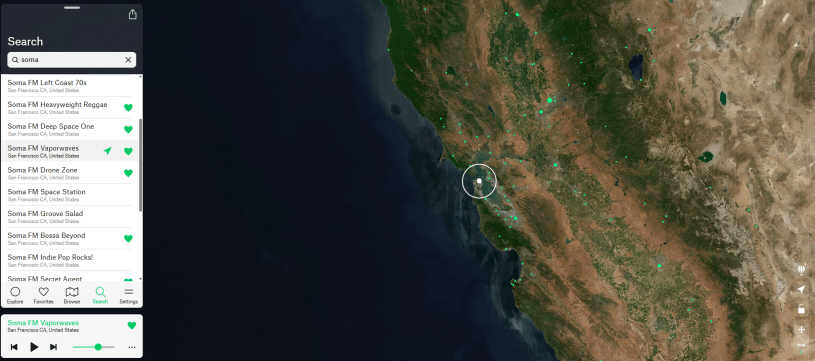
Which brings me to vaporwave, and radio preset #46. Vaporwave fascinates me because it seems uniquely suited to how my reality works. Unlike most genres, it’s not something you’re going to hear in a club or on a radio station. Your town doesn’t have a local vaporwave scene. You likely can’t go to Indy CD and Vinyl and ask for the latest vaporwave album. This is music that emerged from modern reality and can only really exist in modern reality.
Vaporwave is about fragments: samples of old commercials, mall music, smooth jazz, corporate optimism. You know, the soundtrack of a future that everyone in the 80’s pictured, but never quite had. Then it slows those fragments down (like playing your 45 single at 33 rpm) and layers them into memories you don’t have.
I occasionally pull this station up while I’m working, usually when my usual drum and bass, lo-fi, or jazz-hop playlist is getting old. Vaporwave occupies just enough of my attention span to satiate the right side of my brain (you know the one that crafts 1500-word blog posts about vultures, native american myths, river towns, family history, and liminal music) so the left side can focus on programming the conditional access policy for the company’s govcloud. However, it also fails miserably sometimes because, unlike dnb or jazz-hop, vaporwave is more archaeology than music. I can be happily bobbing my head along when suddenly a specific sample appears. Wait, I know that! Don’t I? Is that….? Suddenly, the music stops being background, and I’m opening a new browser tab to Google the name of that song on the B-side of a Gary Wright 45 I had when I was 8. This music is diabolical with its obscure references!
Things like that made me wonder who the audience for vaporwave actually is. I don’t picture teenagers sitting around in a basement with a stack of their vinyl like we did. “Hey, bring your Iron Maiden, and I’ll bring my AC/DC. Doug’s coming with the Judas Priest he bought yesterday.” Definitely not seeing that. In fact, I’m picturing middle-aged technology workers with too many browser tabs open, trying to slow their thoughts down as they navigate a ping trace across 10 different subnets. I mean, it has to be people who remember enough of the source material to feel a strange sense of recognition with the music and who will also hear a sample and immediately begin investigating it so they can send a DM to the artist acknowledging his cleverness.
Wait … that guy sounds strangely familiar.
Maybe that’s why the genre resonates. It’s not so much about nostalgia for the past. It’s more about taking the past and seeing how it can still relate to a modern setting. That’s the same reason I study family history, write science fiction, and craft blog posts where I try to relate a vulture encounter to a genre of music. I don’t so much care about the answers, I just find the trajectory fascinating. How did the grandson of a boatwright become a cloud engineer? How did small river-town communities turn into global peer groups in two generations? How did an oil and steel culture become a network culture in just a couple of decades? Then, the big question: What the heck are my grandkids going to be like when they’re my age? Every generation thinks its world is “normal,” but really, it’s always been liminal.
