
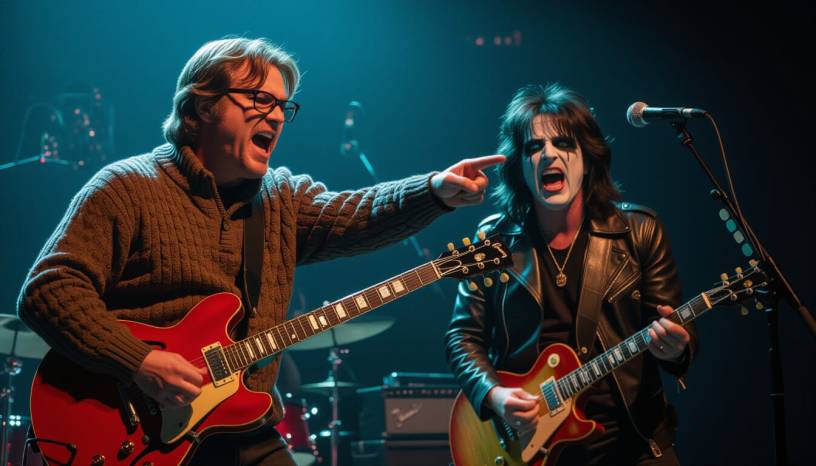
In general, I like cover songs. I should probably establish this before I spend the next several minutes arguing that most of them have no reason to exist. There is a particular little disappointment that comes from discovering that a band you love has covered a song you love. On paper, this should be wonderful, an intersection of musical likes. It’s a Reese’s Cup, or bacon on a cheeseburger.
Of course, sometimes you listen, and you’re thinking, “Yep. That absolutely sounds like … that song … being played by that band.” Now you ask the question nobody involved in the recording session did: “Why?!”
Perfect example: Guns N’ Roses covering Nazareth’s “Hair of the Dog.” It’s fun. Axl Rose is perfectly suited to it. The guitars sound great. Nothing is wrong with it. Except that for almost a month, I was asking, “Why is Nazareth suddenly getting a ton of airplay? Did Dan McCafferty pass away?” Then someone pointed out it was GnR. Who knew!?
Fair, but unless you’re a bar band/paid jukebox, if you’re going to cover a song, you’ve got an obligation to add to it other than a “royalty grab.” To that end, I’ve decided there are nine ways to go. Eight are musical; one is strategic.
1. Recreation: We Like This Song Too
This is “Hair of the Dog.” GnR didn’t find anything new in that song. They didn’t subvert it or reinterpret it. They said, “We like this song and are also capable of playing it.” It’s fine. Musicians have been playing other people’s songs since 15 minutes after music was invented. Still, if your version sounds essentially like the original except that you are playing it, congratulations: you’re now a very expensive bar band.
2. Transformation: Change What the Song Means
A Perfect Circle’s “Imagine” is exemplary in this regard. John Lennon sang about utopia with sincerity — no possessions, no countries, no religion. It’s the Lego song of 1971 — everything is awesome! On the other hand, A Perfect Circle sings it in their own style, and suddenly utopia becomes some kind of imposed conformity that maybe we should rethink. Or maybe that’s just my read. They didn’t change a word, just the mood, and to my ear, at least, it sounds like repeating someone’s words back at them with sarcasm.
The key for me is that it doesn’t replace the original. In fact, it requires the original to make its point. That’s a cover worth making.
3. Misunderstanding: Do You Even Get Why This Song Worked?
I recently discovered Wye Oak’s cover of Kate Bush’s “Running Up That Hill.” Oddly enough, this should have been specifically engineered for my enjoyment. I love Wye Oak. I love the song. Their atmospheric, melancholy, textural approach seems ideally suited to Kate Bush … until they bored me … which, admittedly, takes effort.
The problem is that “Running Up That Hill” isn’t great because it’s dreamy and atmospheric. Those qualities are there, but that relentless drum beat is the song. Kate is bargaining, pleading, obsessing, trying to make it up a hill while that drum part, which required multiple musicians and specialized instruments to create, is the thing pushing her forward and threatening to run her over. Wye Oak wasn’t running up a hill so much as meandering up a slight incline.
So, if A Perfect Circle came in with a paintbrush, rearranged your furniture, and repainted your room, then Wye Oak came in with a sledgehammer and took out the load-bearing supports.
4. Excavation: Find the Other Song Hiding Inside
Similar but more subtle than these two possibilities is a cover that reveals an entirely different, better song hidden beneath the original. I’ll submit Joe Cocker’s “With a Little Help from My Friends” as my textbook case. The Beatles’ version is charming and friendly. Ringo asks whether he can get by with a little help from his friends, and you think, “Yes, of course you can, Ringo. We know your friends. John, Paul, and George are pretty awesome, and we’re here for you as well.”
Cocker sounds like he’s alone and destitute. “Do you need anybody?”
“Yes! Please, dammit, anybody?! Can you recommend a therapist or crisis interventionist?!”
Johnny Cash accomplished something similar with Nine Inch Nails’ “Hurt.” He didn’t need to rewrite it or substantially change the mood, just the singer’s context. Trent’s bottom of a self-destructive path became an old man’s accounting. Both versions of the song were in there the whole time.
5. Revelation: Make Me Rethink the Original Artist
This is one of my favorites. Tom Jones and the Cardigans cover Talking Heads’ “Burning Down the House.” Tom Jones pops up with that charming grin, huge voice, and exactly the sort of swagger you’d expect from a man indeed about to burn down a house.
This one made me rethink David Byrne differently. Was he doing a send-up of Tom Jones all that time? Or … wait … is that what David thinks he sounds like? Are the Talking Heads a secret funk/dance band, and we got all hung up on the wacky stage presence and boops and beeps from the synths? Tom Jones didn’t just make a fun version of the song. He changed how I perceived it. That’s something.
6. Conquest: Thanks, We’ll Take It From Here
Some performers don’t really cover songs. They annex them. Aretha Franklin’s “R.E.S.P.E.C.T.,” Elvis’s “Hound Dog,” Zeppelin’s “When the Levee Breaks,” Cocker’s “Feelin’ Alright,” Hendrix’s “All Along the Watchtower.” Half the time, we forget who did the original or that it even existed. Half the time, the original artist even accepts this and simply enjoys the checks.
7. Genre Tourism: I Love This Music and Want to Play Too
Sometimes, there are covers whose entire appeal comes from hearing someone enthusiastically wander into a genre where they don’t normally belong. Pat Boone does a metal album. William Shatner croons spoken-word rock songs. Dave Grohl reinvents himself as the Dee Gees. Yes, five middle-class British white guys put their spin on American soul, funk, and R&B master Ritchie Havens’ “No Opportunity Necessary.” Usually, these run the risk of being borderline kitsch and of being played for laughs: “Isn’t it hilarious that I’m singing this song?” Yet, there’s also an element of the artist saying, “I genuinely love this, and it’s really good in any context if you stop and think about it.”
8. Foregone Conclusion: Of Course You Covered This
Our penultimate category is the cover that ought to be great. You didn’t do anything wrong in your interpretation, but it turns out I just didn’t need it in my life as much as I thought. For this, I give you Oingo Boingo covering “I Am the Walrus.”
Of course, Oingo Boingo can cover “I Am the Walrus.” Danny Elfman understands theatrical absurdity. The band has the chops. Psychedelic carnival grotesquerie sits comfortably inside their musical vocabulary. Unfortunately, instead of a great new take on one of my favorite Beatles songs, it only really proves that even Elfman can’t out-weird the Beatles on that one.
If we use the earlier metaphor with APC and Wye Oak trashing your living room, it’s largely the opposite of those two. Oingo Boingo moved one couch slightly to the left and installed a second, identical load-bearing wall immediately beside what was already there.
9. Music 2.0: The Trojan Horse Cover
This one is about marketing more than performance. There is a tactic/gimmic proposed in the book “Music 2.0,” which is the “Anarchist Cookbook” for independent musicians looking to make a living at this, and I’ve seen a few local artists pull it off with varying degrees of success. The idea is that you find a song that is overly generic and popular, is complementary (but not completely within) your style, and whose audience has a significant overlap with yours. Then, for approximately $300 to the Harry Fox Agency, you can release a cover version of that song played in your style on Spotify.
Why, you may ask?
Simple. You’re not trying to improve “Wagon Wheel,” “Wonderwall,” “Mustang Sally,” or “Brown-Eyed Girl.” You aren’t trying to make anyone reconsider those songs. You just need to play them as yourself. That way, when somebody on Spotify pulls up your version, and they ask, “Who the hell did this!?” Click. Suddenly, they’re on your artist page, checking out your original music.
It’s the Trojan Horse Cover: You came here for a song you already know. While you’re here, meet the artist you don’t. So, unlike the previous cases, you don’t need to justify the reason you are doing a version of the song. Maybe you should still ask what you want the person to hear about your style when you choose the song, but you don’t need them to prefer your version or justify your take on it. You just need to engage their curiosity about you.
So, we’ll always need covers. Heck, every classical music concert is technically a cover performance if you think about it. I accept this. Whether the goal is to cash in on royalties, change the audience’s mind, make someone rediscover a song, pay tribute to a hero, or trick someone into exploring your back catalog, the goal is still to provoke and entertain, so I say, keep them coming.
