
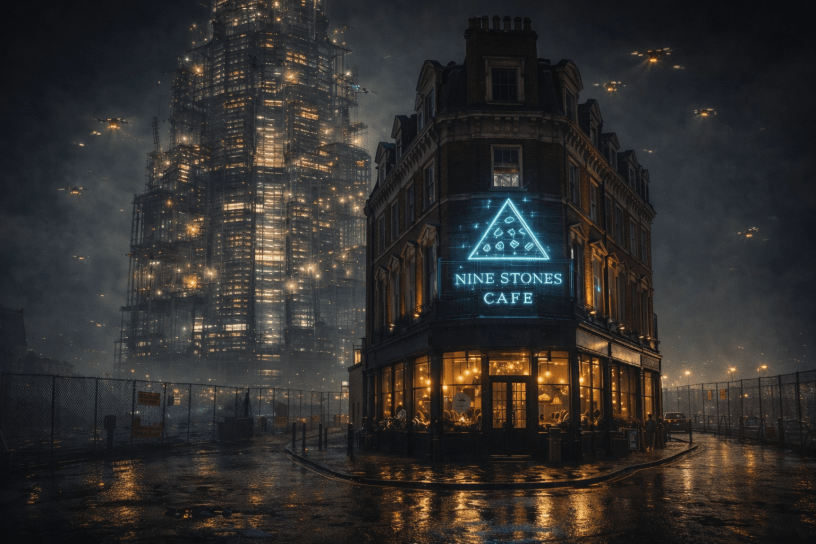
The Kensington-Chelsea dome was subdued for a weekday rush hour. Just after 5:00 PM, the air taxi dropped Serah off in front of the Nine Stones Café, an unassuming, stone structure at the point of a three-way intersection, now free-standing for the first time in centuries. She fought back swelling emotions when she saw the once-familiar building, now falling into disrepair. It was one of the last survivors of a centuries-old London that was being rapidly dismantled, yet it still wasn’t considered “historically significant.” She decided this ironically mimicked the way Nine Stones had defined fashion and popular culture much of the time, yet would still never qualify as “rebellious” or “underground.” Both the building and the business were home to many people over the years, but neither was anyone’s hill to die on.
“Coffee culture” was a twenty- to twenty-five-year cycle, and five years ago Serah was one of the last clingers-on. Given another generation, it may have gotten a new life; instead, looming on the horizon, now less than a block away, the enormous plascrete pylons of the Knightsbridge-Belgravia Arcology rose nearly a kilometer into the air and formed a dimly lit skeleton of what would someday be the fourth most prominent structure in the London Metroplex. It had been slowly growing upward and outward for two years now, and it would be another four years before the work was completed. Still, in 52 days – according to an automated, predetermined schedule that never varied by more than a percentage point – fabricators would start breaking down raw materials on this block and grinding them into their constituent chemicals. Some would be reconstituted into the plascrete and concrete of the new arcology tower. In contrast, others would become an organic restoration compound used to kick-start and accelerate the growth of parks and preserves around the rest of the footprint.
Eventually the arco would house hundreds of businesses, factories, data centers, and living space for up to 200,000 Phramers and fluids. The particles that made up Nine Stones would be part of the particles that made up the new arcology, along with an estimated 20 square kilometers of similar urban sprawl, most of which would be land returned to nature for the first time in centuries.
Serah passed through the glass entryway into the cafe. While the exterior façade was mid-19th-century, the interior was a hodgepodge of the 20th and 21st centuries, although it was unlikely that any of the patrons noticed the incongruity. The energy was a bit livelier than the subdued streets outside and nothing like what she remembered. Five years suddenly seemed like an eternity. The furniture had been reupholstered to a more contemporary color. The music was more danceable and less jazzy. The scent of brewing coffee was, at least, precisely the same, triggering memories and emotions from another version of her in another time.
The clientele were the biggest change. She remembered a less fashionable and more free-spirited crowd, or maybe that was self-projection. The patrons seemed far younger than she had been, and they busied themselves telling stories in larger groups, where the word “I” occurred far more frequently than average. None of them impressed her as being writers, musicians, or artists.
She thought about her old friends and wondered if they had heard about the imminent demolition. Perhaps they had. Perhaps some had already even left their homes for the first time in years to pay their respects. Perhaps, like her, they didn’t want to admit they still clung to those memories. The few she still heard from — via the occasional vidcall, birth announcement, or holiday letter — seemed content enough with their lives. Maybe it just took a more significant occasion to get them to disconnect and drag themselves back to the Root Realm. She couldn’t condemn them for that. She’d given up the dream of the dramaturge for the reality of journalism, after all. The steady paycheck made the sacrifice of some dreams bearable.
She began to relax for the first time in two days. Nine Stones still felt like home, at least. She didn’t know anyone, and didn’t expect to, but this was the one place where that was okay, if not preferred.
Most of the patrons sat in groups. A few stragglers at the counter were easily identified as degenerate fluids looking for a flesh experience to break up the monotony of the Phrame raves. The others were freelance billys looking to rope in any sucker they could find to meet their monthly quota. She didn’t need skill to tell the difference.
One man, in particular, caught her eye as if something in the back of her mind was screaming at her in an attempt to point him out. He was slightly older than her, probably early 30s, too old to be sitting alone in a coffee house that catered to the student crowd. His hair and tanned complexion were darker than a dome-dweller’s, and his eyes were an unusual shade of steel gray, no doubt courtesy of artificial augmentation. Twice, she surreptitiously looked his way, and both times found his eyes fixated on her. Though he had a friendly, approachable smile, it somehow seemed practiced, almost forced or … trace-like. She was flattered that the socially dysfunctional still considered her attractive enough to stare, but there was a fine line between flirty and predatory. She avoided making eye contact again, but she imagined she could still feel his cold, unrelenting stare.
Serah began to think she might be making a mistake. Even if Michael … Robert … had been here, she couldn’t be confident that whatever led to his murder was related to this place and would have left some clue behind. It was doubtful anybody here would have seen anything remotely useful to her. Besides, it would be foolish to simply walk up to one of the large tables of people and ask who had seen a murder yesterday. For now, however, it was the only real lead she had. At least it was a good excuse to revisit Nine Stones and let it forcefully demonstrate the adage, “you can’t go back.”
She decided to have a couple of cups of coffee. It wasn’t as if she had more pressing things waiting for her at home, and somehow, being alone in the crowded room made her feel as if she were socializing, which she rarely did. She took a seat on an oversized couch in the corner, pulling up the personal directory on her trusty datapad. Her thumb scanned a long list of forgotten projects until she found the one she wanted: “Night Owl.” She hadn’t thought about the story in years, when she jotted down the first 2000 words on the very couch where she was sitting – accepting a juvenile challenge with her friends to see who could write a 50,000-word novel the quickest. It was going to be her first masterpiece. It ended up being an insurmountable battle against mediocrity. She smiled as she read through the half-finished draft, a period piece set back in the romantic mid-21st Century. The writing was a bit ambitious, almost naïve, but still nothing that couldn’t be salvaged by the talents she had honed over the years. It was always a shame to let any kind of creativity go without at least salvaging some knowledge or experience from it.
She felt the room stir uneasily. In the corner of her vision, the mysterious man had stood up and was walking toward her. She didn’t dare look up from the pad and acknowledge him, but what felt like icy pins and needles hitting her skin told her exactly where he was. Every instinct she had screamed, “Danger,” even though, consciously, she said she was completely safe, even in this crowd.
“Welcome back,” a voice said next to her.
She yelped in surprise—a kindly-faced waiter standing over her. “I took the liberty of bringing you your usual. I hope that’s okay.”
Distracted, she thanked the waiter and took the cup from the tray. She couldn’t see him, but somehow knew the mysterious man had stopped right behind the couch she was sitting on, possibly waiting for the waiter to leave before he made his move, or introduced himself, or tried to sell her a cybernetic pillow. She inhaled the vapors from the thick brownish liquid in the cup. A rancid, musty scent burned at her nostrils. She squinted in disgust, spilling part of the contents onto her lap. Then, she quickly put the cup back on the tray. “Sorry, that’s not my order. What is that stuff!?” she asked between coughs.
“Thurinese Oolong,” the man said confusedly, taking a quick whiff to confirm that he was correct.
Still shaking off the sudden jolt from the intense odor, Serah realized the mysterious man had suddenly left, taking most of her ill-at-ease feelings with her. She regarded the waiter, trying to recognize the face. He was too young to have been working here when she was a regular patron. “Well then, my personal preference file must have corrupted over the years,” she said, hastily dabbing at the stain on her skirt.
“I’m sorry, I didn’t even check the database. I was certain I served you a half-dozen of these yesterday. It’s so rare that anyone drinks semi-fermented off-world tea that it stuck in my head.”
Serah shook her head. “Wasn’t me. I haven’t been here in years,” she said, smiling. “I’ll just have coffee, dark roast, black, double-sweet.” She grabbed her datapad and transmitted her cred-id to the waiter’s order pad.
“I’m sorry about that, miss. I must be working too hard. The faces are all blurring together. You know how it is.” He fiddled with a couple of displays on his tray and paused. “You’re certain you haven’t been here in years?”
“Positive.”
“You should call the police about an ID theft, then, Miss Wyles. It says you ordered five cups of Thurinese Oolong yesterday.”
“What?!” Serah strained to see the printout on the waiter’s tray. He obliged by kneeling so she could see clearly.
The screen displayed her current ID picture and her recent purchase history at Nine Stones. The first entries were dated five years earlier, and the last was made the previous day.
Serah gasped. “That’s odd. I was a bit out of it yesterday. Maybe I did come here. I suppose it’s possible. I honestly don’t remember.”
“Well, if it wasn’t you. The resemblance is uncanny.”
Her stomach sank as she thought about the missing hours in her memory. “Oh my god,” Serah gasped. “What time was that?”
He thumbed the display, bringing up the details. “You opened the tab at 11:10 AM and closed it at 12:50 PM,” he said.
Her stomach sank again. Her head spun as she suddenly had flashes of being there. Whether it was real or imagined, she could suddenly taste the foul tea. Her hands shook as she called up the police homicide file on her datapad. She scrolled through the pages, stopping on the picture of Robert Galloway. “This man,” she said half hysterically. Was I here with this man?”
The waiter regarded the picture. “Oh, he’s that billy those officers were asking about earlier. Like I told them, I only vaguely remember him. Those guys usually don’t order much and tip even less. Now that you mention it, though, he did try to talk to you, but you ignored him. You were very deep in thought, but since your account was good, I kept bringing you tea.” He paused for a moment. “You really don’t remember this?”
“No, I don’t, but I’m starting to think this man must have drugged me somehow.” Her heart skipped a few beats, and she forced herself to breathe slower and deeper. “Tell me everything you remember.”
The waiter thought for a moment. “Heck, I don’t know. Like I told the officers, it was the lunch rush. I really wasn’t paying much attention.”
“Please, try to remember. It’s very important.”
The waiter closed his eyes. “Let’s see. You were sitting right here, where you are now, in fact. Spent most of your time staring out the window at all the construction out back.” He spoke slowly, carefully running over the sequence in his mind. “That billy came in and walked up to you straight away. You might have talked to him for at most a few minutes. Then he gave up, went over to the other side of the room, and talked to some of the other billys — trading contacts or leads or some such thing, I guess. I don’t think he spoke to anyone after that. You both left about the same time, though. I don’t know if you talked more outside. As I said, it was the lunch rush.”
The room was spinning faster now, and Serah’s stomach was turning circles. She remembered feeling like this in the conference room the day before. Whatever it was, it was happening again. She started shaking. “I have to get some air,” she said, her voice cracking. She forced herself to her feet and stumbled toward the door.
“Do you still want that coffee?” the waiter called after her.
She staggered into the street, bracing herself on the side of the building as the world swam sickeningly around her. The taste of salt crept into the corners of her mouth. She was on the verge of throwing up.
She kept telling herself to calm down. She couldn’t have done what she was thinking. Even if that billy had drugged her somehow, she wasn’t capable of something like that. Was she?
She wanted to scream. Tears of terror and frustration pushed their way to the surface. She stumbled away from the café, half trotting, grabbing hold of whatever she could to help her stay on her feet. Fighting the whole time to keep the contents of her stomach from coming up, she finally stopped a few hundred meters up the street, clutching the security fence that separated the plaza’s construction site from the general public.
It was getting dark now. Even with the construction site’s myriad lamps, glow streets, and lighted pylons, the neighborhood seemed even more eerie and run-down than at dusk. Though she could hear the rumble of machinery and the voices of workers in the distance, she understood at least how, even in the daylight, somebody could commit murder and move a body unseen.
She couldn’t have done that though, she reminded herself. She’d never been violent in her life. She was usually a victim. Perhaps she killed him in self-defense, and that’s why she can’t remember — repressed memory. Michael … Robert … could have assaulted her, and she fought back, somehow finding something to stab him with. Maybe she was subconsciously repressing the horrific memories. She struggled desperately to remember anything, even a vague impression. Nothing. It couldn’t have been that anyway. She had no bruises or cuts, nothing to indicate any kind of physical assault.
None of it made sense. She grasped the fence with both hands, her fingers growing numb with the pressure. She pressed her face to the cold metal and stared at the wondrous, kilometer-tall support pylons, illuminated in a sickly violet glow against a backdrop of stars. She felt a strange sense of déjà vu. The whole site seemed eerily familiar.
An repulsor sounded in the distance, growing steadily louder. A hovercar came into view, passed almost directly overhead, and streaked into the unfinished structure of the building. Its brilliant navigational searchlights traced streaks along the lift shafts as it sped several hundred yards inward, turned sharply, and vanished from sight. As the echo of the car’s engines faded, a series of images ignited in her mind.
The dream, the first one, two nights ago. The reflecting lights from the passing hovercar striking the support pylons were eerily like the light sparks on the towers in her dream. It was as if her subconscious was trying to tell her something. Perhaps she had been to the construction site before as well. Or perhaps she was merely connecting unrelated points. Either way, the answers had to be with those towers.
Pulling her bag around her neck to secure it, Serah quickly scaled the short wire fence. A few minutes ago, she would never have been able to make that climb, but now she was renewed with a sense of purpose. She took a dozen strides across mud and gravel, stopping when she reached the paved access road that led into the sublevels of the Plaza. She had expected everything to look like it had in the dream, but it was much darker, quieter, and even more maze-like. Above her, the illuminated support beams glowed with life and activity as assemblers hovered around like chattering insects carrying enormous support girders.
Serah cursed herself for being so foolish. The Arco construction site was several kilometers long. The odds of finding anything of value, on foot and in the dark, were slim at best. Still, she had to know, so she followed each instinct or first impression, attempting to let her subconscious guide her through the maze of structures, just as the conveyor belt had done in her dream. After a hundred meters or so, the lights from the street were no longer visible, and the work lights above her provided barely enough illumination to keep her from tripping, perhaps even falling into an open maintenance shaft. At least, she hoped they were enough.
She guided herself along the makeshift walls of support beams with her hands, trying to make as little noise as possible. Every few meters, she looked back, trying to maintain her orientation to find the way out again. She was about to give up hope when she heard voices in the distance. They were faint at first but grew steadily louder as she moved through the darkness.
Eventually, she noticed a distant glow of light on her right. She picked up her pace and cautiously made her way toward them, hoping to make up for lost time. The ground gradually sloped downward into a service area. Obviously, this was the central processing point for HVAC and plumbing judging by the abundance of ducts …
… and pipes.
Dream or not, she was certain she had been here before.
© 2022 Darrin Snider. All Rights Reserved.
