
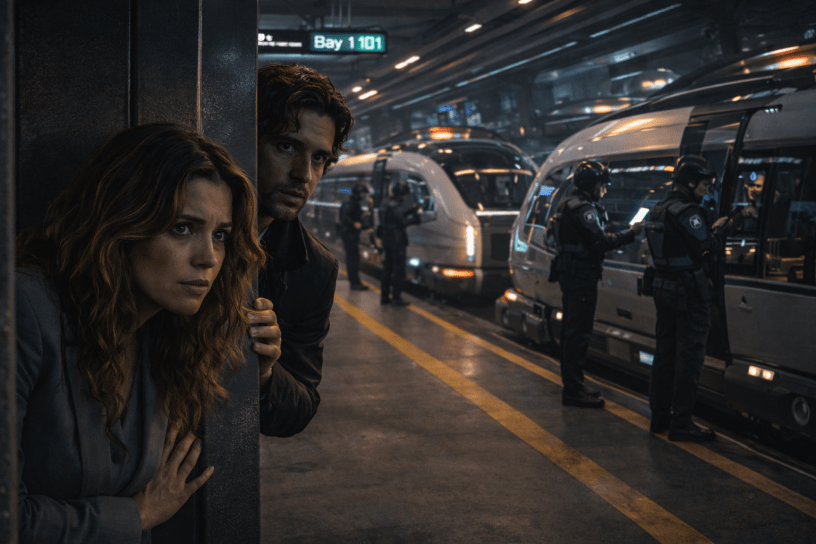
Croydon station at night, while not overly crowded, was an odd intersection of all walks of life. Businessmen, operating on American hours, were making their daily commute. Discount adventurers were buying cheap seats to European destinations. Tourists were visiting London, some for the first time. Then, there was the usual assortment of billys, scoundrels, madmen, and the homeless. Though none of them paid her any mind, Serah felt ill at ease.
A small market had formed around a bonfire of refuse and makeshift tents. Gaunt figures wearing thin clothing had spread out stacks of random items for sale. She glanced at all of the offerings, making sure to give the impression of mere casual interest. The selection was much more limited than Spitalfields’.
Erik was dead now, she thought. In fact, Erik never really existed at all. “Wendi,” however, remained a mystery. What were they actually like? Who was the closest accurate representation of their personality? Flo? Erik? One of the other dozen aliases they used regularly in their virtual life? They kept a holophoto of Serah in their apartment. Why? Surely, it wasn’t some kind of sexual attraction. It almost felt like maternal pride. Why had Erik never indicated such feelings, at least until she met them as Flo? Had Serah lost a co-worker, a friend, or someone who had thought of her secretly as a daughter for the past five years and was just unable or unwilling to show it? There needed to be more time to process this on top of everything else that was going on. She promised herself she would thoroughly investigate Erik’s past when she returned to work.
Work. She shuddered. Should she inform Henry? Had the police already done that? Would they even think to? She felt like she should be the one to do it, but given her current fugitive status, it would be highly unwise to make any type of contact with NPNA. Was she even a fugitive if it was a police officer who convinced her to run? Things were moving so fast now that she couldn’t find the time to process any of it. Maybe Henry was right. Perhaps she wasn’t cut out for this kind of fieldwork. On the other hand, she was still alive.
Finally, she saw what she was looking for. On the corner of a red blanket, amidst a jumble of vidscreen and hoverdrone parts, was an intact datapad, left on to demonstrate that it was functional. It was approximately seven years old, small, and sleek — nothing at all like her lamented 20-year-old bulky pad. She caught the attention of the man sitting in front of the blanket and pointed at the pad.
“Two hundred,” the man croaked. The price was a bit steep, and they both knew it.
“One hundred?” Serah offered, wondering how much English the man spoke.
“One seventy-five,” came the exact response and voice inflection she expected.
“One twenty-five,” she countered, knowing she only had 150 cash.
The man scowled. “One fifty, and that is as low as I will go.”
Serah thought for a moment. She needed that pad to get anywhere in this case. She hoped her desperation didn’t show on her face. Finally, she reached into her pack, extracted the credslips, and handed them to the man, hoping Parrino could finance whatever else was needed for this little adventure.
The datapad was just too modern for her tastes. It distinctly lacked any kind of charm. It even had a gaudy, oversized neural interface wire and jack fastened to the top, worthless to her and yet another constant reminder she just didn’t fit in. She crouched behind a food stand serving a particularly odorous meat wrapped in a pita. She kept one eye on the stairway of the main entrance and hastily pulled her personal data off the Phrame and onto the pad. Parrino assured her that, given the question of Division or local jurisdiction, Mak would not be able to get a warrant to monitor her private transmissions for at least two hours. This meant she would only have about 90 minutes left to use it before she was forced to keep it in “isolation mode.”
The pad indicated a complete transfer. Serah switched it off, folded it over, and shoved it into the inside pocket of her coat. So, she thought, at least there was one advantage over her bulky old antique.
She spotted Parrino walking down the stairs of the main entrance and relaxed for the first time in an hour. He picked up his pace and reached her side shortly after reaching the entrance to the loading platforms.
“Two black market tickets to Calais, departing in fifteen minutes from platform 54, standard class, no frills, pre-cleared border passes included. Sorry, no dinner service, but don’t worry, I’ve brought provisions.” He handed her a processed protein bar.
“Ugh,” she sighed, slipping it into her back pocket.
“Best I could do with a credslip,” he said.
They followed the signs for platform 54. When they were fifty meters away, Parrino grabbed Serah’s shoulder and walked her over to a large column. Serah peeked around the side at the levtrain they were to board.
“The platform’s crawling with policemen,” she whispered.
Parrino shook his head, “I wouldn’t say crawling.” He watched the train for a few moments and counted seven officers. “That’s pretty standard for hunting down murder suspects and rogue policemen.”
“So, how are we going to get on the train?”
“Give it time,” he said confidently.
Suddenly, the officers looked at each other in unison and ran toward them.
“Oh, no!” Serah yelled.
Parrino put a finger over her lips. “Keep calm and don’t look around. Keep your eyes focused on me.”
Serah did as she was told, and a few seconds later, the officers ran straight past them.
“Now, we board our train.” Parrino pointed her toward the last car and started walking her forward. “Keep your head down, and don’t look around. Mak will be controlling all of the vidcams.”
“What just happened?” Serah asked, confused.
“Misdirection,” he said. “I spotted a known petty thief at the black market. I figured Mak would flag every account I had, so I let the thief pick my coat pocket, where I just happened to leave him a fake ID and credslip that were tied to an old undercover identity of mine –the kind of thing Mak would expect me to use in a situation like this. As soon as the thief tried to use it, he set off a perimeter alert, and every available officer ran in to catch him. I’ll consider the arrest of a petty thief small payment for the blow to Mak’s ego.”
They flashed their tickets, boarded the train, and took seats in the rear-most car, facing each other. It was rare for someone to escape a London Metropolitan Police Department manhunt; even more rare to escape one of their finest transhuman officers. Five minutes later, the train was underway. They had done it.
Serah was surprised that the tube ride was neither as bumpy nor fast as she remembered from her dream. The sickening sensation was still there, though not from motion this time. Strangers were dead because of her, her friends were dead because of her, and now Parrino’s partnership and probably his career were ruined because of her. Strange assassins disguised as Division 4 agents were one thing, but now Parrino had jeopardized his career. Was all of this worth it? Could she not have just let the dead stay dead and dealt with a few crazy dreams?
Parrino sat in the forward-facing seat opposite her. Whenever her gaze met his, he smiled reassuringly, obviously reading her concern.
“Tired?” he asked jokingly.
Serah raised one eyebrow and managed a smirk. “You would be, too, if the only uninterrupted sleep you’d gotten for three days was because some mysterious psychopath bashed you on the head with the butt of a plaser before trying to kill you.”
Parrino laughed, nodded, and sat back in his seat. “You may have a point there. So, try to get a nap in now. We’re not going to be able to stop moving when we hit Calais. Trust me, Mak won’t be fooled again.”
“I’m so sorry about that. Believe me, I–”
“You didn’t wake up this morning thinking you were going to bust up a five-year partnership and possibly ruin the career of a handsome young police detective? I know you didn’t. We’re all doing what we think is right.”
“It’s right, but is it worth it?”
“I find it’s best never to ask yourself that question until it’s done. Now, why don’t you take that nap?”
Serah yawned and shook her head. “I’ll sleep when this is all over. Besides, I don’t like to sleep without my dreamspinner.”
“That’s funny, you know. The girl who hates the Phrame, shuns most modern technology, and doesn’t even have a neural jack, completely depends on a computer to control her sleep.”
“Yeah, I’ve never really fit in anywhere, I suppose.” She shrugged.
“Oooh, now, there’s a setup for a story I need to hear.”
Serah shrugged and stared out the window. “When I was a child, I had nightmares.”
“All children have nightmares,” Parrino said reassuringly.
Serah shook her head. “No, not like these.” She closed her eyes as a chill passed up her back. “I was an orphan. Nobody knows who my real parents were — or at least nobody will say. The doctors all said my nightmares probably had something to do with a traumatic memory or some such thing.” She tapped her head and smiled sarcastically.
“What were the dreams about?”
“It’s difficult…” She paused and tilted her head. “You know how they say the scariest monsters are the ones you can’t see?”
“Sure.” Parrino nodded.
“It was like that … only you could … I suppose … feel them. As if they were conceptual. The dreams weren’t so much stories playing in my head, they were just the feelings I got from the stories … playing without context. Like watching a movie without the picture or the sound … but you’re still reacting to what’s happening.” She smiled a little. “I know it must sound weird to you.”
Parrino touched her knee, “You don’t have to talk about it if you don’t want to.”
Serah waved him off. “No, no, this is good. I haven’t really tried to find a way to express this in years. It’s easier to explain when you have more than a 4-year-old’s vocabulary and frame of reference.”
“All right, so tell me more about these non-existent movies?”
Serah thought momentarily, “Are you familiar with Carl Jung?”
“Look who you’re talking to,” Parrino quipped.
“He had a theory that all humans, regardless of culture, shared certain common images — embedded, I suppose you would say — in the wiring of our brains and passed down through our DNA. He used it to explain common themes that run through religion and art. No matter how old or isolated a culture is. There are things that we have basic common emotional responses to.”
“Like why vampires and zombies are universally frightening, or why babies and puppies are always cute and endearing,” Parrino followed the thought.
“Exactly. Or how combinations of certain musical chords played by certain instruments can make everyone feel sad or happy.”
“I’m with you.”
“So, that’s what the dreams were. They were just feelings of being trapped, helpless, abandoned … or like something horrible was about to happen to me … like, being moved to sadness by music that I couldn’t hear.”
“I’m sorry,” Parrino began, but Serah waved him off, smiling.
“Anyway, my foster parents were farmers—the old-fashioned kind—North Yorkshire Ag Preserve. They didn’t have much need for the Phrame, but since I was too young to be medicated, they compromised on the dreamspinner at the Doctor’s behest. Anyway, it cured the nightmares, I suppose. When I went to school in London, I took it with me. I mostly use it now to optimize and minimize my sleep cycle.”
“Why didn’t you get the neural jack when you moved out of your parent’s house?”
“I suppose, just because some of that reactionary upbringing stuck with me. Anyway, I never met Phramers or SI’s until I moved here. I guess they just seemed kind of hollow to me. I didn’t want to be like that.”
“Wait. Let me guess,” Parrino interrupted.” You used to be one of those bohemian artists … no, a novelist!” He snapped his fingers, “Nine Stones! You were all into that scene five years ago, weren’t you?”
Serah blushed, and Parrino smiled in satisfaction. “You probably think I’m a complete social misfit.”
Parrino shook his head, “Hey, we don’t make snap judgments.”
“You absolutely make snap judgments. You’re on this train with me because you have a hunch someone in France can help me.”
“Yes, but that’s not a ‘snap’ judgment.”
“How so?”
“Because I really didn’t like you at first. I thought you were one of those snooty, self-promoting reporters who always make the story about them.”
Serah started to protest, then stopped herself when she realized the joke. Parrino burst out laughing. After a minute, she joined him. It felt good, she decided, until the laughter stopped, and they were left awkwardly staring at each other.
Parrino broke the tension by leaning forward. With a conspiratorial tone, he said, “I’ll let you in on another little secret.”
“Oh, do tell,” Serah said, leaning forward.
He turned his head and pulled the hair back from the side of his neck to reveal nothing but bare skin. He smiled mischievously.
“Oh, great,” Serah sighed, sarcasm dripping in her voice, “I’m on a train to France with a complete social misfit. What’s YOUR excuse for shunning technology then?”
“I’m a policeman from a long line of policemen. I fully intended to get one put in, if anything, to make research more efficient. But, my first assignment out of the academy was infiltrating a slaver ring on the east end. It helped me pass as a helpless immigrant.” He sat back, his tone becoming quieter, “After that, I decided it would come in handy for undercover work. It’s much easier to fake having one than it is to fake not having one.”
Serah yawned again and rubbed her eyes. “Did you get the bad guys?” she asked.
“Don’t you worry,” Parrino said reassuringly. “I always get the bad guys.”
She stared out the window. The sun was just starting to come up over the water, exactly as it had in her dream. “Maybe so,” she said, “but this isn’t your fight anymore. You shouldn’t be here.”
When Parrino didn’t protest, Serah turned, half expecting to see him sleeping. Instead, he was staring blankly ahead, seemingly oblivious to her presence.
“Neither should you,” the voice was Abil Halferne’s.
She jerked her head toward the sound. He was sitting across the aisle in the front-facing seat. “What are you doing here?” She paused and then thought of the more obvious question, “How did you get here?”
“I’m not here,” Halferne smiled impishly. “Well, not really.”
Frustrated at the man’s continued predilection for riddles and nonsensical responses, Serah threw up her hands in disgust. Parrino continued to stare at nothing, occasionally turning his head to start at the nothing outside the window. She looked around the car. In every seat, she saw herself, at least thirty different versions, all dressed in the same clothes she was currently wearing. All of them were asleep.
“I’m sorry about the dreams. They were necessary. I had hoped not so cruel.”
“I don’t understand,” she growled to no one in particular.
“You’re beginning to.” Halferne nodded. “You started to see it earlier when you thought you were going to die. Didn’t you understand that sudden change? You were ready to die, and then you were prepared to risk everything to live.”
“Never mind.” Serah dismissed him, holding up her hands. “I don’t care what it’s about anymore. Right now, I just want you to tell me where I need to go to get whatever you’ve put in my head out so I can go back to a life where people don’t constantly want to kill me.”
Halferne scowled at her. “Such a lust for that life now.” He smiled, amused. “That’s not what you were thinking earlier in your apartment”
She ignored him. “Listen to me. I’m heading for Calais. At least, I think that’s what the instructions you gave me in the dream were. Am I right?”
“It’s all going to change soon enough,” Halferne continued, murmuring half to himself. “If we’re right, there’s so much coming. Wonders and terrors undreamt of.”
“Professor Halferne, where do I go when I reach Calais? Who knows how to get this information out of my head?”
He looked up, concerned. “You’ve come further than I could have wished, but it’s still too soon.”
Serah pulled at her hair in frustration. “Will you just listen to me!?” she said, pleading. “We need to know what to do!”
“Find them.” He said, nodding to the sleeping Serahs that filled the car.
She wasn’t sure how the flechette gun managed to reach her hand. She stared at it, wondering how long it had been there and why she hadn’t noticed it sooner. She had never fired a gun before, but somehow, it felt natural. She ran her fingers over the barrel and down the hilt, caressing the power cell at the bottom. This was right, she decided. She needed to be in control. This made sense. Damn Halferne and his schemes. She slowly brought her arms up, took aim at Halferne’s chest, and, without the slightest hesitation or doubt, pulled the trigger.
Yet again, she watched the man die, but this time, she felt nothing. There was no fear, no regret, no anxiety. She ejected the power cell and checked the levels with a smooth, practiced motion. Thirty-one shots remained. Enough for all of the Serahs in the car. She walked to the end of the aisle, replaced the cell, and primed the charge. So much for Halferne’s dream.
She did not wake up screaming until the last shot had been fired.
© 2022 Darrin Snider. All Rights Reserved.
