
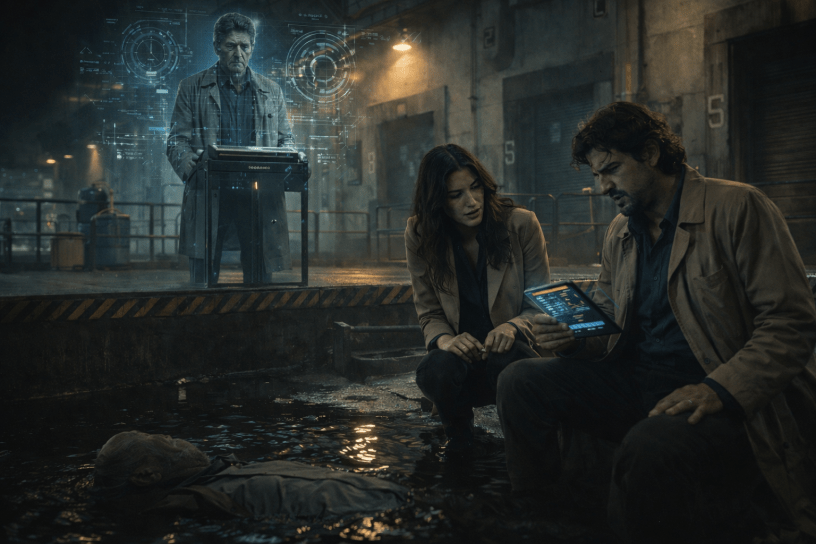
Parrino couldn’t believe his luck—two murders in as many days, and while he missed his chance to be assigned to the first one, he’d managed to maneuver himself into taking this duty. “I love the weird ones,” he mumbled under his breath as he jotted a few more notes on his datapad. Such a lovely change from piracy, data intrusion, stolen property, and the usual fare.”
“You mean you like the easy ones,” Mak said from a hovering scan pod, hits lasers probing and measuring a lump of flesh, half-submerged, face down in a ten-inch-deep pool of industrial runoff. “I know you haven’t seen many, but there’s nothing weird about murder. There are only a few motives, which are usually pretty basic.” Abruptly, the scan pod lowered itself to the ground and powered off. At the same time, a treaded investigator drone wheeled over and, with six extendable manipulator arms, gently lifted and turned the body over. “Once we figure out who our unhappy victim here is, it should be a pretty easy matter to figure out why he died and who killed him,” he continued from the drone, as it retracted its arms and wheeled back to its place, powering down as a holo-projector rose. Mak’s middle-aged man form rezzed in next to Parrino. “Your turn,” he said, gesturing to the corpse. “Tell me what you see.”
Parrino smirked, “Afraid to get your shoes wet, Mak?” he asked, checking the seals on his boots and wading out into the water toward the body.
A large, burly man entered from an access hatch in the wall and gingerly walked around the puddle. “I’ve put out a call asking if anyone’s seen anybody walking around who wasn’t a worker, and I’ve cleared your hearse through security. The lights will stay up until you leave. Will that be all then, officer? I’ve got a deadline to meet.”
“Yeah, sure,” Parrino said, waving the foreman off without looking at him. “I’ve got your contact information. Someone will be in touch in a couple of days to follow up. Thanks for your cooperation.”
The foreman grunted and stepped onto a railed circular platform about two meters in diameter with a small, raised control panel at one point along its circumference. He touched a series of controls, and the hoverdisc soared upwards toward the lights of the construction site half a mile above. Parrino watched as he vanished into the distance.
“They’ll never get me to do that kind of work,” Parrino said to no one as he watched the disc vanish into darkness above him. “Even if it means I’ve got to spend the rest of my life up to my ankles in this stuff.”
“I seem to remember you were wishing for this a few hours ago,” Mak admonished with a smile, studying a series of video displays and readouts floating in the air around him. He rearranged several bits of information, circling and highlighting items that may be of importance.
Parrino scoffed, positioned his scanner a few feet above the corpse’s face, and activated it. The device beeped in acknowledgment, and the detailed visual, thermal, chemical, and multispectral image he had just captured materialized in front of Mak. He then moved the camera down the front of the body, stopping to take an image of what had been the man’s chest, now a six-inch-diameter cavity with protruding bone and a jellied mélange of organ tissue.
“What the hell makes an exit wound like this?” Parrino whispered hoarsely.
Mak enlarged the chest image in front of him and then pulled up an image of the corresponding entry wound in the man’s back. “I’ve never seen anything like it,” he said, almost impressed. “It’s small going in, but sure packs a wallop on the way out.” Additional telemetry suddenly appeared, and a sequence of lines and arrows highlighted various points on the wound. “Analysis shows small deposits of synthetic crystal scattered throughout the cavity.”
“What are we looking at here? Some kind of specialized mini-frag grenade? Who the hell is this guy?”
A soft beep and an alert appeared in the corner of Mak’s telemetry. “Civilian approaching. Maybe the foreman found our witness,” Mak said. He entered another sequence of commands, and a scanner drone zoomed off in the direction of the newcomer. When it reached the target, he activated its spotlight. The beam shone directly down on the figure of a young woman. She was in her mid-twenties, small-framed, with black hair and a manner of dress that said she was not any part of the construction crew.
“This area’s off limits, ma’am. I’m afraid I must ask you to stay back there,” Parrino shouted.
The woman, startled at being discovered, quickly regained her composure and stepped out into the open. “This is a crime scene, isn’t it, officer?” she asked, rummaging through a satchel slung over her shoulder.
“Detective Sergeant,” he coughed out. “Parrino. David Parrino.” He gestured to the rank insignia on his chest. “And, yes, ma’am, it is, but-”
She walked straight up to him, holding up a pair of credentials with an almost triumphant flourish. Judging by the smugness on the woman’s face, Parrino decided they would no doubt say something like “Intersec,” “EBI,” “Division 5″…
“Serah Wyles, Neward and Provident Newsnet Agency,” she announced with a barely detectable hint of nervousness.
Parrino groaned in disbelief. The damned press. That was even worse. At least she was pretty, if somewhat standoffish. Wyles … the name was familiar, as was the face. Maybe she was famous. He didn’t watch NPNA much.
The woman continued, “Per article nine of the Sol Directorate Charter, I have a right to witness, record, and report on this for the press, don’t I?”
Parrino nodded, almost embarrassed. “Yes, ma’am, I apologize.” The drone lifted itself above the corpse and projected a yellow ring around the scene. “You’ll need to stay on that side of the line. This is still an active crime investigation,” he said, starting back down the ramp. “You guys sure work fast. We only got the call a half-hour ago.” He gestured at Mak. “Oh, and this is my partner, LiM. Detective Sergeant Sam Makluskey.”
The girl smiled with the same over-compensating politeness that most people unfamiliar with transhumans exhibited. “Hello.”
“Call me Mak,” the holo said.
“Stop flirting. She’s press,” Parrino jokingly admonished, hoping to put the girl at ease. Her confident façade seemed to be breaking down with his every sentence for some reason. “How did you get here so fast?” he asked her.
“Oh,” she said, shifting her eyeline. Parrino decided this meant she was about to lie to him. “Our ratings analyzer monitors your channels,” she said quickly. “I’m surprised to find you here as well. It usually just sends me out well after the fact looking for bystanders or potential witnesses. I must have gotten lucky this time.”
Parrino glanced at Mak, whose facial expression indicated he’d also noticed the deception. The holo’s face then went expressionless. He knew this meant Mak was running queries on the woman.
Parrino walked to the other side of the crime scene, keeping Serah’s back to Mak. “Why not just go through our press liaison?” he asked.
“This way is a little more effort, but in this business, the first one to the story gets the Pulitzer,” she said, sounding irritated. “Besides, the last guy I talked to kept going on about the District requiring epic amounts of permits just to become a criminal.” She shrugged.
That response made sense, at least. Parrino looked over her shoulder at Mak, who shrugged and nodded, indicating his quick background scan of her seemed to check out. He turned his attention back to the girl. “That’d be Conners,” he nodded. Then, he relaxed slightly and gestured toward the body next to him. “Well, you struck pay dirt this time, as you can see. The corpse is still here, though not very fresh.”
“Sergeant, can you answer a few questions now, or should I wait until you’re finished?”
“No, I think we’re just about done here. There is nothing to do now but wait for the clean-up team. Go ahead and ask. I’m sure you know the drill about what we can and can’t discuss in these situations. Oh, and no pictures or scans, please. After we’ve done the analysis work, we’ll give you all that in the press release.” He walked over to the stack of cases on the opposite side of the crime scene and began securing equipment.
Serah cautiously circled, careful to remain on the correct side of the demarcation line. Her face had a curious expression Parrino could not make out—a combination of fear and acceptance. She almost seemed to be psyching herself up for something.
“There’s not much to report at the moment, though,” Parrino continued, focused on her response. “A foreman found him about an hour ago. It looks like he’s been here a few days. Nobody comes here right now, so it took this long to find him.”
“What’s the liquid?” Serah asked.
“Right now, it’s about 50% industrial runoff from construction going on up there.” He pointed upwards to a lit platform where builder drones buzzed around like bees in a hive. “The other 50% is … well … DNA.”
Serah winced in shock and revulsion, hiked her skirt up, and knelt at the edge of the line, exposing more of two shapely legs than she had probably meant to, Parrino decided. Leaning in to get a better look at the corpse, she gasped a little and turned ghost-white. He probably should have warned her. Even he, a seasoned veteran, had found the half-eviscerated corpse somewhat disturbing, though he wanted to see her natural, unprepared reaction. Something was going on with this girl; every instinct he had was flashing alarms at her behavior.
“Who was he?” she asked softly.
“Nobody. He’s imaginary,” said Mak, who continued to work as the data spinning around him grew and expanded.
Parrino looked at his partner with mild surprise. “You’re kidding?!”
“Imaginary?” Serah replied incredulously.
Parrino nodded, “Sorry, it’s a sick joke my ‘intangible’ colleagues use for cases like this. It means there’s no match in our records: historical, educational, military, consumer … nothing. He doesn’t exist as far as the Sol Directorate is concerned.”
“Is that unusual?”
“It certainly makes this case a bit weirder. This means it may not be a simple random killing or robbery. This chap was hiding from something. I’d be willing to bet it found him.” The girl seemed a bit deflated at the news. “Hundreds of people and agencies out there will offer to remove all traces of you from the Phrame. Some of them do a pretty good job. Given a day or two, though, we’ll probably find something they missed. After that, we can go to the physical archives.”
“I don’t get it,” Serah said. “How can anybody function without ID, a consumer file, or a cred account? How could he purchase necessities for survival, use any kind of public transit system–”
Parrino cut her off with a laugh. For a reporter, she was undoubtedly new at this. “You’d be surprised how easily you can get along. Many use the black market, have someone else make their purchases, or just barter for services.”
“So, that would mean he had at least one friend he trusted,” Serah said quietly, almost to herself.
“Safe assumption. You’re a natural for this kind of work,” said Parrino. There was something about this girl, he mused. She didn’t seem quite as haughty as other journalists he had met. In fact, it was almost as if she had a personal attachment to this unmourned man who met an untimely and no doubt unpleasant end. She was giving away far too much thinking out loud the way she was, which meant she probably wasn’t the type of reporter who wrote half-fetched theories based on limited knowledge. He had to be careful how much information he gave the press, but he appreciated a fresh perspective to run through details with. He desperately needed to crack this case quickly and efficiently, and perhaps she could help. “My guess is our friend here is an illegal immigrant, possibly a fugitive who doesn’t know better, but I’m pretty sure we’ll find he’s an offworlder,” he offered.
“What makes you say that?”
Parrino tapped his left ear. “That neural interface he’s got has a universal connector, but it’s a bit unusual in design. Doesn’t look like Earth tech. I would guess he had it installed on one of the independent worlds. The tech is probably from Thurin. It’s a bit less common, but widely available and imported to most non-directorate worlds, even the ones that frown on augmentation.” He stopped suddenly, realizing he was over explaining. She might already know this.
Serah frowned. “So, you’re not sure.”
Parrino considered the facts for a moment. “There’s a pretty standard procedure for all of this and a pretty limited set of reasons anybody would want to commit murder. Most of the time, we just pop everything into the analyzers, let the system research the facts, and start eliminating the two or three scenarios they feed us. It works 99% of the time to solve a case. I just like to keep in practice by trying to predict what the analyzers will return with.”
“Yes, I have a similar relationship with predicting what story our ratings analyzer is going to send me out on,” said Serah sarcastically, smirking out of the corner of her mouth and arching an eyebrow. “They hate it when you start thinking for yourself.”
Parrino squinted and smiled slightly. “Our medical team’s findings should be available late tomorrow morning. We’ll keep that part classified while the analyzers do their job, but you should be able to pick up our first official report on your way to your office.”
“Sergeant,” she said, her tone suddenly disarming. “Is there any way you could let me make a scan? I know it’s technically not allowed, but we have off-world bureaus that might be able to make an ID check quicker than you can through channels.”
Parrino mused. It was against policy, but he had some leeway if he believed it would help solve the case, and she did have a point about bureaucracy. Seeing no immediate protest from his partner, he said, “One scan. Just one, with full DRM limiting copies to your agency and bio-keyed to my signature.” This would at least ensure the scan couldn’t be duplicated or transmitted without his authorization. Hopefully, this would pan out. She was more amicable – and cheaper – the usual informants he would have shared the san with. Despite the girl’s strange behavior, she seemed more concerned with helping crack the case than the ‘Pulitzer’ she mentioned earlier.
Serah nodded in agreement, set her datapad for capture mode, and scanned the dead man’s face. She looked as if she was fighting back tears. She made a few notations and tried to regain her composure, and then asked, “I don’t suppose he had any personal effects?”
“Just these,” Parrino said, pointing to a collection of items in an evidence case. “An outdated hardwire skullcap, a smashed datapad, and a few credslips. It is not a fortune by anyone’s standard, but it is certainly enough to exist for several days without using a personal account. We’ll have the computers do a trace on the serial numbers, but since he’s gone to so much trouble to erase his identity, I’m sure they won’t tie back to him.”
“I see,” Serah said, showing Parrino her datapad so that he could approve the scan she had made and the message she would transmit with it.
Erik,
Please trace and identify. Possibly immigrant or off-world fugitive.
– Serah
Parrino nodded in agreement and pressed a thumb to the pad, authorizing transmission of the data.
Serah half-smiled and started walking back in the direction she came from. “Well, Sergeant, I look forward to reading your report in the morning. Should I follow up with you directly if my agency turns up anything?”
“That would be fine.” He held up his identification card. Serah pointed the datapad scanner at it, capturing his name and contact information. She then transmitted back her own credentials.
“Thank you,” she said cordially. Then, after one last look at the crime scene, she walked off into the night. She seemed almost sad.
“You could have offered her a ride,” Mak joked.
“She wouldn’t have accepted it,” Parrino guessed, watching her vanish from sight. He heard a low whine that steadily grew louder, and a slight breeze kicked up as an aircar descended behind him.
That’ll be our hearse,” Mak said matter-of-factly.
Parrino turned around as two bright headlights descended into view ten meters away. The aircar was more extensive and modern than the coroner’s hearse. It stopped about a foot off the ground but did not turn off its motor or its lights. Parrino shielded his eyes and could just make out the shapes of two men exiting on either side. Their silhouettes approached the crime scene.
“Sergeant Parrino. Sergeant Makluskey,” the first figure said, holding up an identicard. “I’m Special Agent Ducard, Division 4, European Office. This is special agent Foucan.” His accent was a thick French.
Division 4 was a multi-jurisdictional law enforcement agency that crossed the lines of every local government on all of the Sol Directorate systems. Parrino suddenly feared that this case was more significant than either he or Mak thought. He was pretty sure he knew what was coming next.
“Okay, now it’s a weird one,” Makluskey confirmed over his shoulder.
Parrino smiled cordially. “What can we do for you, Agent Ducard?”
“Well, Sergeant, I know this is a bit awkward, but we’ve been assigned to this case and sent here by your Chief Inspector Somerset to relieve you immediately,” Ducard said, with a hint of remorse but mostly smugness.
Mak had already verified the claim with the dispatch SI at headquarters. “Confirmed,” he said. “We’re to hand over all our analysis and evidence to them and stand down from the case.”
“Well, that’s that, then,” Parrino said, pulling out his datapad again and signaling his readiness to transmit everything he had collected. I can’t say I envy you. This one looked like it was going to be messy. We were having the darndest time making sense of it. I don’t suppose you’re allowed to share any insight with us, just as a professional courtesy?” he asked.
Ducard smiled slightly. “I’m afraid not,” he said, then added, “We saw another person leaving as we arrived.”
“Oh, that was just a journalist,” Parrino said, holding his cards close to his chest. He would respect the order to stand down from the case, but he’d be damned if he was going to help Division 4 any more than he had to. “I don’t remember her name. She was with NPNA, I think.” He glanced back at Mak, who shrugged, expressionless.
“Hey man, you’re the one who talked to her; I was busy workin’,” Mak added, following Parrino’s bluff.
“Neward and Provident.” Ducard thought momentarily, and then his eyes widened ever so slightly. “Was it by chance, Serah Wyles?”
Now, that was very interesting. Parrino pretended to think about it for a moment but then gave up. “Sorry, I honestly don’t remember.”
“You didn’t share any information regarding the case with her?” Ducard appeared suspicious.
“Only what is allowed by procedure. Which at this point amounts to nothing,” Parrino said quickly, acting only slightly offended in order to cover up the deliberate lie. “I told her she could drop by the precinct tomorrow if she wanted a report, as is standard procedure.”
“I see,” Ducard nodded, apparently convinced. He pulled out a datapad and tapped to accept all of the case data Parrino and Mak had collected that evening. He smiled cordially once he confirmed all the data had been erased from their systems. “Well, gentlemen, I’m sorry your work was for nothing, but we appreciate your cooperation. My partner and I will take over from here.”
Parrino, by nature, was an expert at reading people, and Ducard’s smile had just enough genuineness to it to give him the creeps. He gestured to Mac to begin the process of packing up.
© 2022 Darrin Snider. All Rights Reserved.
