
Aside from that brief period when I was 8 and listened exclusively to Top 40 radio, I suppose I’ve never listened to music in the correct order. I don’t mean I put side two on first or listen to concept albums on shuffle. I mean, for most of my life, I’ve discovered entire musical movements years, or even decades, after I should have known about them.
For convenience, I blame Indiana. That’s not entirely fair to Indiana, but there are legitimate sociological studies. (See Spatial Diffusion Theory and the Hierarchical Diffusion of Culture.) Before the Internet, culture moved outward from places like New York, Los Angeles, London, and that one time Seattle suddenly produced seventeen bands wearing the same shoes, and the next thing you know, Friends was being rewritten to change the bar to a coffee shop to cash in on it. By the time anything relevant reached Indiana, the rest of the world was bored with it. I was usually too distracted with my own thing.
While other people my age were discovering the important alternative bands of the mid-1980s, I was listening to jazz fusion. Not casually, either. I was deep into Chick Corea’s Elektric Band, studying what Dave Weckl was doing, and listening to records like Jimmy Rowles’ The Peacocks. Meanwhile, up the hall from me, a friend of mine, a pale young man with eyeliner, brought the Cure with him to the Freshman dorm from Brooklyn. That was his thing. I listened to it a couple of times casually, but I had ghost notes to analyze.
It’s a pattern. I had my hard rock/metal phase, but eventually became interested enough in bands like Cream and Led Zeppelin to start tracing them back, which led to my blues phase. It wasn’t because someone handed me a list of historically important records every serious music fan must hear, but because I wanted to know where the things I already loved came from. That distinction is important. I wasn’t studying history. I was a fledgling computer engineer looking for the source code for my music.
Years later, Nine Inch Nails led me to Golden Palominos and my spoken word phase, which led to Alan Wilder’s Recoil, which sent me backward again. I started discovering that Depeche Mode, the Smiths, and Cure stuff that I’d largely ignored back in the dorm the first time around. Jazz worked the same way. I didn’t dutifully begin with the origins, work through swing, study bebop, and eventually arrive at fusion. I started with the new stuff from Branford Marsalis and Chick Corea and worked backward until I fell in love with hard bop and planted a flag there.
So, apparently, given any musical family tree, my instinct is to climb toward the roots.
The Internet should have fixed this, but instead it introduced a recurring character into my musical life. I’ll call him “Some Guy Who Knows.” Some Guy Who Knows is always there whenever I get excited about discovering something.
“Holy crap, have you heard Ringo Deathstarr?! I think I like shoegaze.”
“Yeah, that’s been over for years.”
“Oh.”
“They’re sort of the last holdouts because they’re popular.”
Or:
“James H-T played dubstep on his show yesterday, and I had my most productive hour of programming ever. This dubstep stuff is killer!”
“Dubstep is dead.”
“Oh.”
“You should listen to drum & bass.”
So I do, and I discover I like drum & bass even more. Some Guy Who Knows is very helpful. He’s also kind of an asshole.
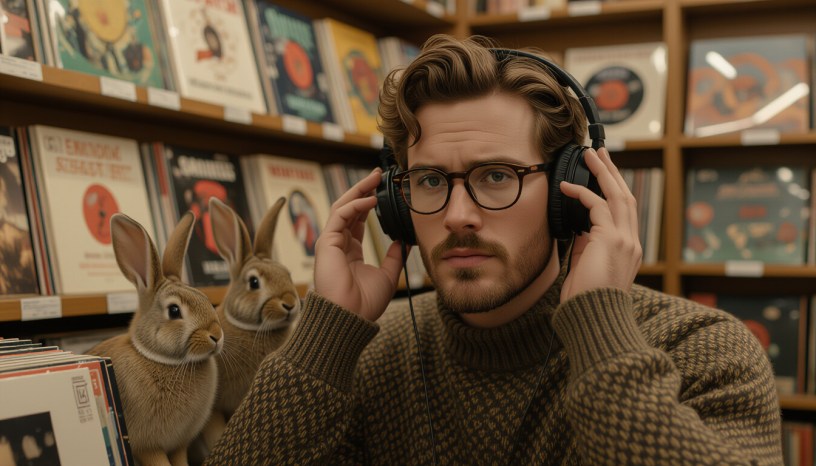
The most absurd example may have been Mt. Ossa. I stumbled across this little California band playing a mixture of surf, psychedelia, and dreampop. They’d apparently evolved out of an alt-country band called Union Line. Even their musical history was a rabbit hole. Naturally, I became obsessed. This was exactly the sort of thing I didn’t know I needed in my life. I wanted more of it. I started investigating the surrounding scene, the influences, related bands, and everything else that inevitably happens once I find one record that pushes the right buttons.
Meanwhile, Mt. Ossa put out one album and broke up almost immediately after I found them, splitting into several side projects, including electronic and less-adventurous synthpop. Apparently surf psychedelia was played out, and I had discovered a musical movement so late that the band I discovered it through was already tired of being the band I liked.
“Welcome aboard, Darrin. We’re delighted you made it. Unfortunately, the show’s over. Please fold your chair and leave it stacked neatly by the door.”
There is a worthwhile explanation for some of this. For a significant chunk of my adult life, I wasn’t particularly interested in keeping up with national music trends because I was running Indy In-Tune and surrounded by new music. It just all happened to be made inside I-465. If you couldn’t reasonably drive to my studio for an interview, there was a decent chance I had not purchased or sought out your new album because I had too much new stuff being personally handed to me every time I walked into Birdy’s or the Mel.
This is at least a good way to become culturally isolated. I wasn’t like the rest of my high school friends who stopped listening to new music sometime around 1994 and spent the next thirty years complaining that nobody makes good records anymore. I was listening to enormous amounts of new music. I was just listening to the wrong new music.
While critics and tastemakers were documenting the artists who supposedly defined a particular year, I was listening to Indianapolis musicians most of those critics would never hear, and only heard about “tastemakers” when someone mentioned being influenced by them during an interview, which again, due to “spatial diffusion theory,” was far less common than hearing, “I grew up listening to Bruce Springsteen.”
Consequently, entire national and international movements passed around me while I was paying extremely close attention to something happening ten miles away. When I eventually started looking outward again, the landscape was littered with abandoned genres, and naturally, I started exploring them. This is important because I no longer experience it as nostalgia. I wasn’t there. I don’t remember what shoes everyone wore. I don’t remember which bands were considered cool and which ones were embarrassing. I still don’t know if I’m cool or some kind of Wezzie hipster for liking The Pigeon Detectives. They could be the Nickelback of Leeds for all I know. All I have is the music, and better yet, I have all of it.
A music scene has to move forward. Musicians get bored. Critics get bored. Audiences get bored. After you’ve spent five years hearing variations on the same aesthetic, someone inevitably declares it exhausted, but it isn’t exhausted to the person who just discovered it last Tuesday.
Streaming makes this stranger, because nearly the entire recorded history of popular music now exists simultaneously. Fashion still moves chronologically; music doesn’t. I can hear something released last Friday, discover that it reminds me of a record from 1997, learn that the 1997 band was obsessed with somebody from 1981, trace that person back to a record from 1963, and lose the remainder of the afternoon.
This is why rabbit holes ruined my life, because I will always jump down one and not resurface for days. The older I get, the less useful “genre” becomes as a way of explaining my musical tastes. My record collection looks like it belongs to a half-dozen roommates who share an account and don’t speak to one another: prog, art rock, fusion, hard bop, metal, blues, synthpop, shoegaze, dreampop, d&b, lounge, vaporwave, psychill, experimental spoken word soundscapes, even classical sometimes.
In my head, it all makes sense. There is a genealogy between these things that I discovered them through. This is not an efficient system. But efficiency was never really the point. I don’t have a musical timeline. I have a dependency graph. This may explain why I occasionally find myself passionately discussing a musical movement with someone who has to gently explain that everyone else finished talking about a decade earlier. Fine. They got the zeitgeist. I got the history.
There are still enormous pieces missing. There always will be. Every time I think I have a reasonable understanding of music, somebody mentions a band I’ve never heard of. Within twenty minutes, I’ve opened twelve browser tabs and discovered that I apparently need to understand “Lowercase” music now. I’ll get to everything eventually — not when I’m supposed to, but at least I’ll have depth.
